Lorries Ply With Gay Abandon
pp. 83-84 · Read in the full issue
Gilbert Islands, 1955
Where Battle Of Tarawa Raged
By Nancy Phelan
NEVER having been to the Gilberts before, I cannot say whether or not life there has t changed much since the war, but I [suspect that in certain material ways it has. Judging from conservations I have had with people who lived 1 there in pre-war days, I imagine that . Tarawa is much more mechanised now than ever before, that communications are easier and that the scene generally, at any rate in the south of Tarawa, is “more [European” than it was.
Once you get north of Abaokoro, .into the realms of Native Govern ment, everything becomes Gilbertese again, and by the time you reach Buariki, at the top of the atoll, you might be at an outer island.
Betio, the scene of the American landing at Tarawa during the war, is still rather a battlefield, and though building has gone ahead and replanting has been carried out all over the islet, the coconut palms are still small. This makes the place rather hot.
There are still ruined pillboxes and gun replacements along the ocean beach, and war wreckage is rusting in piles on the lagoon-side.
Round about Betio quay are the offices of the Colony Wholesale Society, the main store, the native handicraft store, the CWS boatyard md the Customs sheds. And a little further off, in an outer circle, are the Betio Club, the Tangi Tang L,afe and the Tangi Tang store, iffices and sawmill.
There is a new District Office, on »fnnvl ago °S. e : b uilt of concrete Jocks wffh thatched roof, and on he other side of the town are the
wireless station and offices of the Co-operative Societies Officer.
REGULAR radio communication between islands and between Tarawa and local shipping is, of course, the normal thing, and it is possible for people to speak direct to one another from different parts of Tarawa on the daily radio “sched.”
Broadcasts are made every week, on Sunday afternoons, from Betio, of music, singing and talks in Gilbertese.
Betio, despite its war-torn appear ance, is a busy, cheerful place with its mixture of Government per sonnel and shipping and CWS people, and, like all ports, it has an air of being alive.
Launches run twice daily between Betio and Bairiki, carrying the mail and passengers, and at least twice a week, usually more, the hospital launch comes across from Abaokoro with one of the doctors or medical personnel.
Building has also been going on at Bairiki, the Government head quarters, and a number of Euro pean concrete-and-thatch houses have been built in place of the native-type houses formerly used.
The new Residency at Bairiki, built on the site of the old one, is also of concrete and thatch. De signed by the Resident Commis sioner and Mrs. Bernacchi, it has been specially planned to facilitate entertaining and has modern kitchens and a commodious wing for guests.
A social club has recently been started at Bairiki, in a delightful te ba house at the edge of the lagoon. The building, which houses
the Government transit quarters, also has a bar and a large room for dances, games and so on. Accom modation in the transit quarters is cheap and comfortable, and meals are cooked by the caretaker. The club has been given benevolent and practical support by the Adminis tration.
FURTHER up the atoll, at Bikeni beu, work continues on the new hospital which is being built to replace the present hospital at Abaokoro, and the new King George V School, also at Bikenibeu, has been completed and is in use. It stands right on the beach, in a delightful position, and classrooms, offices and dormitories are cool, light and airy.
The list of local shipping circu lated to Government offices is now quite a large one. The names go down the page, and at a glance there seems to be always something going somewhere.
I was not able to sample Govern ment ships during my visit. Most of them were away from the Group, either coming from or going to wards Fiji.
At one stage only the valiant Maureen was in circulation, busily occupied carrying thatch and trans porting Government personnel from island to island.
There is also constant activity among the little ships of the Tangi Tang societies, moving about the Central Gilberts, collecting copra from the co-operative societies and bringing it to Tarawa.
At present there is a regular con nection every month between Tarawa and Ocean Island.
This is made possible by the fact that the British Phosphate Com mission ship Triadic is taking up regular cargoes from Australia for Tarawa and that a CWS ship (sometimes two) is sent across every time to meet her.
In between the Triadic trips, of course, shipping between Ocean and Tarawa is not regular, but for the present at least one can depend on
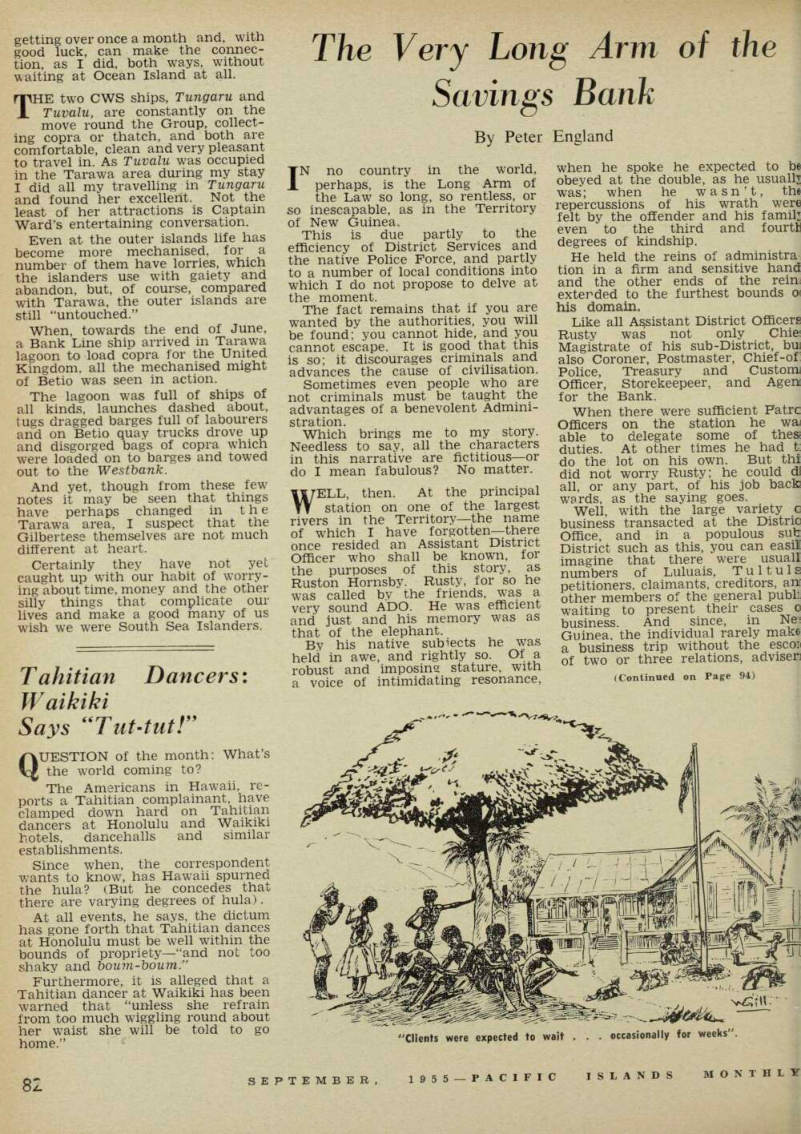
Betio Goes
Into Action
Tarawa, scene of one of the bloodiest battles the Pacific War, is to-day concerned solely with peaceful develop ment, commercial and [?] therwies. These Gibertesese workers at Betio quay are unload ing lorry - borne copra for the British ship "Westbank". When thips arrive, says the writer of the accom panying article, "all the mechanised might of Betio goes into action".
Photo by Nancy Phelan.
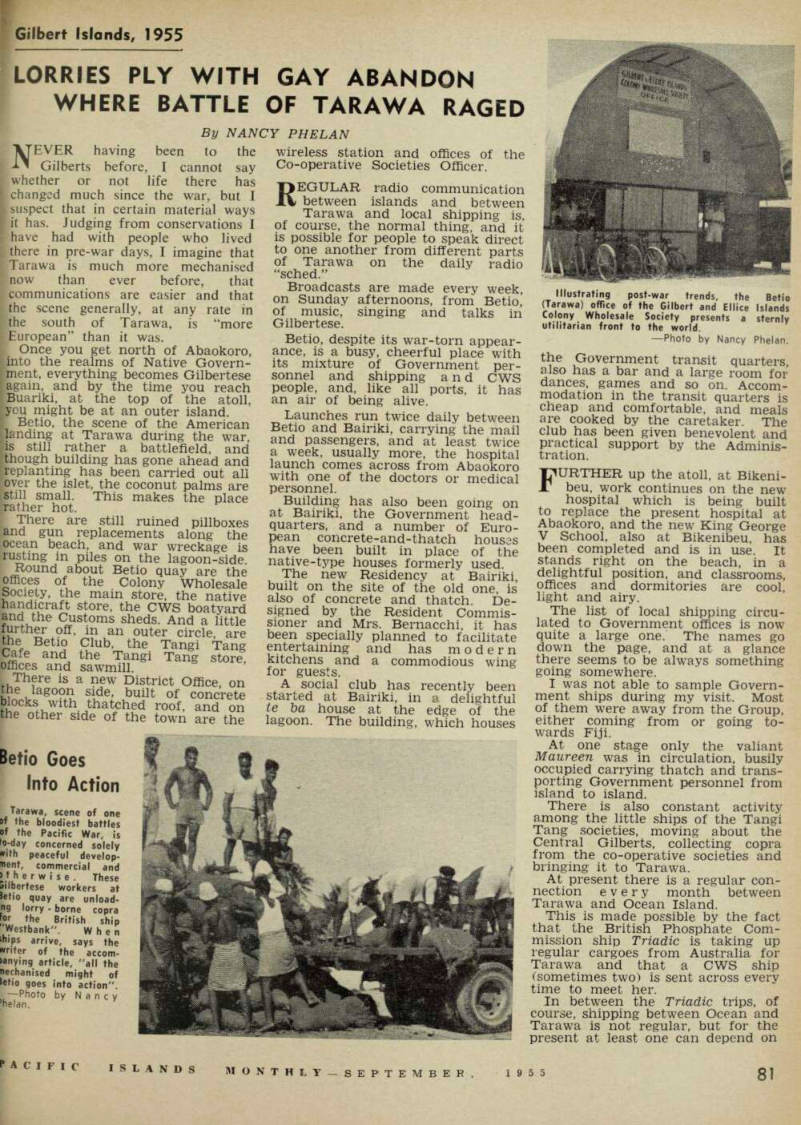
Illustrating post-war trends, the Betio (Tarawa) office of the Gilbert and Ellice Islands Colony Wholesale Society presents a sternly utilitarian front to the world.
Photo by Nancy Phelan.
getting over once a month and, with good luck, can make the connec tion, as I did, both ways, without waiting at Ocean Island at all.
THE two CWS ships, Tungaru and Tuvalu, are constantly on the move round the Group, collect ing copra or thatch, and both are comfortable, clean and very pleasant to travel in. As Tuvalu was occupied in the Tarawa area during my stay I did all my travelling in Tungaru and found her excellent. Not the least of her attractions is Captain Ward’s entertaining conversation.
Even at the outer islands life has become more mechanised, for a number of them have lorries, which the islanders use with gaiety and abandon, but, of course, compared with Tarawa, the outer islands are still “untouched.”
When, towards the end of June, a Bank Line ship arrived in Tarawa lagoon to load copra for the United Kingdom, all the mechanised might of Betio was seen in action.
The lagoon was full of ships of all kinds, launches dashed about, tugs dragged barges full of labourers and on Betio quay trucks drove up and disgorged bags of copra which were loaded on to barges and towed out to the Westhank.
And yet, though from these few notes it may be seen that things have perhaps changed in the Tarawa area, I suspect that the Gilbertess themselves are not much different at heart.
Certainly they have not yet caught up with our habit of worry ing about time, money and the other silly things that complicate our lives and make a good many of us wish we were South Sea Islanders.