Lorry Inside Apia's
p. 73 · Read in the full issue
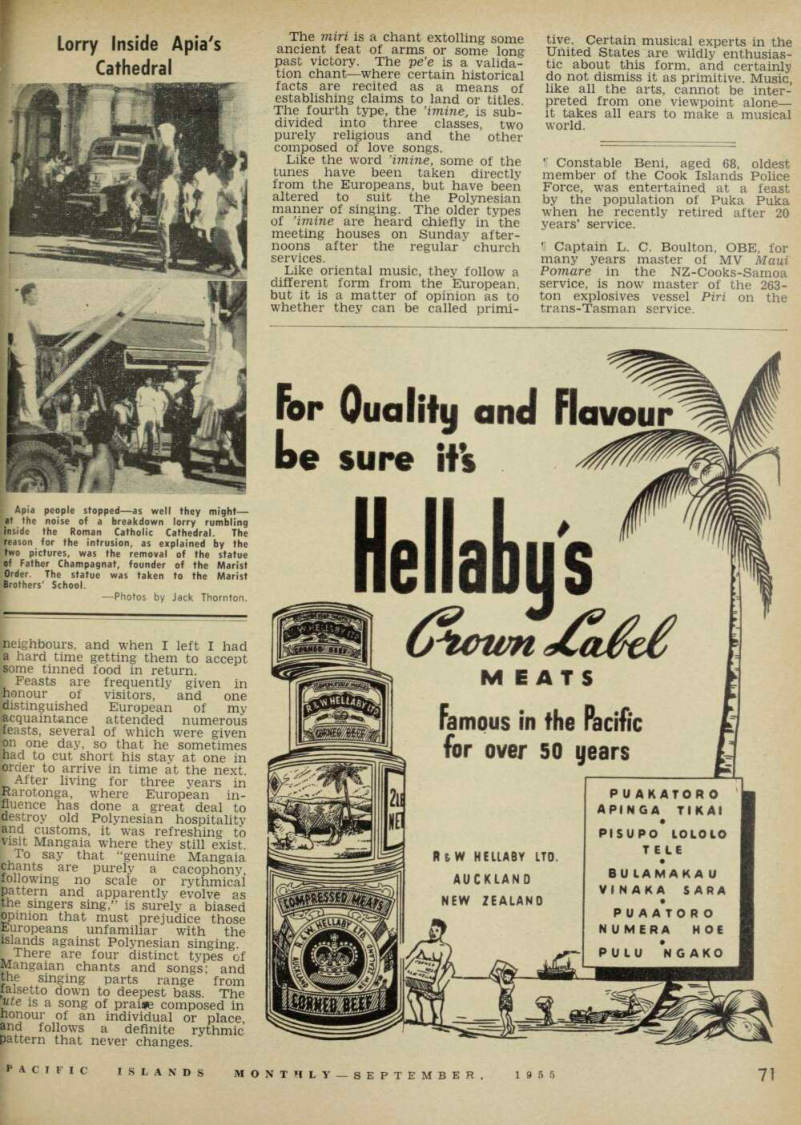
Cathedral
The miri is a chant extolling some ancient feat of arms or some long past victory. The pe’e is a valida tion chant—where certain historical facts are recited as a means of establishing claims to land or titles.
The fourth type, the ’imine, is sub divided into three classes, two purely religious and the other composed of love songs.
Like the word ’imine, some of the tunes have been taken directly from the Europeans, but have been altered to suit the Polynesian manner of singing. The older types of ’imine are heard chiefly in the meeting houses on Sunday after noons after the regular church services.
Like oriental music, they follow a different form from the European, but it is a matter of opinion as to whether they can be called primi
tive. Certain musical experts in the United States are wildly enthusias tic about this form, and certainly do not dismiss it as primitive. Music, like all the arts, cannot be inter preted from one viewpoint alone— it takes all ears to make a musical world.
II Constable Beni, aged 68, oldest member of the Cook Islands Police Force, was entertained at a feast by the population of Puka Puka when he recently retired after 20 years’ service.
II Captain L. C. Boulton, QBE, for many years master of MV Maui Pomare in the NZ-Cooks-Samoa service, is now master of the 263ton explosives vessel Piri on the trans-Tasman service.
Apia people stopped—as well they might— at the noise of a breakdown lorry rumbling inside the Roman Catholic Cathedral. The reason for the intrusion, as explained by the two pictures, was the removal of the statue of Father Champagnat, founder of the Marist Order, The statue was taken to the Marist Brothers' School.
Photos by Jack Thornton.