Dwelling
p. 23 · Read in the full issue
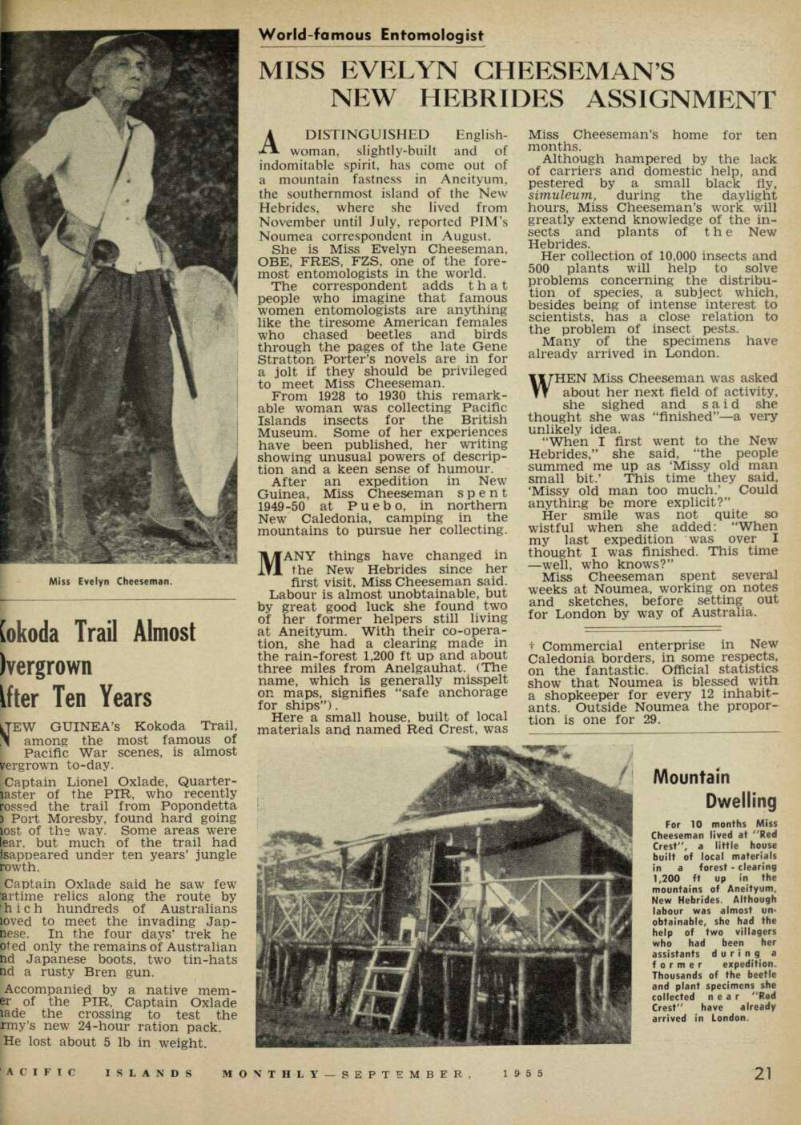
World-famous Entomologist
Miss Evelyn Cheeseman’S
New Hebrides Assignment
A Distinguished English
woman, slightly-built and of indomitable spirit, has come out of a mountain fastness in Aneityum, the southernmost island of the New Hebrides, where she lived from November until July, reported PlM’s
Noumea correspondent in August.
She is Miss Evelyn Cheeseman, OBE, FRES, FZS, one of the fore most entomologists in the world.
The correspondent adds that people who imagine that famous women entomologists are anything like the tiresome American females who chased beetles and birds through the pages of the late Gene Stratton Porter’s novels are in for a jolt if they should be privileged to meet Miss Cheeseman.
From 1928 to 1930 this remark able woman was collecting Pacific Islands insects for the British Museum. Some of her experiences have been published, her writing showing unusual powers of descrip tion and a keen sense of humour.
After an expedition in New Guinea, Miss Cheeseman spent 1949-50 at Puebo, in northern New Caledonia, camping in the mountains to pursue her collecting.
MANY things have changed in the New Hebrides since her first visit, Miss Cheeseman said.
Labour is almost unobtainable, but by great good luck she found two of her former helpers still living at Aneityum. With their co-opera tion, she had a clearing made in the rain-forest 1,200 ft up and about three miles from Anelgauhat. (The name, which is generally misspelt on maps, signifies “safe anchorage for ships”).
Here a small house, built of local materials and named Red Crest, was
Miss Cheeseman’s home for ten months.
Although hampered by the lack of carriers and domestic help, and pestered by a small black fly, simuleum, during the daylight hours, Miss Cheeseman’s work will greatly extend knowledge of the in sects and plants of the New Hebrides.
Her collection of 10,000 insects and 500 plants will help to solve problems concerning the distribu tion of species, a subject which, besides being of intense interest to scientists, has a close relation to the problem of insect pests.
Many of the specimens have already arrived in London, WHEN Miss Cheeseman was asked about her next field of activity, she sighed and said she thought she was “finished” —a very unlikely idea.
“When I first went to the New Hebrides,” she said, “the people summed me up as ‘Missy old man small bit.’ This time they said, ‘Missy old man too much.’ Could anything be more explicit?”
Her smile was not quite so wistful when she added: “When my last expedition was over I thought I was finished. This time —well, who knows?”
Miss Cheeseman spent several weeks at Noumea, working on notes and sketches, before setting out for London by way of Australia. t Commercial enterprise in New Caledonia borders, in some respects, on the fantastic. Official statistics show that Noumea is blessed with a shopkeeper for every 12 inhabit ants. Outside Noumea the propor tion is one for 29.
Mountain
Dwelling
For 10 months Miss Cheeseman lived at "Red Crest", a little house built of local materials in a forest - clearing 1,200 ft up in the mountains of Aneityum, New Hebrides. Although labour was almost un obtainable, she had the help of two villagers who had been her assistants during a former expedition.
Thousands of the beetle and plant specimens she collected near "Rad Crest" have already arrived in London.