In Papua-New Guinea
pp. 103-117 · Read in the full issue


Current News Items From Our Correspondents In Papua-New Guinea
Port Moresby Buses
The Papua-New Guinea Admin stration has turned down a sug estion by the Port Moresby Ad isory Council that Administration uses should be available to Euro eans only.
The Administrator (Brigadier » M. Cleland) said in June that le bus service is not restricted to se by any particular section of the immunity. All passengers, however, lust conform to accepted standards f dress, conduct and cleanliness.
A recently-appointed bus inspector ensuring that all persons travel ing in the buses meet the customary jquirements.
[Alaria Campaign Stepped
UP Fourteen new posts—a Malaria ontrol Officer and 13 Malaria ontrol Assistants have been eated in the Papua-New Guinea ealth Department, and applica ans for 11 of the positions were died for in June.
Malaria is the most serious health •oblem in the Territory. The irector of Health (Dr. John unther) has reported that if it sre eradicated, infant mortality ight be halved and the expecta m of life doubled. These changes
could lead to the possible doubling of the population in 15 years.
Education and the awakening of a desire for community control are the basis of anti-malaria policy.
There is already a Malaria School at Minj, in the Western Highlands, which provides courses for health officers and native affairs officers.
Recent research suggests that residual spraying, previously thought to be ineffective, will be successful.
Further departmental proposals include the appointment of a medical specialist as Malariologist.
Land Valuation In
Highlands
The Eastern Highlands District Advisory Council, at a meeting at Goroka, on June 3, decided to advise the Administrator that the “intro duction of the new land system and attendant publicity has already re sulted in misleading overvaluation of land.”
Members said that the difficulty of obtaining exactly “adjoining land” for extensions had added to the problems of existing settlers and suggested that “adjoining” should be stretched to mean “within five miles.”
It was claimed that “pressure by the Administration to get land
under the new system could become dangerous because there is a vast difference in the native mind between a land inquiry by a private in dividual and a land inquiry by an Administration officer.”
The council “does not consider that many more areas of land can be offered to new settlers until road extensions are financed to reach
those places where land is still available and to enable parallel native economic advancement.”
The resolution embodying these views was moved by Mr. G. Great head. During the council discussion, he said: ‘‘We were fighting for a genuine recognition of native land rights, which must extend to the right to choose their European
neighbours. I do not believe the land team purchase system protects native rights sufficiently.”
Highlands Roads
Because the Eastern Highlands district has no sea approaches and no inland waterways and is con sequently dependant on roads, the Advisory Council has asked the
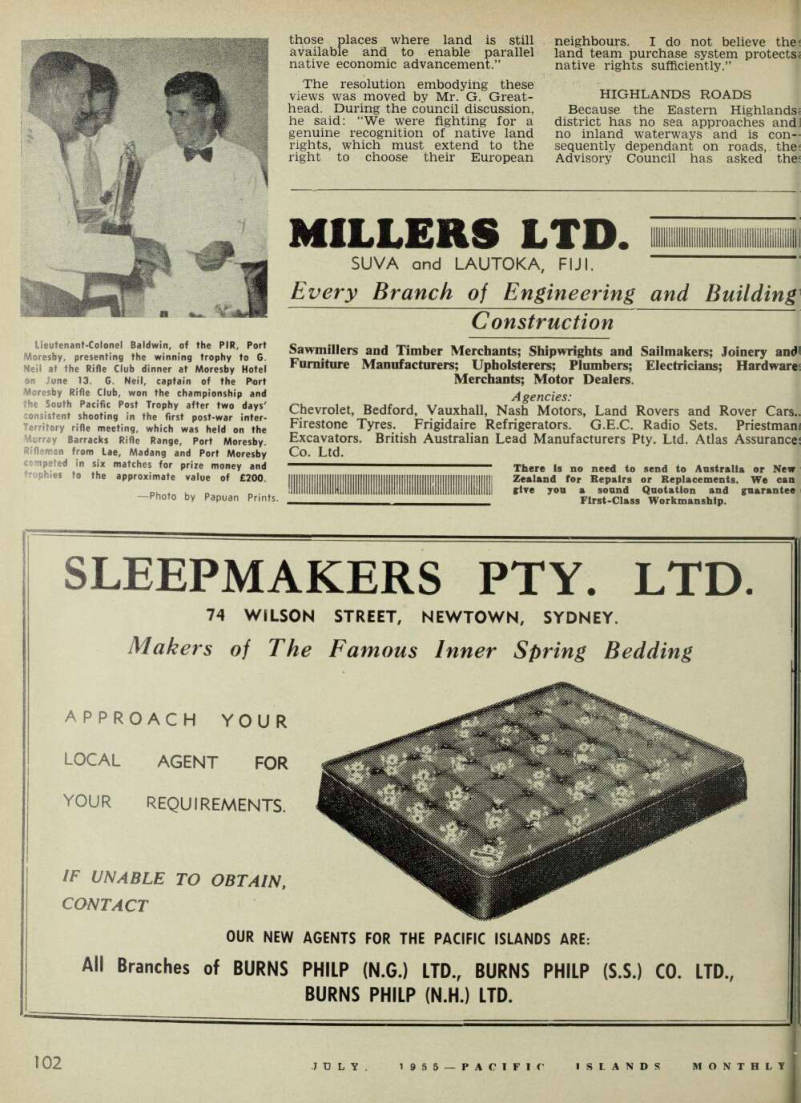
Lieutenant-Colonel Baldwin, of the PIR, Port Moresby, presenting the winning trophy to G.
Neil at the Rifle Club dinner at Moresby Hotel on June 13. G. Neil, captain of the Port Moresby Rifle Club, won the championship and the South Pacific Post Trophy after two days' consistent shooting in the first post-war inter- Territory rifle meeting, which was held on the Murray Barracks Rifle Range, Port Moresby.
Riflemen from Lae, Madang and Port Moresby competed in six matches for prize money and trophies to the approximate value of £200.
Photo by Papuan Prints.
Administrator for priority in the allocation of road funds.
It is pointed out that although air services are available, they are largely used for imports and ex ports. The agricultural areas are not served because airfields cannot be constructed on the terrain.
At the council’s June meeting at Goroka, Father A. Schaefer said that it was essential to have good roads for the transport of native produce.
The chairman (Mr. I. F. G.
Downs) said: “One of the most gratifying sights is the bags of native produce left along the main road to be picked up by Europeans, md it is a graphic illustration of vhat a road can do for a backward Deople.”
Land Alienation
When the Eastern Highlands Advisory Council was discussing and problems, Mr. G. Greathead
questioned statements by the Min ister of Territories and the Director of Lands to the effect that plenty of land was available.
“There is certainly not plenty of land,” Mr. Greathead said. “We have attacked the principle of alienation of large areas and the prevention of the native owner choosing the settler.
“Unfortunately, we have been in cluded in a Territorial scheme of land alienation which does not fit the dense native population of this particular district.
“I think the statement that there is plenty of land available is mis leading and dangerous. . .Any further land that could come within the category of being available for alienation should be reserved for
settlers at present in the area.”
Meanwhile, in Port Moresby, the Administration announced that eight blocks would be put up for tender in the Minj and Mount Hagen areas of the Highlands.
The blocks range in size from 131 acres to 273 acres and all are said to be suitable for the cultivation of highland crops.
Applications closed with the Min ister of Lands, Port Moresby, on June 25.
Goroka Telephones
The Eastern Highlands District Advisory Council has proposed that telephone services based on the Goroka exchange “should be ex tended to those farms within an eight miles’ radius of Goroka not
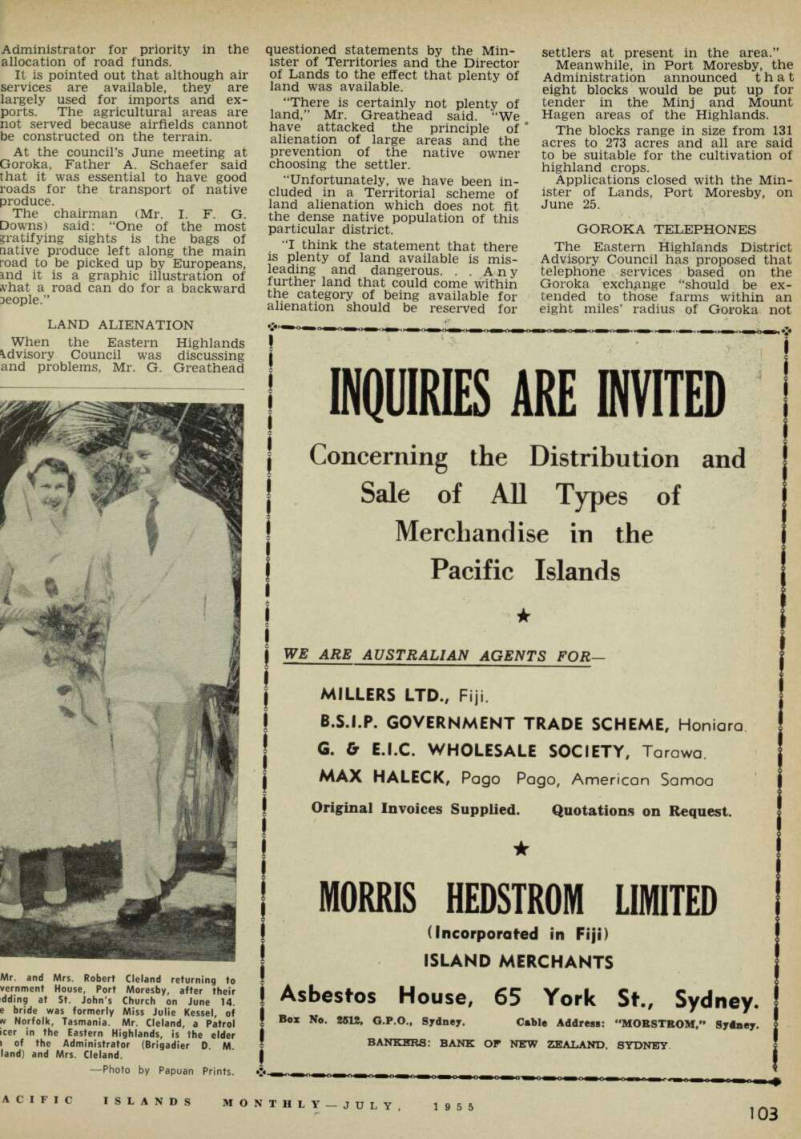
Mr. and Mrs. Robert Cleland returning to vernment House, Port Moresby, after their dding at St. John's Church on June 14. e bride was formerly Miss Julie Kessel, of w Norfolk, Tasmania. Mr. Cleland, a Patrol icer in the Eastern Highlands, is the elder [?] of the Administrator (Brigadier D. M. land) and Mrs. Cleland.
Photo by Papuan Prints.
pet linked, and that the District Commissioner be asked to furnish a jlan to support the proposal.”
Homesick Islanders Back
At Bam
Since the Bam Islanders were vacuated after a volcanic eruption n November, their physical and isychological condition has steadily leteriorated. They are now to be llowed to go home.
After the eruption, more than 400 slanders were taken from Bam one of the little Schouten Islands etween Manus and the New Guinea lainland), and were established in tie Bogia area.
In June, however, the Adminis ration stated that “it is clear that s an island people they cannot lake a satisfactory readjustment to lainland environment.”
Fourteen deaths have occurred nee the evacuation, at least some : them being due to changed con ations and weakened resistance in iced by homesickness.
Since February the 422 Bam Jople have twice petitioned the dministrator to allow them to re irn to their island, stating that icy were sick and feared that more iuld die if they had to remain on ie mainland.
New arrangements include the irmanent posting of a District irvices officer at Bam and the pro si o n of sufficient canoes to
svacuate the en tire population in the event of a major emergency.
Health and Agricultural Officers will stay at Bam until the community is fully re-established.
On June 3, an explosion in the volcano sent an ash-cloud thous ands of feet above the crater, but the activity appeared to be of shallow origin.
Industrial Leases
There has been more agitation in the Territory for an extension of industrial leases from 25 years to 99 years.
At a meeting of the Madang Advisory Council, Mr. N. Grieve suggested that the Administration
should take note of such a proposal, The main reason for an extension was that considerably more money
Leaving St. John's Church, Port Moresby, on June 4, are Mr. and Mrs. Kaufmann and Miss Joan Brown (brides maid). The bride was formerly Miss Vale[?]e Meads, who was nurs ing at the European Hospital, Port Moresby, and at Manus. Mr.
Kaufmann is with the Department of Civil Aviation.
Photo by Papuan Prints.
was invested on industrial leases than on residential leases.
After all, he said, people wanted to know where they stood. If residential leases were granted for 99 years, he saw no reason why in dustrial leases should not be for the same period.
Mr. Grieve’s suggestion is shared by a number of the members of the Port Moresby Town Advisory Council.
Blood Transfusions
The National Executive of the Australian Red Cross Society has approved the extension of Red Cross services in the Territory in the field of blood transfusion service and the provision of buildings for clinical, convalescent and pre-natal accom modation.
The executive has also approved a grant to assist the Territory division with these services.
The National Headquarters repre sentative in the Territory (Mr.
Etheridge) said that the develop met of a blood bank in the Terri tory was a major step forward in the lives of all residents of the Territory, both European and native.
It was intended to build an annex to the Red Cross Divisional Head quarters building at Port Moresby and from there to supply the needs of the medical services. Plans for clinical pre-natal and convalescent accommodation included buildings at Boroka and Kavieng.
Mr. Etheridge said that a con siderable amount of work and effort would have to be done before the blood bank was ready for use. Most important of all was the registering of blood donors.
Mr. Etheridge appealed for sup port for the blood bank. He said: “It is always easy to remember that becoming a blood donor and giving blood is not only good citizenship— your own life at some time or other may depend on it.”
Flying-Boat Wreckage
The war-time famous valley of “Shangri-La” came back into the headlines in June with the discovery there of the wreckage of a Dutch flying-boat by New Guinea pilot Laurie Crawley.
The plane, a Short Sealand, operated by the Christian and Mission Alliance in Dutch New Guinea, had been missing for more than a month. A Dutch airline, the Dutch Navy and others had abandoned the search.
Crawley carried out his search on a flight to Sorong and sighted the wreckage on the side of the mountains surrounding Shangri-La.
He said at Lae that the aircraft was about 10,000 feet up on the mountainside and seemed to have disintegrated on contact. The cargo was only about 10 to 15 feet from the wreckage.
Crawley said he had with him as observer a man who was well acquainted with the aircraft and who was able to identify it from its markings and the type of cargo
ying in the vicinity.
It appeared that the pilot had lad little chance of survival.
Crawley described the area he had earched as the worst he had seen mywhere in New Guinea. The ountry was extremely rugged and here were several peaks of up to 4,000 feet.
Civil Aviation authorities at lollandia have sent a search and escue team to the area. (A US plane crashed in so-called ihangri-La late in the Pacific war ears. Most occupants of the plane /ere killed; among the few sur ivors was a girl, a member of the VAC. She and the others were Itimately rescued by gliders which r ere “dropped” in, and then pulled p on the end of a line towed by plane. The whole incident was world sensation at the time. The rchbold expedition had discovered le valley some time late in the )’s.)
Native Apprentices
Some employers apparently had a impression that the Native pprenticeship Board would Select jtential apprentices and allot lem to employers, said the cecutive officer of the board (Mr. . Linton) at Port Moresby, on me 20.
This was wrong.
Employers must select the persons they wish to apprentice and then apply to the board for their acceptance under the native appren ticeship scheme.
“The initial step is for employers
to apply to the board to have their training facilities examined for the purpose of being approved as em ployers of native apprentices,” Mr.
Linton continued.
“Inspection will be made by mem bers of the local committees.”
In June and July the executive officei’ visited centres in the Terri tory to advise employers on the de tails of the scheme, which is quite different from other native labour arrangements. (Over)
The wedding group photographed after the marriage at the Church of St. Francis Xavier, Rabaul, on June 4, of Miss Dorothy Jean O'Meara and Mr. Robert Henry Moxham. From left to right are Mr.
Harry Moxham (best man). Miss Cecilia Berryman (bridesmaid), the bridegroom and bride, and Mr. Barry Flannery, who gave the bride away.
Photo by C. H.
Meen.
Big Rubber Fire
An inquiry will start soon into the cause of the destruction of 90,000 lb of rubber at Kanosia this week.
The rubber, which represents a month’s production from Kanosia Estates and the British New Guinea Development Company at Kanosia, was worth £15,000.
It is believed that a native may have started the fire by dropping a lighted cigarette near the rubber.
Minutes later, the rubber and the building in which it was housed were ablaze.
The fire was the most serious in the Territory since the Burns Philp store at Port Moresby was destroyed several years ago.
Port Moresby Turf Club
There is a move afoot in Port Moresby to reorganise the Papua Turf Club.
The club has never been dis banded, although it held its last race meeting 25 years ago on what is now Jackson s Airstrip.
Unknown to most Port Moresby people and even to some of the old time members of the PTC, the club still has money in the bank and has as its president the Sogeri rubber planter, Mr. P. J. McDonald, of “McDonald’s Corner.”
The move follows the outstand ing success of the Red Cross race meeting at Boroka, Port Moresby, on the Queen’s Birthday.
About 2,000 Europeans and 3,000 natives attended the meeting, the first since the war.
Horses were brought to Moresby mainly from the Sogeri district, where they are used on the rubber plantations. Although many of them look as if they are due for retirement, some good times were
clocked down the straight 3 furlong dirt track.
One horse covered 2 furlongs in 27 seconds. Crack Sydney and Mel bourne racehorses usually cover the same distance in about 22 seconds.
The Moresby Cup was won by Royal Miss, a 6 to 1 chance.
Before the meeting, 8 horses were auctioned and became the property
of the top bidder for the day.
Several buyers rode in the last event, the owner-rider race, one of the entrants being the Territory Director of Health, Dr. John Gunther.
During the afternoon Dr.
Gunther’s talents were required in another direction —he attended two jockeys injured at the meeting.
One, Mr. M. O’Brien, of Sogeri, was kicked shortly before the start of the Port Moresby Cup, and the other, Mr. V. Chlow, was thrown from his mount, Joe, before the last race began, Sogeri planters are keenly in terested in getting racing going again in the Territory. There is a rumour that if the club is re organised, a track might be laid out at Sogeri.
Filming Under Way
Work has started on filming Aus tralia’s latest movie, “Walk Into Paradise,” with Chips Rafferty tak ing the lead.
Only a few people saw Rafferty and 16 other members of the film unit pass through Port Moresby on their way to Goroka.
Rafferty brought news that there was a chance that “Walk Into Paradise” would be screened In Papua-New Guinea soon after shooting is completed. However, on this question, much will depend on negotiations yet to be carried out with the distributors.
At Jackson’s Airstrip, Rafferty said the film would take about three months to make. Scenes would be shot at Goroka, Madang and Port Moresby.
The full-length film will be in Sastman Colour.
A consignment of nearly 3,000 feet )f film left the Territory in late June for Paris, where it will be jrocessed.
The consignment was packed in dry ice to keep it at the correct temperature.
Japanese
Ammunition
Australian Army Bomb Disposal
personnel working in New Guinea believe it will be many years before the Territory is rid of unexploded
ammunition left by the Japanese, Although the Pacific War ended 11 years ago, at least 10 tons of
Administrator D. M. Cleland, of Papua-New uinea, looks grim as he has difficulty in pin ing the British Empire Medal on the tunic f Sergeant Sina at a special parade in Port loresby on June 23. Sgt. Sina received the ecoration for loyalty and devotion to duty. e served in the PIB during the war and is aw a member of the Pacific Islands Regiment.
Photo by Papuan Prints.
A concert staged by schoolgirl members of the Junior Red Cross at the Xavier Hall, Rabaul, on June 7, ended with the tableau shown here Photo by C. H.
Meen.
bombs and ammunition are being destroyed every month in the Rabaul area.
A tunnel discovered recently by foraging natives on Tunnel Hill, Rabaul, yielded 150 large shells.
These were taken across the bay and exploded.
Lieutenant B. Florence, of the Ist Australian Bomb Disposals Section, said at Port Moresby that dumps were often covered with 11 years’ jungle growth and in many cases were found only by accident.
Recently, 115 shells were found a few yards from where the Govern ment Vujcanologist takes his read ings at Rabaul.
The Army Bomb Disposal Section has been in operation in the Terri tory since 1949, and has had no casualties. The section has two men stationed permanently at Rabaul and four on patrol—two in New Britain and until recently two in Bougainville.
Construction Programme
The Commonwealth Department of Works, in June, marked up one good point and one bad point to is construction programme in Papua-New Guinea.
Two days after reports had been received telling of major blunders by the Department in Bougainville, the Director of Works, Mr. Vidgen announced that the third important bridge within three months would be open to traffic within a fortnight.
The new bridge crosses the Erap River in the Upper Markham valley area. The other two are the Kimidan Bridge, about 100 miles from Kavieng, and the Peracles River Bridge on the Wau-Labu Road Meanwhile, reports from Bougain ville s f ate that several bridges on the Kieta-Iwi Road passed as sound by the Department of Works, had been washed away or severely damaged in their first wet season.
Damage was estimated at about £5O 000. One bridge had been left isolated in the middle of a river. .All the Department has said is that “an officer will go to Kieta to investigate the matter.”
Timber Mill Burned
Fire destroyed the Laloki River j timber mill owned by Mr. Ken i Burke, of Port Moresby, in June.
Damage is estimated at £5,000.
The fire was caused by an ex plosion in the exhaust of a machine ' at the mill.
Tb In Territory Cattle
The P-NG Department of Agri- I culture has stated that the incid ence of TB in cattle is low in the i Territory.
Officials believe that further work I in this field will result in the com plete eradication of TB among I cattle in the Territory.
Already tests have been carried j out near Port Moresby, Lae, Madang and Wau. At present two officers i are testing cattle in the Rabaul area.
Liquor For Natives
The controversial matter of liquor ir £ a xT^ es came ba £ k mto t] l e new ! 1 P " NG when native members of te Seventh Day Adventist Mission ®^Sy ai ? vll }£ expressed strong jposition to the proposal.
PlM’s correspondent in Bougainville says that many members of the mi£Slon have written to the elected member for the New Guinea Islands, Mr. Den Barrett, asking him to express their views at the coming Legislative Council Meeting.
The decision to oppose liquor for natives was made at the annual general meeting of the native mem bers of the SDA Mission “Liquor for Natives” is expected to be the big matter raised at the current P-NG Legislative Council
Royal Mist, seen here winning the McGregor [?]dies' Sprint Race, was the outstanding horse Port Moresby's first post-war race meeting June. Miss Isobel Kelly is the rider in this
instance. Royal Miss (owned by Mr. Mick Lloyd of Sogeri) also won the Port Moresby Cup. At right the Administrator, Brigadier D. M. Cleland, presents the trophy for the
Birthday Plate to Mr. C. Sefton whose horse, Gay Lady, won the race.
Photos by Papuan Prints.
meeting, which started on June 27.
Although the elected members, as well as appointed members, have their own views on the subject, no one seems prepared to voice them until the Council meets.
It appears certain that some natives will eventually get per mission to drink. When, is another matter.
Moresby Milk Supply
One of the biggest disgraces in Port Moresby may be rectified by Christmas.
By then, residents should be able to get fresh milk, a commodity now obtainable only at 2/3 a pint.
A Port Moresby taxi proprietor, Mr. Ken Burke, plans to start a dairy farm on his property near the Brown River, near Port Moresby.
He hopes to have at least 100 head of dairy cattle in production by Christmas, The most modern machinery available will be installed, and the milk will be distributed in bottles to retailers. The milk at no stage will be handled by hand.
Mr. Burke’s 2,000-acre property is being fenced and cleared in pre paration for the arrival of the cattle.
It is understood, however, that no ships are available to bring the cattle to the Territory at present, and the stock Mr. Burke now has at Sydney may have to be sold. But any number of cattle are available, and Mr. Burke says he expects no difficulty.
He hopes to distribute about 400 gallons of milk a day when the dairy is under way. ttft tpopttt’t? crß , T?vrr , ‘R i Q „ There taffltaSe thatK and Ne , w p uinea may beat Australia in introducing commercial helicopter services.
It was announced at Port Moresby
in June that negotiations were under way for the introduction of commercial helicopters in the Terri tory.
A conference has already been held between senior Administration officials and the Regional Director of Civil Aviation, Mr. John Arthur, and further talks are planned.
Mr. Arthur has said that the inference worked out what ser ices helicopters could be applied i in the Territory, and what work le Administration would be able give a commercial operator.
The information gathered at the Iks would be passed on to an rline company which was con dering helicopter operations. He d not name the company.
However, he said it was proposed at helicopters would operate to tints where fixed-wing aircraft uld not go. Sikorsky 5.55 heli pters would be used. These air aft have about the same payload sea level as a Norseman aircraft id carry seven passengers for stances up to 70 miles.
A.t present, there are four Bell licopters in the Territory, three der contract to the Australasian troleum Company, and one to the w Guinea Resources Prospecting mpany. Since their arrival in the rritory in November, 1953, they ve flown 6,000 flying hours.
Hie contract held by Bahamas licopters Ltd. has been taken iv by a new company, World Wide : Services of Papua, rhe company is headed by an icrican living at Port Moresby, . Arni L. Sumarlidason, who has jrated helicopters in Alaska, nada and Greenland. iVhen helicopter operations first rted in the Territory 20 months ), only American personnel were ployed, as Australians qualified to and maintain the rotor-blade craft were not available. Now 80 cent, of the American staff has n replaced by Australians, in Australian, Mr. Robert Wilson, Mullumbimby, is the company’s ef pilot, and is also the first stralian licensed as a helicopter >t in the Commonwealth.
New Dutch Airline
Tie Australian Embassy at The ?ue has been informed that a 7 airline was to begin operations Dutch New Guinea on July 1. is known as Dutch New Guinea Transport Company. iLM will manage the new service co-operation with the Dutch /eminent —the Government pro ng the finances, hree DC3 aircraft used by KLM Dutch New Guinea are to be isferred to the new company and Beaver aircraft will be added. ; is believed that another five iver aircraft and several Bell copters will be added to the Lne soon.
Blic Service Conditions
he P-NG Public Service Associa i has taken steps to improve litions for its members in the ritory. heir complaint was poor accom iation, and their method of iing with the matter was to ask Territories Minister, Mr. Paul luck, not to permit any new male ointees to take up duty until
proper accommodation is available for them.
In a telegram to the Minister, the president, Mr. Brennan, said the Association was gravely concerned over the increasing deterioration of accommodation at Port Moresby.
Several officers were doubling up in single rooms; three were living in a hostel lounge, and several others were occupying rooms rented by Administration officers at present away from Port Moresby.
Mr. Brennan told the Minister that the association had consider able doubts regarding the Admin istration’s proposed building pro gramme. He asked Mr. Hasluck to call for an urgent report on the matter.
Students’ Newspaper
Native students of Fatima College,
near Banz, in the Western High lands, have published their own newspaper.
The paper, believed to be the first written in English by native students in New Guinea, tells of the develop ment of the college and its grounds since it was started last year.
A farm attached to the college has more than 200,000 coffee plants in its nursery. There are 5,000 banana trees, 4,000 pineapple plants and five acres of vegetables.
The ten-page paper, named the Fatima Chronicle, as well as giving local news, has its own cartoons and advertising section. One advertise ment says that newspaper for cigarettes is available at the teach er’s house for 3d a sheet or one hour’s work on the farm!
For a 6id stamp, payment is one and a half hour’s work. (Over)
The headmaster of the college has Dinted out that the production of le paper is especially worthy of Dte as Highland natives were merally considered less advanced tan their coastal brothers. He )ted also that the area had had ily 22 years of contact with Euro ;ans, and that schools were first >ened only nine years ago.
Big Land Purchase
The New Britain District Com issioner, Mr. Foldi, and the [rector of Lands, Mr. Mclnnis, ive completed the purchase of ,000 acres of native land at arongoi, near Rabaul.
The land will be open for public .plication when it has been de led what crop it is best suited for.
It is understood, however, that is will not be for several months.