Coveres Broad Field
pp. 85-87 · Read in the full issue
P Research Council
The wisdom of the formation of the South Pacific Commission had jeen demonstrated repeatedly, said the Secretary-General (Dr. Ralph Sedell) when opening the seventh meeting of the Research Council at Noumea on June 20.
0 other international co operative body had at its dis posal more valid advice than t provided by the Research incil in its first six sessions, Dr. [ell said. rhe South Pacific Commission is ost unique in the world in its vision for and reliance on the out ie of interpretations of scientific eavours formulated by research ntists,” he added, ighteen experts from the six nber-nations of the Commission nded the 10 days’ session. Mr.
C. Groves, Director of Educa . in Papua-New Guinea, was ted chairman. bservers from three United ions Specialist organisations O, UNESCO and WHO) and the tralian National University were :omed by the Secretary-General, ibjects on the agenda included fisheries, coconut and rice in dies of the Pacific: the intro :ion of plants for improved agri ure; the development of atolls; >ical school and dispensary de ; control of pests and diseases igriculture, especially the rhino ►s beetle: assessment and im rement of nutritional standards; ;rol of filariasis and malaria; iperative societies; promotion of •ature for Islands people; and use of visual aids in health and national work.
IE Commission’s Executive Officer for Health (Dr. Emile Massal) said at the opening meeting that Commission was collaborating jasingly with other international health organisations, le Williams Waterman Fund of Research Corporation, New c, has awarded 8,000 dollars he Commission to enable vita assays to be made on Island s. (Miss Yvonne Macfarlane, a Zealand biochemist with Lon experience, is now at Noumea vitamin studies in the Corn ion’s food analysis laboratory).
Massal said that WHO will 1 its health education adviser, Lynford Keyes, to the Islands year in connection with the [mission’s programme, le School of Public Health and )ical Medicine, Sydney, had q the services of Dr. Black, se malaria research for the Com ion was ready for review by the larch Council. ose collaboration existed be in the Commission and the torial administrations through :h the results of Commission k would be used.
THE deputy-chairman (Dr. Eric Ojala) said that although some development of industry in all South Pacific territories was de sirable and inevitable, most people in the Islands would live for many years in rural societies which must achieve better living standards largely through improved agricul tural production.
“Where agricultural resources are good and high-priced cash crops can be introduced, economic pro gress may be rapid without much diversion of labour to industry,” Dr.
Ojala said.
“Transport and trade facilities in rural areas are indispensable.
Speedier development of commercial agriculture in the village systems will pose social problems of custom, culture-change and fundamental education, as well as nutritional problems.
“The South Pacific Commission and the Research Council have an important role to play in helping administrations to meet these problems.”
(Continued on Pag« 85)
R. ALEX KROON, Executive Officer for Economic Develop ment, said that the South :ific provided an almost untapped rce of wealth in fish, shells and ale algae.
Fish-farming in ponds seems to a promising development for the mds,” he said. “A fishpond in tropics under native manage at usually produces more fish n a fishpond in Europe under opean management.” he Commission’s Fisheries Officer '. H. van Pel) had visited many nds and found the Islanders ly interested in the idea of fish ning. A fishpond had been iblished in Rarotonga with pia fry from Fiji during Mr. van s visit. uring its session the Research incil discussed the report pre bed to the Commission by the ntists who met at Canberra in 7 for consultations on plant col ion and introduction, he report covered the possible fiopment of a long-term regional it introduction programme com ing (1) Evaluation and improve it of indigenous and introduced lomic and subsistence plants; (2) eductions from outside the on; (3) Plant exploration; (4) T-territorial movement of plant material.
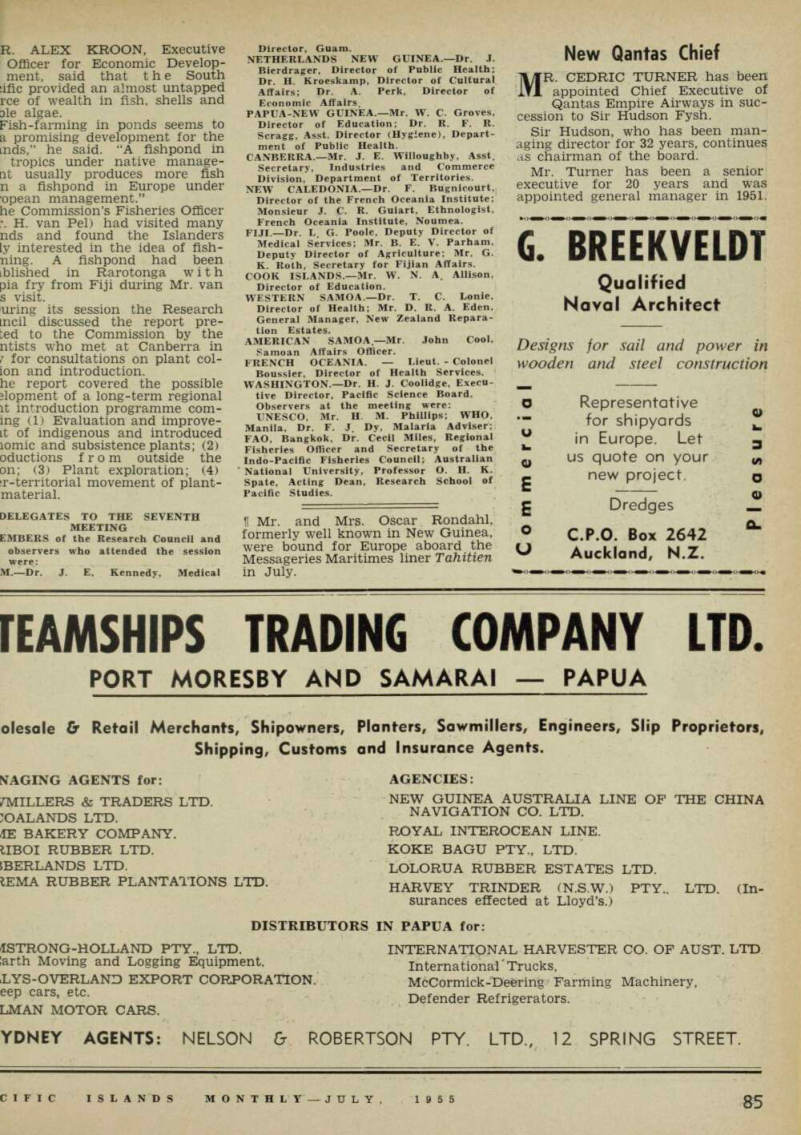
Delegates To The Seventh
Meeting
EMBERS of the Research Council and observers who attended the session were: M. —Dr. J. E. Kennedy, Medical
Director, Guam.
Netherlands New Guinea.—Dr. J.
Bierdrager, Director of Public Health; Dr. H. Kroeskamp, Director of Cultural Affairs; Dr. A. Perk, Director of Economic Affairs.
Papua-New Guinea.—Mr. W. C. Groves.
Director of Education; Dr. R. F. R.
Scragg, Asst. Director (Hygiene), Depart ment of Public Health.
CANBERRA.—Mr. J. E. Willoughby, Asst.
Secretary, Industries and Commerce Division, Department of Territories.
NEW CALEDONIA.—Dr. F. Bugnicourt, Director of the French Oceania Institute: Monsieur J. C. R. Guiart, Ethnologist, French Oceania Institute, Noumea.
FIJI.—Dr. L G. Poole, Deputy Director of Medical Services; Mr. B. E. V. Parham.
Deputy Director of Agriculture; Mr. G.
K. Roth, Secretary for Fijian Affairs.
COOK ISLANDS.—Mr. W. N. A. Allison, Director of Education.
Western Samoa.—Dr. T. C. Lonie.
Director of Health; Mr. D. R. A. Eden, General Manager, New Zealand Repara tion Estates.
AMERICAN SAMOA—Mr. John Cool, Samoan Affairs Officer.
FRENCH OCEANIA. Lieut. - Colonel Boussier, Director of Health Services.
WASHINGTON.—Dr. H. J. Coolidge, Execu tive Director, Pacific Science Board.
Observers at the meeting were: UNESCO, Mr. H M. Phillips; WHO, Manila. Dr. F. J. Dy, Malaria Adviser: FAO, Bangkok. Dr. Cecil Miles, Regional Fisheries Officer and Secretary of the Indo-Pacific Fisheries Council; Australian National University, Professor O. H. K.
Spate, Acting Dean, Research School of Pacific Studies.
If Mr. and Mrs. Oscar Rondahl, formerly well known in New Guinea, were bound for Europe aboard the Messageries Maritimes liner Tahitien
in July.