Territories Talk-Talk
pp. 77-80 · Read in the full issue
By TOLALA, on board MV Bulolo.
be AE 1 Browsing through a June, 1934, ;M I noticed where the TNG Re rned Soldiers had held their mual meeting and had decided to ect a war memorial; the location be that triangular section rdered by Mango Ave., St. George re. and Kamarere Street (opposite e old BP garage). This was a job, ifortunately, never completed ough the clock, I believe, arrived )m England before War 11. The teresting point, however, is the zt that according to the report, le memorial will particularly refer the crew of the AE 1, which dis peared so mysteriously in 1914.”
A.s far as I remember, there has ver been any attempt in TNG Dr anywhere else for that matter to commemorate that sad fatality, istralia’s first naval loss in War I, len the submarine AE 1, com mded by Lieu t.-Commander sant, RN, together with a com jment of 35, mysteriously dis peared on September 14, 1914, ien bound for a patrol off Cape izelle.
Dver to the RSL with the sug stion that a suitable memorial ould be erected for these “for tten men.” >r the Record \ couple of months ago I made 'erence in these columns to the a-worshipper, Auguste Englehardt, d some of his disciples. Just to ep the record straight, the date Englehardt’s death was May, L 9. For some years prior to his ath he had been the sole adherent the faith he preached. Others, th the exception of one Bradtke, re sent back to the Vaterland by b German administration. quor Permits for Natives rhere is more than usual interest Port Moresby over the question granting “certain” indigenes the ht to consume alcoholic liquor. I aid find no single individual, 10m I questioned on the matter, favour of the measure; although e very tanned and somewhat szled person in the Snake Pit ex sssed the view that all humans Duld drink if they wanted to, and the natives were human . . . and on. [ tapped a very fair cross-section the capital’s community. The )st naive reply I received was >m a Tolai lad —sophisticated to ; finger-tips—who remarked to ;, in his own vernacular: “To me is a matter of indifference. If rmits are issued I wouldn’t re ve one, anyway. But I always t a drink when I want one.”
I met quite a few Tolai in the capital city and nearly all, on be ing asked how they liked Port Moresby as compared with Rabaul, wrinkled their noses in the approved discriminating manner and said Port Moresby was no good because there was no food. Nothing but r i ce every day; no yams, or taro, n 0 go od kaukaus. ! sympathised with them, but have my doubts as to whether they were being quite truthful in describing the situation. They knew me as hailing
from Rabaul and a native always likes to tell you what he thinks you like to hear.
Samarai’s Foreshore
Only last month, I mentioned the Samarai foreshore as I knew it in Days Belong Before, with its row of Specialist Houses that could have been erected by Chic Sale, Gone are those days without any doubt whatsoever, Samarai’s fore shore now—in the vicinity of the wharf, at any rate—is as fresh as paint and as neat as a new pin.
The island is so typically tropical and a delight to the eye Such a contrast to Moresby, which has the
ipearance of a North Queensland wn.
rthday Honour
At least one of the newly-created .ights in the Birthday Honours
List had an association with T-NG for several years during the ’twenties.
I refer-to Sir Edwin McCarthy, who since 1949 has been Deputy High Commissioner for Australia in Lon don. I mentioned him in a recent
Talk-Talk. He was Officer-in-Charge of the Commonwealth Audit in Rabaul, taking over that office from Colonel Ling, who was in charge during part of the Military Occupa tion up there.
The Disappearing Upi
Mention was made a few months
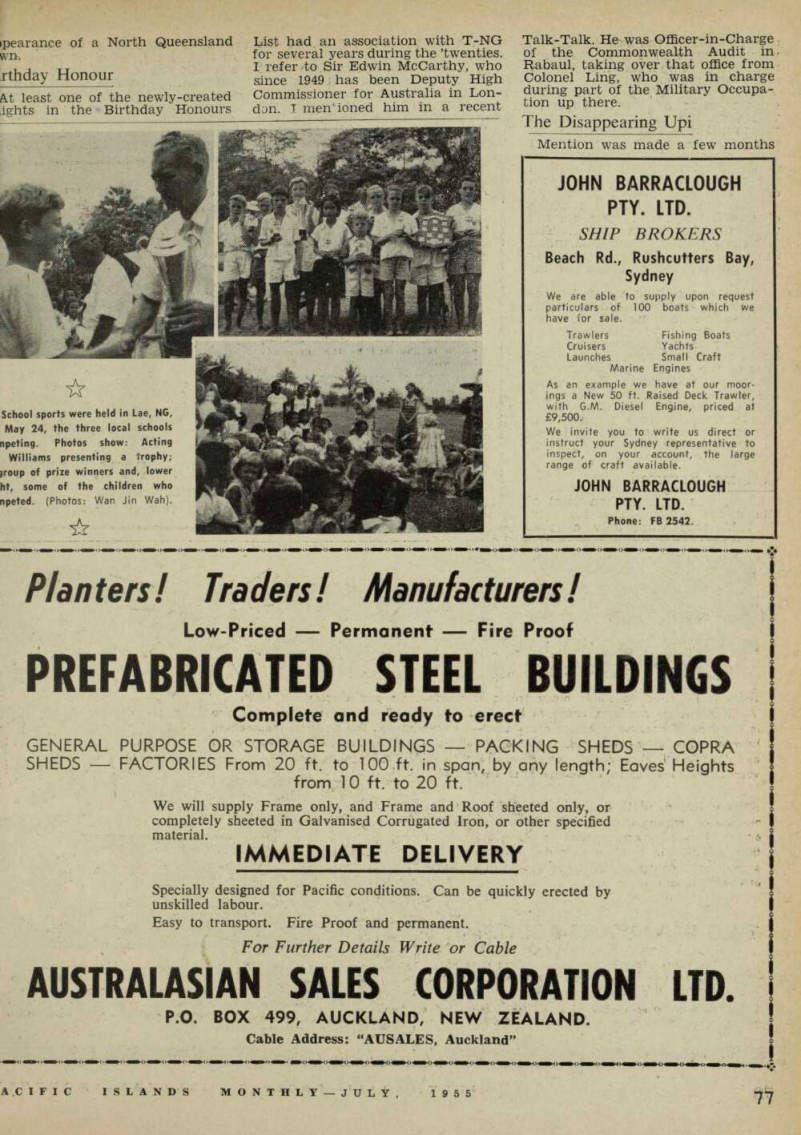
School sports were held in Lae, NG, May 24, the three local schools [?]peting. Photos show: Acting Williams presenting a trophy; group of prize winners and, lower ht, some of the children who [?]peted. (Photos: Wan Jin Wah).
ago in PIM of the upi head-gear, worn by some of the Bougainville natives, which appears on the P-NG one-penny stamp.
Before War 11, young lads in certain parts of North Bougain ville wore the upi hat for several years until they had passed through the initiation to manhood. Now, I hear, most of the villages which respected this custom have abolished the practice as a result of modern civilisation and mission pressure.
Only two villages remain which observe the upi, and these are hill villages in the Kunua district. The folk there stoutly refuse to abandon their old rites and customs and defy both government and mission in fluence.
There was a time when Admin istration policy was to encourage the preservation of native cultures, customs, rites and what-have-you, providing they did not violate or affect peace and good order or the laws of the land. But, apparently, that policy, with many others which are well-deserving, has been put into the discard. If the lads of Kunua want to remain uncivilised, let them do so. Posterity would then be able to see what a genuine Bougainville native is like.
Costumes Reversed
There was a time when most of the native women in and around Port Moresby wore only a grass
skirt, with no covering above the waist.
The Himalaya came into port while we were there and it struck me that fashions had been reversed.
European female tourists for the most part, had most revealing tops to their sun-suits (or whatever they may be called), while the Moresby
maidens were well covered from neck to knee, some of them even sporting the old-fashioned Mother Hubbards. Likewise with the male species. Europeans walked the streets clad only in shorts and sand shoes, while native males were fashionably attired in shirts, shorts, ties, long white stockings and shoes.