Kill in Malayan Jungles
pp. 70-75 · Read in the full issue



HoW Fijians Hunt and Kill in Malayan Jungles
From R. W. ROBSON, in Singapore, June 2.
fITHE fact that I had driven 100 1 miles in the filthy Malayan heat to reach this place, and that during a very long evening I had been subjected to the kind of hospitality that abhors an empty glass and an undanced-to tune, made no difference in my awaken ing.
“Good morning, sare,” said the huge, smiling Fijian, with a big cup of tea. “The Major say the car will leave in 30 minutes.”
The sun had not emerged from behind the cone-shaped hills which guard the Fijian Battalion’s HQ in Johore. My wearied body howled for more sleep. But these were small things. Every day, HQ officers go out to see the Companies camped scores of miles away in the jungle.
Life here is real and earnest.
Within the hour, we were far away across what were once the stinking swamps of North Johore— now drained by a vast network of wide ditches, covered thickly with countless millions of rubber and palm-oil trees, and serviced by the finest system of roads in SE Asia.
I - "" FOUND my situation almost in credible. I was in a heavily armoured car. In front of me, beside the driver, sat an armed Fijian soldier. Beside me was Major Ratu Penaia Ganilau, also armed.
One hundred yards ahead there was , a ßren-gun carrier, with a very alert Fijian up on top, swinging his
Brens as he examined each side of the be-jungled road Another Bren carrier fol lowed a hundred yards be hind. Soon after we started, the soldiers, at a certain point, slipped cartridge clips into their kept their rifles at the ready. No one spoke Just routine, I sun pose?” I said, a little anxi ously.
Penaia smiled his slow smile “M-m-m, yes,” he said and then told me f® m . e T funny stories of life m -^^ laya nothin g to do
with bandit-hunting.
certain places, the cars travelled very fast I learned later that these h W f^ plac^much favoured by the CT s (Communist
Terrorists) for ambush —a road ris ing slowly in a curve, between high banks covered with dense under growth.
When, at HQ afterwards, I saw a map bespattered with coloured markers, I realised that that day we had passed scores of places where cars and trucks had been ambushed—mostly with little harm, but some with grave loss—as in the recent case when Major Genge, travelling unescorted, was killed.
They showed me that spot, and how cunningly the CT’s worked it.
THERE are four camps—A for Abel; B for Baker; C for Charley; and D for Dog—and during some strenuous hours, under a blazing sun, amid maddeningly monotonous rubber-trees and un relenting heat, I saw the lot.
The pattern was generally the same. Rows of tents pegged neatly to the parched yellow earth; a water-supply brought in from some where —mostly wells; a small engine to run a generator for lights. and radio batteries: barbed wire and sandbagged machine-gun posts all around; a few men on camp routine; and an officer close to the radio, keeping in touch with HQ and the patrols far out in the bush.
For, as Oliver Edwards said, “this is no bloody picnic.” The Fijians have a job to do. Overall statistics on these Malayan operations show that it takes 1,000 hours of patrol ling to get a contact, and 1,600 hours to get a kill. The Fijians claim 182 “eliminations” (for which they have paid with 22 lives) and that represents hundreds of
thousands of hours of hard and systematic slogging in thej jungle. They have the best record of all the 22 Battalions which are hunting bandits in Malaya—and everyone acknowledges that there was no luck about it —just goodt hard soldiering.
It is not exciting work—mostly endless patrolling, systematic, quartering of the jungle terrain: silent creeping through the leech-, infested ravines, relentless tracking when once the track is found.
But the Fijians love it —and the CT’s know it. When the Terrorist; realises that the brown-faced mem from the South Seas are on his. trail —and he usually is warned, be cause a lot of these plantation-!workers are in league with the Reds —he literally goes for his life. Hunt and Kill is the name of a monthly bulletin compiled by base for the men; and it is a good title. The Fijian hunts continually; and he kills more often than any other soldier in Malaya.
MY last visit was to Dog. Dog was just making a new camß in primitive jungle, away out. at the end of 15 miles of red-dust* choked road.
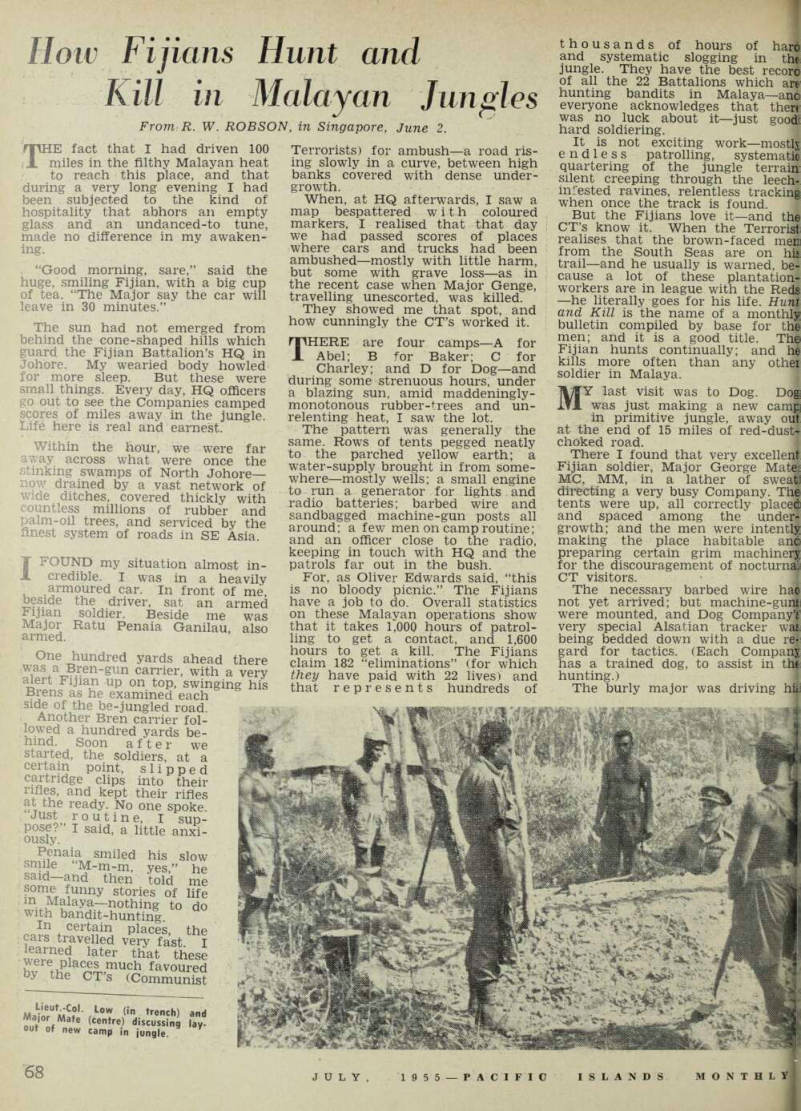
There I found that very excellent.
Fijian soldier, Major George Mate£ MC, MM, in a lather of sweat! directing a very busy Company. The tents were up, all correctly place® and spaced among the under growth; and the men were intently making the place habitable and preparing certain grim machinery for the discouragement of nocturnal!
CT visitors.
The necessary barbed wire hao not yet arrived; but machine-gunSj were mounted, and Dog Company’!' very special Alsatian tracker was being bedded down with a due re-! gard for tactics. (Each Company has a trained dog, to assist in the hunting.) The burly major was driving hisi
Lieu.-Col. Low (in trench ) and Major M a t e (centre) discussing lay out of new camp i n jungle.
en hard, to secure a reasonable sposition before dark. That camp is right out in “tiger country.”
TRAVELLED the long miles back to HQ in Colonel H. J. G. Low’s car—a “soft-skin.” This young, ir-toughtened CO —he got his llitary Cross with the New Zea iders in the 1944 Italian campaign nates armoured cars and favours ift movement. He travelled with ly one carrier escort —but I was ately conscious of the way he pped the cartridges into his big mlver and placed it handily, as 3 winding road reached hilly intry.
Vs I considered the difference be een an armoured and a “soft n” car, I felt the marrow crawling ug my backbone, rhe Colonel showed me how every [age now is enclosed in barbed •e, and how each is entered and t through massive gates manned police. All cars are inspected, is keeps the CT’s out of the ages, and maintains a check oyer licles which might be carrying cit food and equipment to a idezvous with bandits.
Tie system was designed by Gen -1 Templer—and implemented as 1 as the politicians will’ allow — bring the bandits within reach, nes and helicopters fly over “tiger :ntry,” and bomb any food gardens ich may be supplying the CT’s. 3 ever-trading Chinese who sup them with goods are “dis raged.” The core of the plan is s to deny food to the CT’s and ae them out of the deep jungle, are they are most elusive, into more settled and open country, are they can be cleaned up.
'he troops are doing their job, 1 enough. But they are being ferly and consistently defeated the Chinese villagers, among am are many CT sympathisers. 3 politicians, in turn, protect the agers against the wrath of the liers. lEN our car swung around a curve, upon an extraordinary scene. Two huge trucks and one were in the ditches; two other 3 were on the roadway; a couple deeding men were receiving aid; up the steep banks, on either ;, Fijian soldiers, rifles at the dy, were pushing through the ib.
Vn ambush!” I exclaimed. It had the earmarks of one. he Colonel, tight-lipped, strode into the midst of the confusion, apped out with camera ready—l ight I was going to get a pic ; of CT’s in action, ut it was only a collision. A ay driver, with a truckload of Company wire, came too fast md a curve on his wrong side, a police armoured car, bounced a a couple of other cars, and le a very expensive mess, alonel Low’s sentiments were lily expressed—l heard forgotten
words that were banned by an over sensitive society 30 years ago.
CHATTING on that long drive home, I learned just what sort of an administrative headache is represented by the transfer of this Fiji Battalion to the Malayan Terrorist area.
Operationally, it is on a war basis.
It gets its fine record (the biggest number of kills in Malaya, with the Suffolk Regiment next, and the Gurkhas close up) by keeping a full two-thirds of its 850 officers and men always out on patrol.
But, for British records purposes, it is on a peacetime basis. So there must be a meticulous accounting for everything—there lately has been tremendous uproar because a half-pint of brake fluid is missing.
The Fijians are superb jungle fighters, and they loathe adminis trative duties—“We came here to fight, sir—not to keep accounts,” is the burden of their constant pro test. British HQ actually refused for a year to provide the Battalion with an efficient quarter-master, and thus forced valuable officers and NCO’s onto desk work.
The Fijians seriously lacked equipment—their outfit of ordinary uniforms was sadly inadequate. Yet a very bumptious type of old-style British officer wanted to equip them, for brigade parade purpose, with useless red jackets and white sulus —and snarled a great deal when the Fijian officers opposed and defeated him.
In the field itself, British co operation and goodwill have been overwhelming. The friendly East Yorks and Eleventh Hussars have given the Fijians invaluable help in training for administrative work and for servicing of machines.
One night, in A Company’s camp, I heard the unforgettable harmony of Fijian singing. There, in their
recreation hall, were a hundret Fijians, singing to a score of Easi Hampshire lads, and passing arounc the kava. The Hampshires seemec a little staggered by the unexpecte( flavour of yaqona and the absence of beer; but they certainly appreci ated the singing.
Very wisely, the officers keep thei Fijians away from all alcohol—no'
r any Sunday School reasons, but icause liquor maddens them, and jstroys their great good-humour id invariable courtesy which have ade them first favourites from ngapore to Kuala Lumpur.
But they do love their kava. The dies’ committees in Fiji, who have »ne such a fine job, should keep e supply of yaqona moving *adily along.
An officer I was with out in a ngle camp noticed a distressed rviceman with a package. What is wrong?
Lhe soldier said he couldn’t get ything with which to break up ? yaqona. ‘Well, godammit, go out and steal coffee-grinder or a hammer or nething—but see that they get ;ir yaqona,” bellowed the officer, e cool and refreshing bowl was ng passed along, with proper ■emony, within twenty minutes. 1 is dull for the Fijian lads out amid these endless, monotonous rubber-trees. They are not en iraged to go on leave into Singa *e and Penang, where they tend drift into filthy Asian establish es. There are only a handful Fijian wives here, grouped around |, far from the operational camps, inese and Malays, in Fijian eyes, 7 e few social qualities; and the s are thrown much onto their n resources. rtajor Oliver Edwards, the new mp Commandant at base, is a dess, ingenious worker, and he > done wonders in. devising new reational services, issuing a ;kly printed sheet with news m home, devising kitchens that I do more than merely feed, nning spare-time instruction in led trades and civil administra i. The Fijians have never com ined—but they do appreciate se later developments. .s part of their habit of making nds and influencing people, the s out in the camps have lured little grey monkeys down out :he trees; and now every platoon its pet. The monkeys like noth better than to sleep on a Fijian ulder, with their ugly little faces ggled into a Fijian neck, his Malayan duty is doing the ans no harm. Seeing the adful social and political condi is here, they are better able to ireciate Fiji. I talked to two idsome young Fijian lieutenants. ;y were much amused by the ernmental set-up in Johore. At head of the State is the Sultan, pears old. His Highness’s deputy e is his own son, aged 61, while Highness himself lives in Lon l with a new wife and a daughter, d 5. . . I hope, when the Bat-
Photo taken in the dusk after coming upon [?]e road smash (see story).
'he staff of the cers' mess, Ist lalion, Fiji Infantry iment, Batu Rabat, are, Malaya, in May. rent Row (left to it) —Pte. E. Raisevu, S. Nasikele, Sgt. N. asere, Pte. R. ito, Pte. S. lokimi. ack Row—Pte. S.
Pte. J. George, !pl. A. Ramanakiwai, S. Boila, Pte. Y.
ion returns early next year it the lieutenants will repeat in /a, for the entertainment of tual friends, their delightful iments on this Oriental situation.
The Battalion’S Present
Officers
The following were the officers of the Fiji Battalion in Malaya, when it was visited by the Editor of PIM at the end of May:
Battalion Headquarters
Lt.-Col. H. J. G. Low, MC, Command ing Officer.
Maj. P. K. Ganilau, Bn. 2ic.
Capt. R. J. B. Ackland, Adjutant.
Capt. T. K. Galuvakadua, Chaplain
Cl. Iv.
Lt. A. L. Hansard, Bandmaster.
Lt, R. I. Launder, Int. Offr.
Headquarters Company
Haj. O. G. R. Edwards, OC.
Capt. W. D. Sorby, MTO.
Lt. W. Wood, Si". Oflfr.
Lt. B. C. Stevenson. OC Mor. PI.
Maj. A. J. Palmer, QM.
A Company
Maj. H M. McDonald, OC.
Lt. K. M. Tagivetaua, 2ic.
Lt. E. D. Levula, 1 PI. Comd.
Lt. J. N. Lotawa, 2 PI. Comd.
Lt. E. Toronibau, 3 PI. Comd.
B Company
Maj. H. W. R. Petersen, OC.
Capt. A. P. Keelan, 2ic.
Lt. E. N. Seniblci.
Lt. G. Komaisavai,, 4 PI. Comd.
Lt. R. I. Thorpe, 5 PI Comd.
Lt. J. W. R. Murphy, 6 PI. Comd.
C Company
Maj. J. R. George, OC.
Capt. S. R. McKeon, 2ic.
Lt. N. Lalabalavu, 7 PI. Comd.
Lt. I. L. N. Veikoso, 9 PI. Comd.
D Company
Maj. G. S. Mate, MC, MM, OC Capt. A. L. Masi, MC, 2ic, Lt. S. S. Momoivalu 10 PI. Comd.
Lt. L. L. Nasilivata. 11 PI. Comd.
Lt. S. W. R. Tarte, 12 PI. Comd.