Quarter-Century ?
pp. 67-68 · Read in the full issue
Editorial . . .
And Now, What Of The Next
’ you would know the future—in broad outline—look back over your shoulder. In human affairs, ! pattern does not change. History >ws you where you are going, and v you will get there. n a general way, the records of y 25 years do not help much. 2 normal human life—three times -actually is itself too short to ye as a real guide. But, with developmental pace of later ,es, these quarter-centuries do w some significant trends, for guidance. the quarter-century described in this issue. The year 1930 seems a very little time ; yet who, in 1930, would have eved that by 1955 the cream of is-Pacific transport would have a transferred to planes? That a iber would fly from Tokio to ney in daylight? That the oncegerous malaria and scrub ius would be conquered? That ■y isolated plantation and adistrative post and mission ion would be linked with headrters by radio? That, although might of Japan had been :en, the British and French and ch would be marching out of theast Asia, abandoning about
half the human race to a screaming, snarling and wholly unpredictable nationalism?
In 1930, our South Pacific world seemed—despite the economic travails of the Depression very calm and very secure. Some talked of “the awakening of Asia.” We agreed that Asia might awaken — might even be troublesome—but that clearly was a matter for our great great-grandsons of next century.
Mussolini was strutting; but Adolf Schickelgruber, and Buchenwald, and the implications of the Jap seizure of Micronesia were still in the future. The “Bolsheviks” were occasionally a nuisance; but no one gave even a thought to Communism as a political force in any country outside Russia.
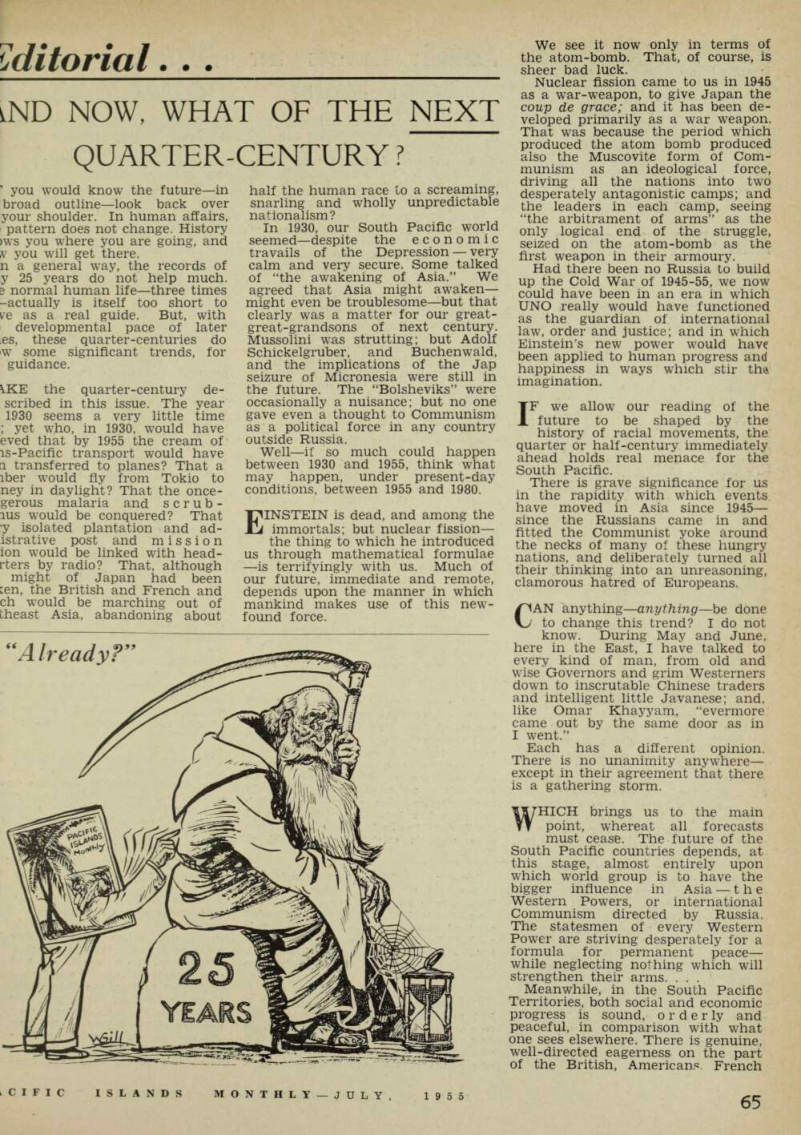
Well—if so much could happen between 1930 and 1955, think what may happen, under present-day conditions, between 1955 and 1980.
T7HNSTEIN is dead, and among the Hi immortals; but nuclear fission— the thing to which he introduced us through mathematical formulae —is terrifyingly with us. Much of our future, immediate and remote, depends upon the manner in which mankind makes use of this new found force.
We see it now only in terms of the atom-bomb. That, of course, is sheer bad luck.
Nuclear fission came to us in 1945 as a war-weapon, to give Japan the coup de grace; and it has been de veloped primarily as a war weapon.
That was because the period which produced the atom bomb produced also the Muscovite form of Com munism as an ideological force, driving all the nations into two desperately antagonistic camps; and the leaders in each camp, seeing “the arbitrament of arms” as the only logical end of the struggle, seized on the atom-bomb as the first weapon in their armoury.
Had there been no Russia to build up the Cold War of 1945-55, we now could have been in an era in which UNO really would have functioned as the guardian of international law, order and justice; and in which Einstein’s new power would have been applied to human progress and happiness in ways which stir tha imagination.
IF we allow our reading of the future to be shaped by the history of racial movements, the quarter or half-century immediately ahead holds real menace for the South Pacific.
There is grave significance for us in the rapidity with which events have moved in Asia since 1945 since the Russians came in and fitted the Communist yoke around the necks of many of these hungry nations, and deliberately turned all their thinking into an unreasoning, clamorous hatred of Europeans.
CAN anything— anything —be done to change this trend? I do not know. During May and June, here in the East, I have talked to every kind of man, from old and wise Governors and grim Westerners down to inscrutable Chinese traders and intelligent little Javanese; and, like Omar Khayyam, “evermore came out by the same door as in I went.”
Each has a different opinion.
There is no unanimity anywhere— except in their agreement that there is a gathering storm.
WHICH brings us to the main point, whereat all forecasts must cease. The future of the South Pacific countries depends, at this stage, almost entirely upon which world group is to have the bigger influence in Asia the Western Powers, or international Communism directed by Russia.
The statesmen of every Western Power are striving desperately for a formula for permanent peace— while neglecting nothing which will strengthen their arms. . . .
Meanwhile, in the South Pacific Territories, both social and economic progress is sound, orde r ly and peaceful, in comparison with what one sees elsewhere. There is genuine, well-directed eagerness on the part of the British, Americans. French
and Dutch to help the intelligent, friendly native peoples of the Islands to an ever-increasing degree of education, local orderliness and self-government.
I think it is in this field that we shall see the greatest progress in the next quarter-century—always provided that our quiet world down here is not invaded by Asiatic migrations, or the clashing ideologies
of West and East.-