The Changing Islanders
pp. 44-51 · Read in the full issue

\ Review By R. W. Robson
Factors which have modified native life
in a quarter of a century.
SOCIOLOGICAL change among the indigenous peoples of the South Pacific Islands during the last 25 years has been considerable and significant: and is closely re lated to political and economic developments.
The most important of these, of course, was the Pacific War of 1941-1945. But there were other events and developments which affected all three communities — European, Asian and native —and if
we take these in their chronological order we are given a fairly accurate picture of what happened to the resident peoples in this quarter cemury.
The Great Depression Because the swing of the economic pendulum, following World War I, was not kept under international control, the boom times of the ’Twenties were followed by the calamitous D e -
pression of the early ’Thirties.
In the ’Twenties, the Islands en joyed huge revenues from copra and most other products, and trade was ex tremely buoyant.
When the crash came, in 1929-30, copra fell to an all-time low, and a semi-paralysis of trade occurred throughout the South Pacific.
This did not affect the natives much in their liv in g conditions — those who had been attached to the European economy simply returned to the native Islanders’ way of life. But Europeans and Asians were desperately hard up for years; there was no surplus money for native education and health: and little advance was made in native sociology.
Depress! on’s effect, however, was cushioned in the South Pacific’s
two most important Territories-!
New Guinea and Fiji—by the de velopment of valuable gold ini dustries. Although a valuable pro duct like copra was at starvation prices, the world’s cock-eyedi economy was clamorous for gold— which promptly was drained away to America and buried in a hole in the ground (Fort Knox) !
Unhealthy Recovery
All Pacific Territories began to enjoy better conditions in the mid 'Thirties, but that economic re-| covery had no healthy basis. It was the result of a demand created by world re-armament this, in its turn, following the appearance of Mussolini and Hitler, and thej formation of the Rome-Berlinl Tokio Axis.
Prices of copra, rubber, coffee, cocoa improved throughout the Islands and trade recovered steadily.
There was increasing money for services to improve native living standards.
In those few years, native life in Polynesia and Micronesia came perceptibly closer to European waysJ In the more primitive Melanesia— especially New Guinea and the Solomons —more and more people made their first contact with Euro peans, and tens of thousands were officially “brought under control.” i This was a time of great missionary activity. The “Christianising” in fluence, exercised from early in the 19th century, was the most definite and consistent factor in bringing the natives along to European standards of life.
It was in this period—the ’Thirties —that Australia discovered she had a magnificent new Territory (the New Guinea Highlands—then described as “a second Kenya”) in her charge;; and that in those great valley systems were hundreds of thousands of natives of a good type, who never had seen a white man. Here was a new task for administrators and missionaries.
There was increasing develop ment and sociological progress, especially in the Southwest Pacific.
But over it all was the uneasy con-j
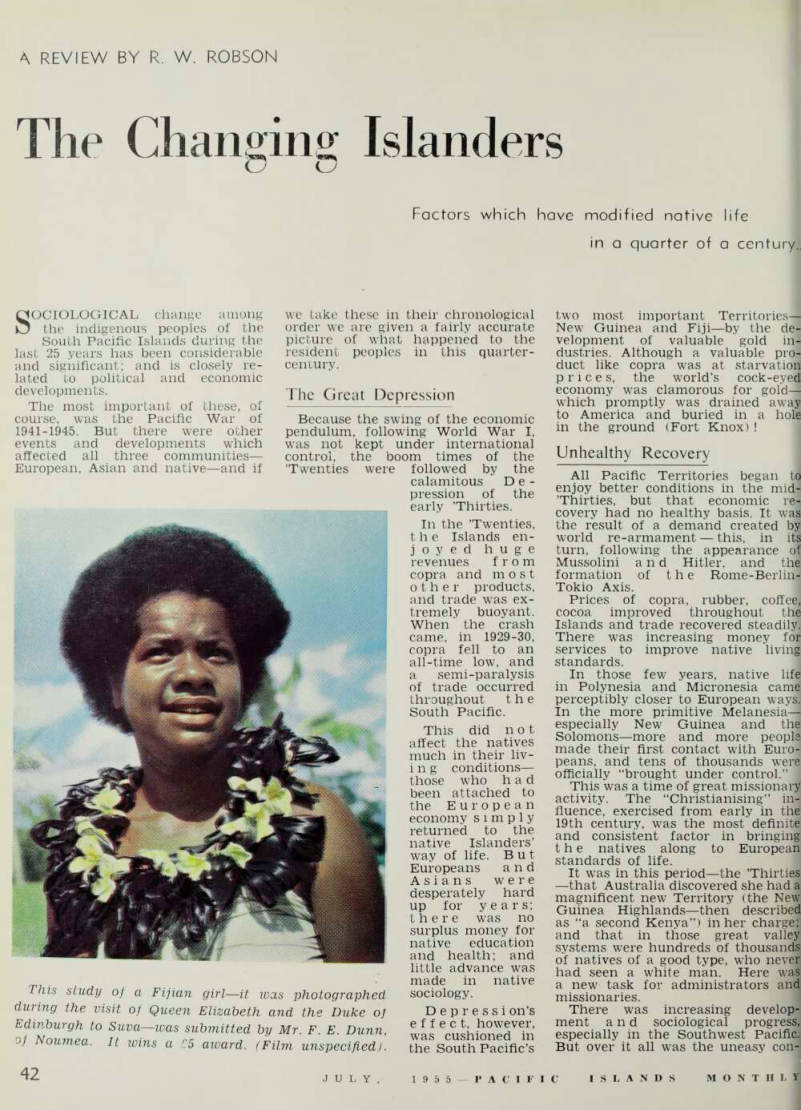
This study of a Fijian girl—it was photographed during the visit of Queen Elizabeth and the Duke of Edinburgh to Suva—was submitted by Mr. F. E. Dunn, of Noumea. It wins a £5 award. (Film unspecified).
iousness of the growing menace Japan. Japanese traders, mine jrkers, shell-poachers, undefined mderers, were all over the South icific Islands.
The outbreak of World War II
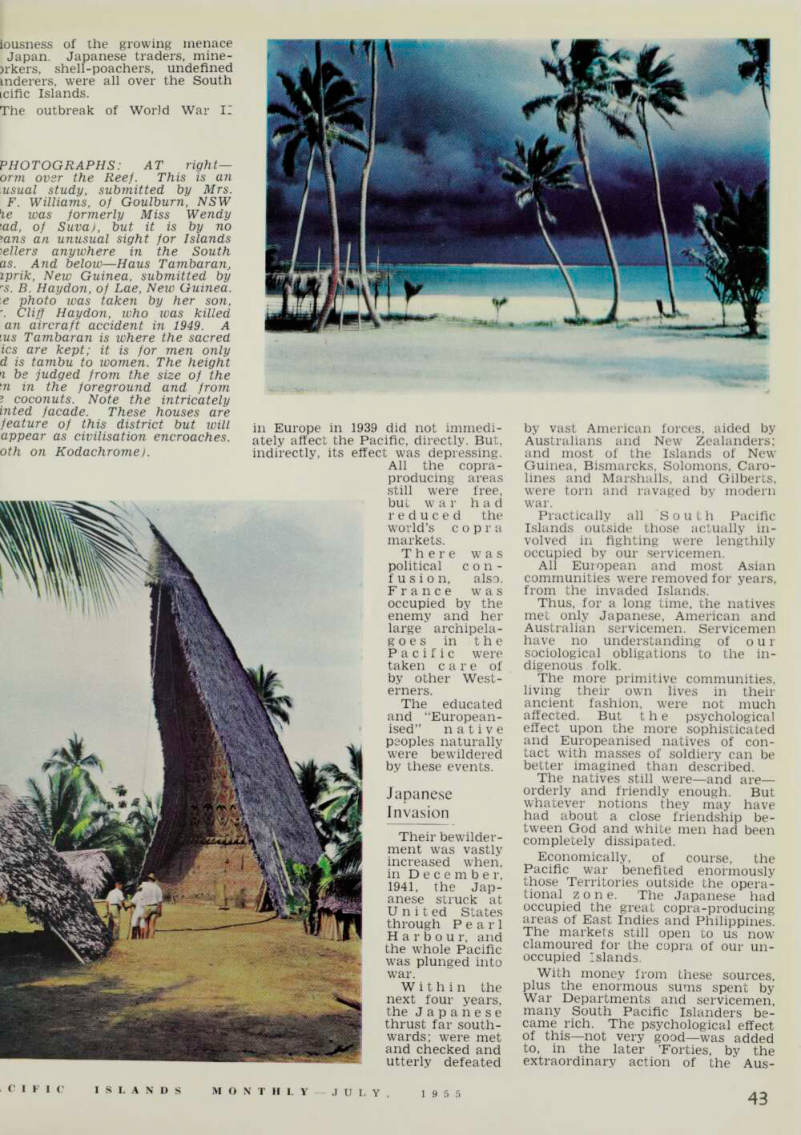
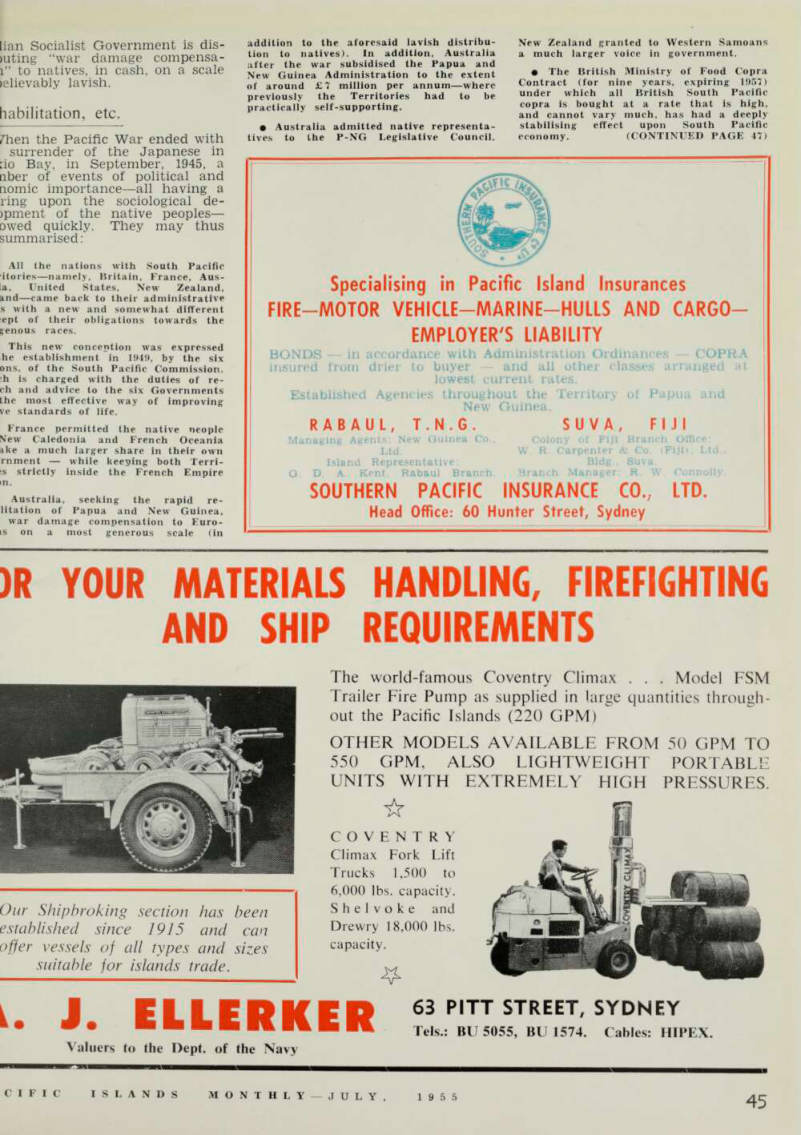
Photographs: At Right—
orvi ovsr the Reef. This is an usual study, submitted by Mrs.
F. Williams, of Goulburn, NSW 'le was formerly Miss Wendy '.ad, of Suva), but it is by no *.ans an unusual sight for Islands lellers anywhere in the South as. And below —Haus Tambaran, iprik, New Guinea, submitted by r s. B. Haydon, of Lae, New Guinea, e photo was taken by her son, Cliff Haydon, who was killed an aircraft accident in 1949. A ms Tambaran is where the sacred ics are kept; it is for men only d is tambu to women. The height n, be judged from the size of the ■n in the foreground and from ’ coconuts. Note the intricately inted facade. These houses are feature of this district but will appear as civilisation encroaches, oth on Kodachrome).
in Europe in 1939 did not immedi ately affect the Pacific, directly. But, indirectly, its effect was depressing.
All the copra producing areas still were free, but war had reduced the world’s copra markets.
There was political con fusion, also.
France was occupied by the enemy and her large archipela goes in the Pacific were taken care of by other West erners.
The educated and “European ised” native peoples naturally were bewildered by these events.
Japanese
Invasion
Their bewilder ment was vastly increased when, in December, 1941, the Jap anese struck at Uni t ed States through Pearl Harbour, and the whole Pacific was plunged into war.
Within the next four years, the Japanese thrust far south wards; were met and checked and utterly defeated
by vast American forces, aided by Australians and New Zealanders: and most of the Islands of New Guinea, Bismarcks, Solomons, Caro lines and Marshalls, and Gilberts, were torn and ravaged by modern war.
Practically all South Pacific Islands outside those actually in volved in fighting were lengthily occupied by our servicemen.
All European and most Asian communities were removed for years, from the invaded Islands.
Thus, for a long time, the natives met only Japanese, American and Australian servicemen. Servicemen have no understanding of our sociological obligations to the in digenous folk.
The more primitive communities, living their own lives in their ancient fashion, were not much affected. But the psychological effect upon the more sophisticated and Europeanised natives of con tact with masses of soldiery can be better imagined than described.
The natives still were—and are— orderly and friendly enough. But whatever notions they may have had about a close friendship be tween God and white men had been completely dissipated.
Economically, of course, the Pacific war benefited enormously those Territories outside the opera tional zone. The Japanese had occupied the great copra-producing areas of East Indies and Philippines.
The markets still open to us now clamoured for the copra of our un occupied Islands.
With money from these sources, plus the enormous sums spent by War Departments and servicemen, many South Pacific Islanders be came rich. The psychological effect of this—not very good—was added to, in the later ’Forties, by the extraordinary action of the Aus
lian Socialist Government is dis
>uting “war damage compensa
i“ to natives, in cash, on a scale
»elievably lavish.
habitation, etc.
/■hen the Pacific War ended with surrender of the Japanese in
:io Bay, in September, 1945, a
nber of events of political and
nomic importance—all having a
ring upon the sociological de )pment of the native peoples—
owed quickly. They may thus
summarised: All the nations with South Pacific ■itories —namely, Britain, France, Aus ia, United States, New Zealand, and —came back to their administrative s with a new and somewhat different ept of their obligations towards the venous races.
This new conception was expressed he establishment in 1949, by the six ons, of the South Pacific Commission. ;h is charged with the duties of re ch and advice to the six Governments the most effective way of improving ve standards of life.
France permitted the native neople New Caledonia and French Oceania ike a much larger share in their own rnment while keeping both Terri !S strictly inside the French Empire m.
Australia, seeking the rapid re litation of Papua and New Guinea, war damage compensation to Euro is on a most generous scale (in
addition to the aforesaid lavish distribution to natives). In addition, Australia after the war subsidised the Papua and New Guinea Administration to the extent of around £7 million per annum—where previously the Territories had to be
practically self-supporting.
• Australia admitted native representatives to the P-NG Legislative Council,
New Zealand granted to Western Samoans a much larger voice in government, * , „ , „ • T^e British Ministry of Food Copra Contract (for nine years, expiring 1057) under which all British South Pacific copra is bought at a rate that is high, and cannot vary much, has had a deeply stabilising effect upon South Pacific
economy.
(Continued Page 47)
> Far-reaching political changes in lonesia and Indo-China have cut off an labour to New Caledonia and New brides, increasing the demand for tive labour. > There has been no economic develop nt worth noting in the British Terri ies of Solomons and Gilbert and Ellice list as well, perhaps, because native rale in Solomons was much affected er the war by an anti-European arching Rule” movement, and the ives are still not disposed to offer dily for service. i Because of the extraordinary post ' development of air transport, ship g communications with all the Islands e been greatly changed, and trans lation taken on a new aspect. The t that a plane can travel from Fiji New Guinea to Sydney in a few hours, ;re a ship took a week, affects Euro ns directly much more than natives. in numerous indirect ways it has tearing upon native life and outlook.
The visit of the world’s greatest larch. Queen Elizabeth 11. to the South ific in 1953-4, was far more than a ctacuiar event. She was seen by usands of Fijians and Tongans, and selected parties of Polynesians ami ua-New Guinea natives. The effect that happy occasion upon the native d, is beyond computation.
)gress—But Under a Cloud
luropean policy generally since
5 has been directed to a great
nulation of all factors which may
regarded as likely to assist the
ives towards self-government
I independence.
Natives generally—and especially those of the Central and Eastern archipelagoes—have reacted favour ably. One would say that, compared with 25 years ago, there is greater friendliness towards Europeans, and a much more intelligent apprecia tion of what Europeans are trying to do for the Islands communities.
There has been, simultaneously, a marked increase in the extent and quality of the educational and medical services given to the native communities by the numerous —in some ways, too numerous—Christian Missions.
There is a much better liaison now between Administrations and Missions. This is important be cause, as the Governments develop their politico-economic plans for the better education and technical training and medical care of the natives, they are liable to get their numerous instrumentalities tangled with those of the Missions.
But, just as in the later ’Thirties, the sociological progress in the South Pacific in the ’Fifties is com ing under an international cloud.
Then, it was the creeping menace of Japan. Now, it is the steadily in creasing threat of a restless Asia, profoundly influenced by Commun ism and encouraged to look for ex pansion towards the rich, desirable, undeveloped countries of the South Pacific.
Unless something happens soon to
check this terrifying new thing in Southeast Asia, all political, economic and sociological plans and progress in the South Pacific will be subverted to the paramount needs of defence.
Asian Communities in Pacific This threat from Asia necessarily directs attention to another factor which affects all sociological plan ning for South Pacific natives. This is the establishment of influential and tenacious Asian communities in the South Pacific Islands. Here they are: In New Guinea. —A small Chinese community of some 3,000, descend ants of Chinese labourers introduced by the Germans. Traders and artisans In Solomons —A small but steadily growing Chinese community, en gaged mostly in trading.
In N. Caledonia and TV. Hebrides —lmportant remnants of Javanese and Tonkinese labourers, not re patriated in 1940-45 because of war conditions, now have established small communities of traders and artisans, and tend to increase.
In Fiji —A large and important community of about 160,000 Indians (compared with 143,000 Fijians) now is a factor of great importance in the present and future Fiji. There is also a community of 4.000
Chinese.
(Continued Page 49)
[?] fisherman casts his net —a study from Tahiti.
(Continued from page 47)
In Tahiti A close-knit corn unity of 10,000 Chinese is an im >rtarit factor in the life of this jrritory.
The most superficial observer may e that the existence of these Asian mmunities in these Territories ust in time influence very much e future life of the natives.
The European communities are t markedly increasing in numbers id, in due course, they will tend disappear. But the Asians are ere for all time; their hold on e Territories’ commercial life is m and increasing: and their jwpoint and their ambitions must ect all future planning in relation the indigenous peoples. [n this review, one should mention e case of Western Samoa. As in iw Guinea, the Germans intro ced a large corps of Chinese >ourers to Samoa. When New aland took over in World War I, 3 Chinese were allowed to stay, d most of them took Samoan . v e s. The Chinese-Polynesian >ss is an excellent one, and the tie Chinese-Samoan community ild be described as desirable. But ien the NZ Socialists got control government in 1935, they decided it the Chinese community was a ;ial and economic menace to moa, and almost all Chinese were
shipped away. Except for a Euro pean-Samoan community of about 4,000 (in a total population of 80,000) Samoa now is the only large South Pacific country to-day without foreign implantation.
make a colour sound-film record of the London Missionary Society’s work in the Gilbert and Ellice Islands, Samoa and Tonga. He will travel from Suva to the Gilberts in the society’s 400-tons supply ship, John Williams VI.