In South Pacific Industries
pp. 36-64 · Read in the full issue
The Last Quarter-Century
Has Seen
Depression, Total War And Boom
In South Pacific Industries
The price of copra has been the barometer of Pacific Islands prosperity in the last 25 years although the economy of all Pacific Islands is by no means based on copra.
JN Fiji since 1890, sugar has been far ahead as the most lucrative of that Colony’s exports; from the mid-30 s, gold has been second in importance. In New Guinea, from the early 30’s, gold took the lead, amounting late in that decade to two-thirds total export value This lead was not relinquished until 1948-49. when boom-price copra from plantations recovering from war damage and neglect, sent that commodity ahead.
Such groups as the Cook Islands depend on fruit and pearl shell.
Nonetheless, when copra prices tin ?£S in th e Islands are booms 6 times are ‘‘s-ood .i'* 7 * 1611 copra Dooms, nmes are good.
s P° trade in native copra JUS.,* 011 ha s gone on for several man y a trader had the cookm g ovens—before SJou^l n J cc ? Coun t Plantations were established m the Pacific Islands Fiji, cotton-planters who had been completed annihilated by ibnfpH aStroUS . slum P of the 70’s, SLd for“otfon ° n d prevlousl y In New Guinea, the first com mercia! plantation was established S mq ™ ?mma (Mrs. Forsayth) tbp lB7 ?* ?- n land she bought from Koknn? at f VOS near Present-day Kokopo for some umbrellas and °° c klng - glasso s. However, labour was a considerable problem in untamed New Britain, and ? was not until the 90’s that much actual planting was accomplished. wSih t w outb reak of the First World War, over 77,700 acres of coconuts had been planted in -German New Guinea
In 1860, the German firm of Godeffroy owned 25,000 acres of land in Samoa and their agent there was industriously preparing to plant coconuts and cotton.
It was during this period, and up until the end of the First War, that coconuts acquired their reputa tion as money-spinners. “Consols of the East”, they were called.
Another unwise saw was to the effect that if you took care of a coconut for the first seven years of its life, it would take care of vou for the rest of yours.
Certainly, copra had its ups and downs during that period but no real disaster struck until the Depression of the 1930’5.
Towards the end of the First War, copra reached a record high price which, in terms of real money has not yet been passed.
After the First War, the New Zealand Government took over former German plantations in Samoa (Reparation Estates); and German plantations in New Guinea were acquired by the Expropriation Board and later disposed of by them to returned World War I servicemen.
Copra prices in the 20’s remained profitable and planters were prosperous. There was some extension of pre-war plantings.
The Wall Street debacle that triggered the world Depression occurred in 1929, but it was several years before the real effect was felt in the Pacific planting world; unfortunately it then became a prolonged agony lasting years.
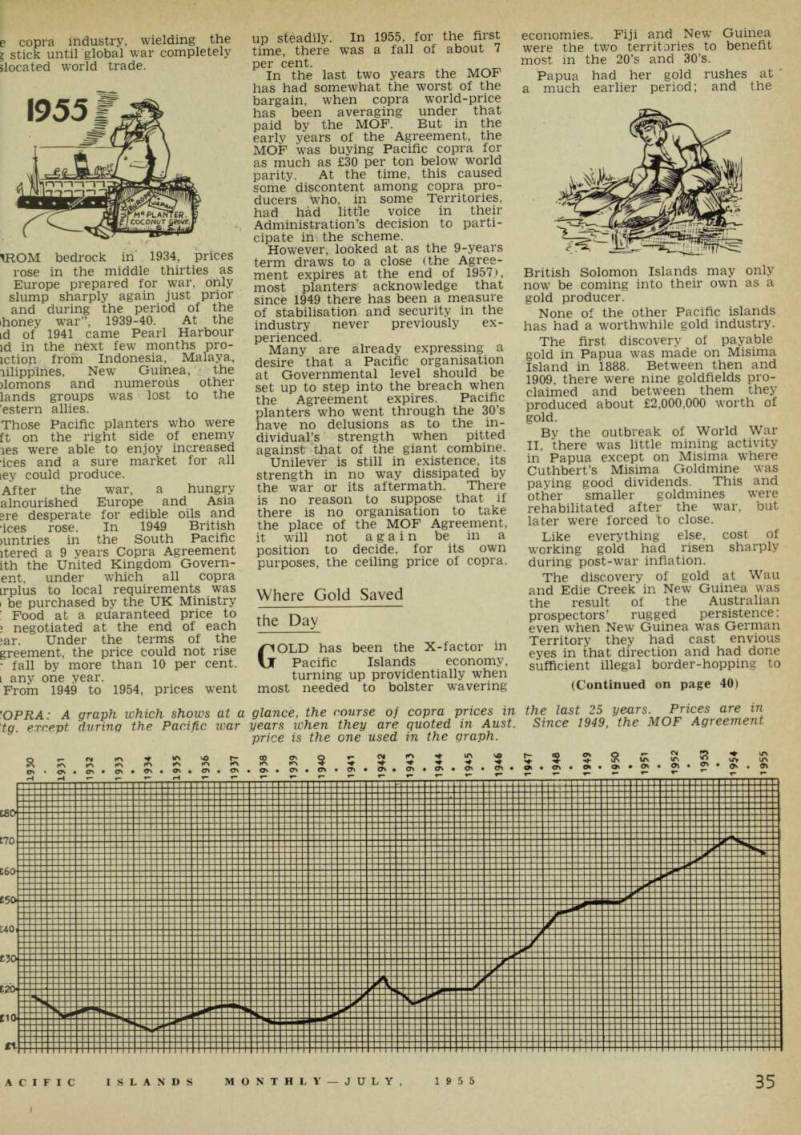
A glance at the graph will show that copra did not reach bedrock until 1934, when on several occasions it was under £8 cif London. The plight of planters at this period was dire indeed.
This was a period, too, when an incredible number of experiments were undertaken by governments m a vain attempt to get out of their financial troubles.
Britain went off the gold standard: America buried gold in the ground. Ferocious import taxes were clapped on overnight; some currencies were devalued. Pro
ducer countries dropped export tax m New Guinea a moratorium temporarily suspended payment o principal and interest for purchaser of Expro. Board plantations.
But nothing seemed to help th copra industry to regain its feel Many many articles were writtei suggesting “alternative crop s’copra was suggested as a pig food and Is coconut oil any good as s motor-fuel?” pim asked at om time. At another it was suggestec it might be used as a moto] lubricant.
Whale oil, biggest rival o coconut oil. was over-produced- s< was soya bean oil, peanut oil anc every other vegetable oil. Bui over and above all this, there wai another factor. “The monstrous Unilever combine,” FIM called it in January, 1933.
To assist Empire copra producers the British government had a few months previously imposed a 10 per cent, import tax on foreign copra. Unilever was little concerned about that—it bought copra where it liked and processed it in Continental mills.
“Unilever can snap its fingers at the British Government, copra growers and everyone else”, we said in 1933, “It is well-known that when this monstrous, soul-less combine was formed it closed scores of British crushing mills in order that, for its own profit making purposes, it might send its copra to the various Continental mills which it controls. Previously a large proportion of Empire copra went to the British mills . . , the only way this thing can be controlled is by inter-governmental action, and that is not likely before the ruin of the coconut planting industry . .
Fighting words, certainly; but Unilever continued to sit on top of
e copra industry, wielding the I stick until global war completely slocated world trade.
IROM bedrock in 1934, prices rose in the middle thirties as Europe prepared for war, only slump sharply again just prior and during the period of the ihoney war”, 1939-40. At the id of 1941 came Pearl Harbour id in the next few months pro ictiop from Indonesia, Malaya, lilippines, New Guinea, the ilomons and numerous other lands groups was lost to the ’estern allies.
Those Pacific planters who were ft on the right side of enemy les were able to enjoy increased ■ices and a sure market for all icy could produce.
After the war, a hungry alnourished Europe and Asia sre desperate for edible oils and •ices rose. In 1949 British luntries in the South Pacific itered a 9 years Copra Agreement ith the United Kingdom Govern ent, under which all copra irplus to local requirements was i be purchased by the UK Ministry : Food at a guaranteed price to ; negotiated at the end of each ;ar. Under the terms of the greement, the price could not rise • fall by more than 10 per cent, i any one year.
From 1949 to 1954, prices went
up steadily. In 1955. for the first time, there was a fall of about 7 per cent.
In the last two years the MOF has had somewhat the worst of the bargain, when copra world-price has been averaging under that paid by the MOF. But in the early years of the Agreement, the MOF was buying Pacific copra for as much as £3O per ton below world parity. At the time, this caused some discontent among copra pro ducers who, in some Territories, had had little voice in their Administration’s decision to parti cipate in the scheme.
However, looked at as the 9-years term draws to a close (the Agree ment expires at the end of 1957), most planters acknowledge that since 1949 there has been a measure of stabilisation and security in the industry never previously ex
perienced.
Many are already expressing a desire that a Pacific organisation at Governmental level should be set up to step into the breach when the Agreement expires. Pacific planters who went through the 30’s have no delusions as to the in dividual’s strength when pitted against that of the giant combine.
Unilever is still in existence, its strength in no way dissipated by the war or its aftermath. There is no reason to suppose that if there is no organisation to take the place of the MOF Agreement, it will not again be in a position to decide, for its own purposes, the ceiling price of copra.
Where Gold Saved
the Day
GOLD has been the X-factor in Pacific Islands economy, turning up providentially when most needed to bolster wavering
economies. Fiji and New Guinea were the two territories to benefit most in the 20’s and 30’s.
Papua had her gold rushes at * a much earlier period; and the
British Solomon Islands may only now be coming into their own as a gold producer.
None of the other Pacific islands has had a worthwhile gold industry.
The first discovery of payable gold in Papua was made on Misima Island in 1888. Between then and 1909. there were nine goldfields pro claimed and between them they produced about £2,000,000 worth of gold.
By the outbreak of World War 11. there was little mining activity in Papua except on Misima where Cuthbert’s Misima Goldmine was paying good dividends. This and other smaller goldmines were rehabilitated after the war. but later were forced to close.
Like everything else, cost of working gold had risen sharply during post-war inflation.
The discovery of gold at Wau and Edie Creek in New Guinea was the result of the Australian prospectors’ rugged persistence: even when New Guinea was German Territorv they had cast envious eyes in that direction and had done sufficient illegal border-hopping to
(Continued on page 40)
[?]OPRA: A graph which shows at a glance, the course of copra prices in the last 25 years. Prices are in [?]tg except during the Pacific war years when they are quoted in Aust. Since 1949, the MOF Agreement price is the one used in the graph.
have an adequate idea where to head when Australia took over that territory. (A few Australian prospectors had been allowed on the Waria River by the Germans), The most-persistent border hoppers were Matt Crowe, Arthur Darling and W. (Sharkeye) Park who were continually investigating the Morobe ranges before 1914 and being chased out again by the Germans. Darling is believed to have found Koranga Creek (near Wau) during this period: Sharkeye Park located it again at the end of 1921, and the Morobe Goldfield was born.
The fantastically rich find at Edie Creek (altitude 6,500 ft) was made in February, 1926 by W. G.
Royal and R. M. Glasson. The development of the Morobe Gold field and the leases of the Bulolo Gold Dredging Company a few miles further down the Bulolo Valley, was completely interwoven with the establishment of air trans port services from the coast to the goldfields. A full account of this appears in the special article, “The Air-Minded Pacific”, elsewhere in this issue.
The first dredge at Bulolo began work in early 1932 and by 1941 seven others were also operating.
BGD was, however, by no means
the only big company operating in the area. New Guinea Goldfields, formed in 1929, began to acquire most of the available leases in the Upper Bulolo, Koranga Creek and Edie Creek. By 1935 this company had its issued capital at £4,500,000, but although undertaking valuable pioneering and development work did not recover gold in sufficient quantities to pay a worth-while dividend on this capital. Early in 1935 it wrote down its capital by 75 per cent. It is, of course, still carrying on operations near Wau.
In this period scores of mining companies sprang up in New Guinea; many of them disappeared during the war. Guinea Gold, Enterprise, Koranga Sandy Creek, Sunshine are some that are still in existence.
In addition there were on Morobe scores of individual miners who later in the thirties, turned their attention to other fields—the Sepik, the Ramu and the Aitape-Wewak hinterland.
Gold began to add substantially to New Guinea’s export income from 1927, and in 1940 accounted for £3,021,731. At the outbreak of the Pacific war, a scorched-earth policy was rigorously applied in Wau and Bulolo, with the result that when production began after
the war, whole towns had to be ex P ensi ve mining equip ment, hydro-electric schemes etc. replaced entirely.
Costs had risen and only the vived su^s^an^ companies sur- BGD and NGG are still the biggest operators on the held—bul Bulolo has only 3 dredges now operating, and calculates that the * a ®,k I dredge will close down in 1959 ~T hls company has joined with the Commonwealth Government m a £2 million company to exploit th e magnificent forests of Klinki and Hoop pine around the Bulolo area and in the setting up of a plywood factory that manufactures a superior product, mostly for the American market.
New Guinea Goldfields also are interested in timber as well as in their several gold mining properties.
The individual miner and prospector has become almost as
(Continued on page 51)
re as the dodo. Many of them ill live at Wau, or along the war ne-built road to Lae, or in the ighlands, growing cattle, cabbages, ffee, kau-kau, peanuts, vegetables id flowers.
IHE first gold to be discovered in Fiji was at Mount Kasi in Vanua Levu in 1929; and in 32 an old prospector, Bill irthwick, staked by Mr. Pat istello, found gold in the scrub vered hills of northern Viti Levu, iis latter discovery led to estab hment of the rich gold mines of loma, Emperor and Dolphin.
During the gold boom in Fiji, 20 ars ago, shares in mines and ;n in options on leases, soared to traordinary prices. But the Tavua Id was as limited as it was rich d hard to work, and by 1936 it d been left to the E. G. Theodore crests to develop the area on the ge scale that was required.
Dold exports from Fiji topped ; million £ mark in 1939, fell during the war and were back the million £ bracket in 1947.
Carly this year it was indicated it Loloma is almost worked out i interest now centres on new ias being tested on Emperor’s item boundary and the three irs programme of exploration iertaken by the three companies.
At. Kasi, after producing well in i 30’s, closed down in 1943.
OLD was worked in the Solomons for many years before the war, mostly on Guadalcanal, i mostly around Gold Ridge ich has figured largely in BSIP airs in recent months.
Jenerally, it was found un nomic to work and a great deal time has been expended in king the mother lode—which ; not discovered until this year.
Tiis is recent history—and so as BSIP is concerned, Guadal ial gold could be a new story bead of a closed chapter as in st other territories. A full ount of progress has been pub ied in recent issues of PIM.
'he Theodore interests from . interested themselves in Gold ge before the war, but active ipaigning in the vicinity put an . to that in 1942. The same ‘rests were prepared to recom ice after the war had not irictive legislation make it an iractical proposition. This too, incient history. i recent years the BSIP govern it has had a change of heart is now sponsoring and actively ouraging private enterprise to jme interested in mining and specting in the Protectorate. •old has been found in New edonia, but that extraordinarily icralised country has concen ;ed on other metals, building an
economy that depends almost wholly on the exploitation of the large deposits of nickel and chrome.
Apart from these minerals there are also large deposits of man ganese, cobalt, iron and copper and smaller deposits of many other minerals.
In the 30’s, Japan secured con cessions for working New Cale donian iron but the war put an end to this. For years, it has been suggested that Australia should interest herself in Caledonia's iron deposits, but although negotiations were many they always broke down —until 1955. A scheme is now under way to sell shipments of ore to the Broken Hill Proprietary of
Nsw.
In Fiji, since the war, there has been considerable interest in manganese, but this mining has been in a small way and it has not yet made much impact on the economic life of the Colony.
Oil Search is Costly,
the Prize Rich
SEARCH for petroleum in the Pacific has been concentrated in Papua and New Guinea (so far unsuccessfully) and in Dutch New Guinea (successfully).
Indications of oil have been found in the Gulf region of Papua since last century, and in the first 30 years of this century, the Australian government encouraged, with a subsidy, any who would engage in the search. This aid ended in 1930 —possibly due to the Depression. Three large companies were left in the field —Papuan Oil Development (Shell); Island Ex
search?" representing m) Aus n t?aii?n
interests, By 1938, most of the above, plus D’Arcv Exploration of London (Anglo-Persian), were as- SO ciated in Australasian Petroleum Co pty Ltd which has carried on the bu i k of exploration since.
(Continued on Page 52) 6
Deep drilling on a a large scale was being undertaken before thej war, and since the war this company has become even mo~e heavily involved. About £l4 million has been sunk by this company in oil exploration in Papua, up to date; and deep drilling to depths of up to 2i miles has been per formed—all, so far, without positive result, although residents of Papua still speak of “when oil is struck’' —not “if.”
Every modern aid to oil search has been enlisted, no money or h as , been spared, and the V -5 as * eft . no roorn to doubt that if there is oil in Papua, it will eventually find it.
Price of Oil Search shares has been the barometer of public interest in Papuan oil search. This company, which now has a minority holding in APC, is the only one open to direct public investment.
For years the shares were around 2/-;. two years ago, after an oil drill stuck at 13,743 feet, in the Omati No. 1 hole following indica tions of gas pressure, the shares began to rise and in July, 1954 were 32/-. It took well over a year for the company to get back to work on Omati No. 1, then the hole was deepened in mid-April, 1955 to the possible limit, over 14,000 feet —and. alas, abandoned. The gas pressure of two years before had apparently meant nothing.
It was the luck of the game-j but Oil Search shares were down to 9/- at the end of May, 1955.
As the larger companies have poured more capital into APC, Oil Search’s holding has become a very minor one. There has been no indication from APC as to the stage at which they consider oil search in the Territory is no longer worthwhile. In the meantime, they are spending at the rate of £2 million per year. The prize, if found, will be great—and not the least to benefit will be the Territory of Papua which will receive substantial royalties.
Other oil-search companies are also operating in P-NG. Papuan Apinaipi has recently been granted a prospecting area of 8,600 miles in Papua. Enterprise of New Guinea is engaged on prospecting in an area in the Sepik River district. ] Since the war, the Dutch have discovered and developed oil wells some hundred miles to the northH westward of where APC are drilling. They are producing and exporting about 750,000 tons of oil per annum. They spent millions on search and about £l2 millions on development after oil was disj covered, in 1938. The war and post-war political difficulties inj tervened and the first crude oil was sent to Victoria for refining only inj 1949.
Production of oil in DNG has caused Papua to hope that petroleum will be found in that Territory, too —although the Dutch
ells are near Sorong at the far estern point of Dutch territory. 3me Stake All in ocoa—Some in Rubber N the early thirties, cocoa and rubber prices did not engage in the erratic up-and-down course iat was pursued by copra. It can ; said, rather, that prices were liformly poor until the mid and te 30’s, when they began the ward trend that produces the aks on the graphs. (Pages 54, 59).
Other than that, of course, there not much similarity between the r o products.
Virtually, all of the rubber pro iced in the South Pacific comes iw from Papua, although at one riod Fiji entered the field and in 26 reached peak exports with 3,990 lbs.
Fiji export was revived during the icific war when the Japs had er-run Malaya and rubber was a •ategic material in very short pply. However, Fiji’s rubber lands ■day present a very sorry spectacle, d are virtually abandoned.
Rubber is Papua’s chief export— st rubber planting going back to )3. This was on the Sogeri plateau imtry behind Port Moresby, which
is still the chief rubber-growing area. By the 20’s rubber planting was well established both there and in the N-E of the territory, about 900 tons per annum being exported.
In spite of widely fluctuating prices, considerable planting was under taken in the 20’s and 30’s and Aus tralian Government assistance after much pressure permitted
rubber producers to weather the De pression better than those whose fortunes were tied up in copra.
Australia has always been Papua’s
only rubber market and although it entered free of import duty until 1933, the somewhat unusual step was taken then of imposing duty
in order to help the Papuan in dustry. The 4d per lb duty (later reduced to 2d) was collected by.
Australian Customs and paid back: to producers in Papua.
During the war, many rubber-: plantations had to be abandoned* but some were kept in production] by a special defence unit, all prices, *, of course, being “fixed.” After the; war, the price of rubber did not; rise spectacularly like copra andJ cocoa—synthetic rubber had beer* developed during the war andJ thenceforth was virtually to imposed a ceiling price on the natural pro-i
duct.
(Continued on page 59)|
RUBBER: The fortunes of rubber planters rose and fell between 1930-55 with the graph above. Price per lb (shown left) is London price.
Rubber’s post-war boom began ir the outbreak of the Korea war the intensification of the Com list Cold War when the Western ions started vigorously to stock strategic materials, rices reached their peak in 1951 7 to slump drastically again in two years following. In 1953 part of 1954 prices for Papuan ber had again slumped below of production for many planta s and the industry asked again assistance from the Common -Ith. ivestigation into whether the imonwealth should or should not ough the Australian Tariff
Board) was protracted to such an extent that rubber had time to rise and fall several times.
The Board’s report has not yet been released.
COCOA was planted in Western Samoa by the Germans and when New Zealand took over German plantations in that Terri tory the industry was already
COCOA: The above graph shows clearly the fluctuating fortunes of cocoa in the period under review. Price per ton (Australian currency) shown in left column.
established. As can be seen by the graph, cocoa created no wealthy planters during the thirties and apart from a brief rise in 1937, did not begin to be a real money spinner until 1946-47. Then, except for a brief recession in 1949, prices rose in spectacular fashion reaching their peak at about £673 Australian during 1954.
In the last six months, prices have fallen steeply to more reasonable levels and this is regarded as a healthy sign rather than as a re verse.
There had been considerable planting of cocoa in New Guinea before 1942, mostly interplanted with coconuts. But these plantings were wiped out during the war. Soon after the war, however, a cocoa planting fever commenced in the Territory and has gone on steadily ever since in Bougainville, New Britain, New Ireland and in the Markham Valley. Some of this cocoa is now coming into production and swelling the incomes of the most far-sighted planters—many of whom are already doing exceedingly well from copra. A post-war interest in cocoa growing has also manifested itself in Fiji, the British Solomons and elsewhere in the Pacific.
The Western Samoa cocoa boom has brought great wealth to that Territory and has substantially aided the Samoans’ march towards political independence.
Pacific Shell Buttons the World’s Shirts THE Pacific trochus industry has not followed the same pattern as most other commodities, its depression coming after the war,
rather than before.
Trochus, a cone-shaped shell, it used for the manufacture of pear, buttons, the button blanks being cuj in an ingenious spiral around th. shell. Before the war, the buttox business was centred in Japan amt in the central European countri© such as Czecho-Slovakia. Post-was
nbles prevented the quick re nption of the industry and hence » slump in trochus prices, fhe most spectacular rise has ;n since 1952—which coincides re or less, with the time Jap ling vessels once again started to ,m the Pacific. In May, 1955, the ce of trochus reached £A435 per —the result, according to some, of ! fact that Japan is poaching >ut three-quarters of her trochus uirements and does not care what i pays for the remainder, n 1953 a button factory was set at Levuka, Fiji. This uses local chus —much of it purchased be b the rise in price of shell. This tory in early 1955 was doing well; high prices persist, however, it y in time have some difficulties h Japanese competition.
i’s £7,000,000 Sugar
ome (GAR has sweetened the Fiji economy for so long now, it has come to be accepted, simply as accepts the scenery, b other South Pacific territory a sugar industry—not because ar will not grow in other terri es, but because of the delicate ince of world sugar markets, le of the best sugar-cane breed material has been found in the i cane of Papua and New nea. agar milling in Fiji is now in hands of one company—the mial Sugar Refining Company; sugar-cane growing is practic al! in the hands of Fiji-Indian int farmers. The sugar in try, directly or indirectly sup ;s the Indian community of the >ny; and the Indians support the ir industry. The two make up integral parts of the whole.
Bcause of this, sugar in Fiji has :imes become not so much an istry, as a red-hot political issue, ar planting began in Fiji in the ’s and indentured Indians were ight in to work the sugar fields the mills. In 1916 the system adenture ceased; there followed ?riod of some difficulty and re alisation, then the Indians ed in as tenant farmers and by it was calculated that 95 per . of the cane supplied to the !>’s five mills was grown by ans. le industry was peaceful enough I 1943, when at a time calculated lisrupt Fiji’s all-out war effort, Indian mill-workers and growers ed a strike for higher rates, mg the ensuing troubles, which ' protracted, some canefields i burned; some farmers refused »lant others. These incidents, wing as they did the Indian munity’s total failure to engage le Colony’s war effort, infuriated Fijian and European commun and was the cause of much
anti-Indian feeling for years.
The farmers themselves are, in the majority, industrious and good agriculturists and left to themselves would have caused no trouble. But the post-war period was one of rest less nationalism everywhere, and there is a class of Fijian-Indian who is a natural political agitator and trouble-maker. Most of the trouble can be laid at the door of this minority.
In the last few years, political troubles appear to have died down.
Under an agreement between the CSR Co., and the Indian cane farm ers, the price paid for cane rises and falls in proportion to the rise and fall in the price of raw sugar.
In this way, the farmers have shared in the post-war price rises
and at the same time the industry has been stabilised for them by the fact that Fiji is a partner in the Commonwealth sugar agreement under which Empire sugar produc ing countries are assured of a market for a large proportion of their crop. The price is negotiated each year in London.
In 1953, the value of Fiji’s sugar exports was £7,706.000. In the best pre-war year (1935) it was £1,314,000.
Fruit, Farming and
The Future
THE Islands fruit industry— supplying of oranges, bananas, pineapples and winter tomatoes
to the insatiable New Zealanc market—has had its Depression woes and post-war difficulties. Thii trade is in the hands of native growers in Fiji, Cook Islands Tonga, Niue and W. Samoa ano. although there have been no native millionaires as a result of it, it is a,u present, producing an adequate lin ing for thousands of these people 1 Since the war a new class o European farmer has emerged in the Pacific islands, particularly ir Papua and New Guinea. He ii not the rich planter, but £ prosperous grower of cattle, tables, corn, other farm products peanuts and coffee.
So far this class of Islandi resident has made little impact on the export income of his he is providing the binding materia* for an overall, integrated Islands! economy.
As well as progress in primarr production, secondary industries havr also been established since 193® Two giant coconut oil extracting mills have been built by the Wv R. Carpenter interests at Rabaus. and Suva —the latter also manu-j facturing margarine. Biscuit ano soap factories are well establisheo in Suva.
In the Aird Hills district ot Papua, a factory for the extraction of tanning and dyeing materials! from mangrove bark has been se? up. In the Bulolo valley, the huge plywood mill of CommonwealtH New Guinea timbers is in pro]( duction.
Sawmills are doing boom business all over the P-NG Territory in the Solomons, and Fiji. In the Highii lands of New Guinea, a passion-i fruit pulping factory is processing fruit for an Australian cordial manufacturer.
Retail trade, with more spending money in the pockets of native peoples and non-indigenous alike is booming as never before, until at this writing, in mid-1955, it can be said that the Pacific Islands world was never more prosperous. I The last Quarter-Century hasj brought extraordinary changes to the Islands, particularly in the waj in which the native people themJj selves now are working alongside the Europeans as planters ano producers on their own account Even the primitive New Guinea; highlander is a grower of the Irish spud, or of passionfruit, or some-n times is a coffee-planter. Fijiansi produce the bulk of their country’s copra and New Britain natives have gone into cocoa in a big way Depression, war and post-walj boom —all have occurred during these last 25 years. The first twe are gone; the third is still with us, What will the next quarter-century bring? Good and bad, that »i certain. But whether we emergf at the end of 1980, in the same happy condition as we find our+ selves today is something that no canny person would like to predict in these uncertain times.