The Air-Minded Pacific
pp. 28-159 · Read in the full issue
Diminishing Distance In
From Southern Cross to Super Constellation
Aquarter-C Ent U R Y Has
brought a transportation revolu tion to the Islands world. No longer can the South Seas be re garded as a dreamy backwater where time is regulated to the slow move ment of the Islands schooner.
The impractical find something to regret in this—but the Islands resident is definite on the subject.
He likes to be within easy reach of an international airline that can, when it is necessary, have him in civilisation in a matter of hours. He has no desire to turn back the clock.
Twenty-five years ago, aeroplanes were still more akin to the box kite than to the streamlined giants that now ply the skyways at over 300 miles per hour. But the real start of the Pacific air age was a few years before the first PIM appeared—about 1927.
In July, that year, Charles Kings ford Smith and Charles Ulm left Australia for America with what most people regarded as the crazy idea that the Pacific could be flown from America to Australia. A few months before this, a plane had made its first flight in New Guinea —from Lae on the coast, to Wau, about 40 miles inland.
The two events were quite un related but they were the begin ning of aviation in the South Seas.
Kingsford Smith and Ulm spent 10 months in the United States pre paring for their trans-Paciflc flight
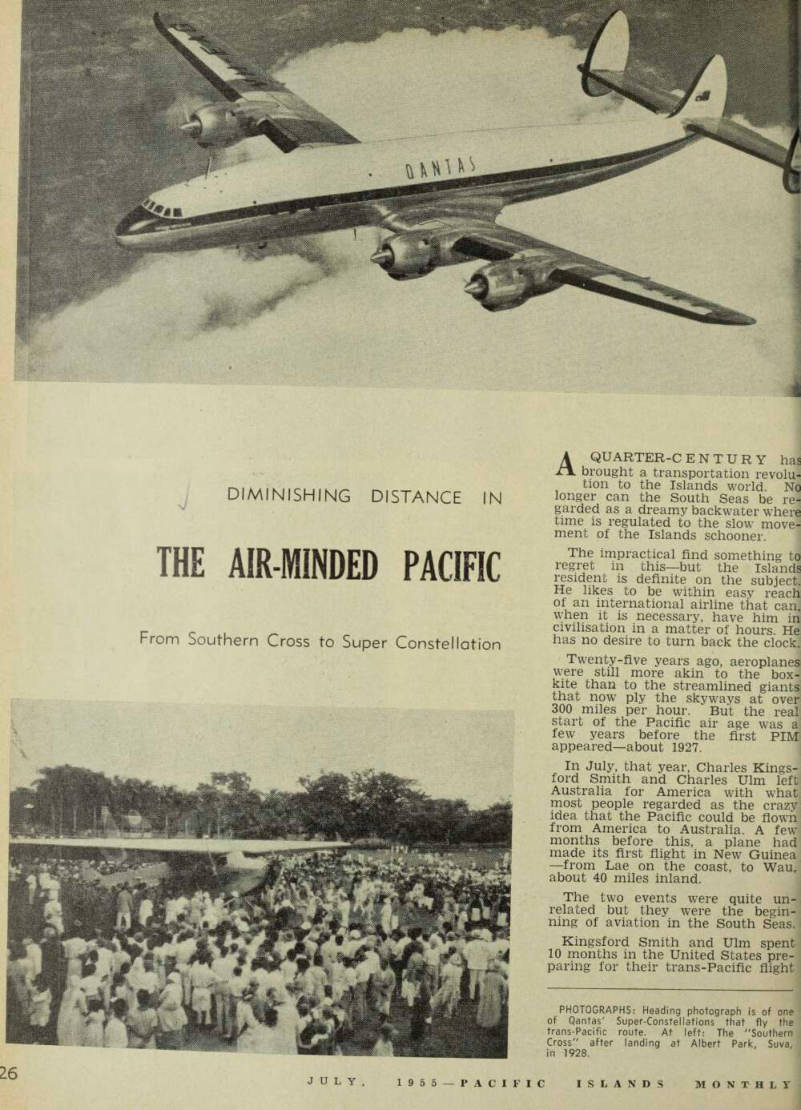
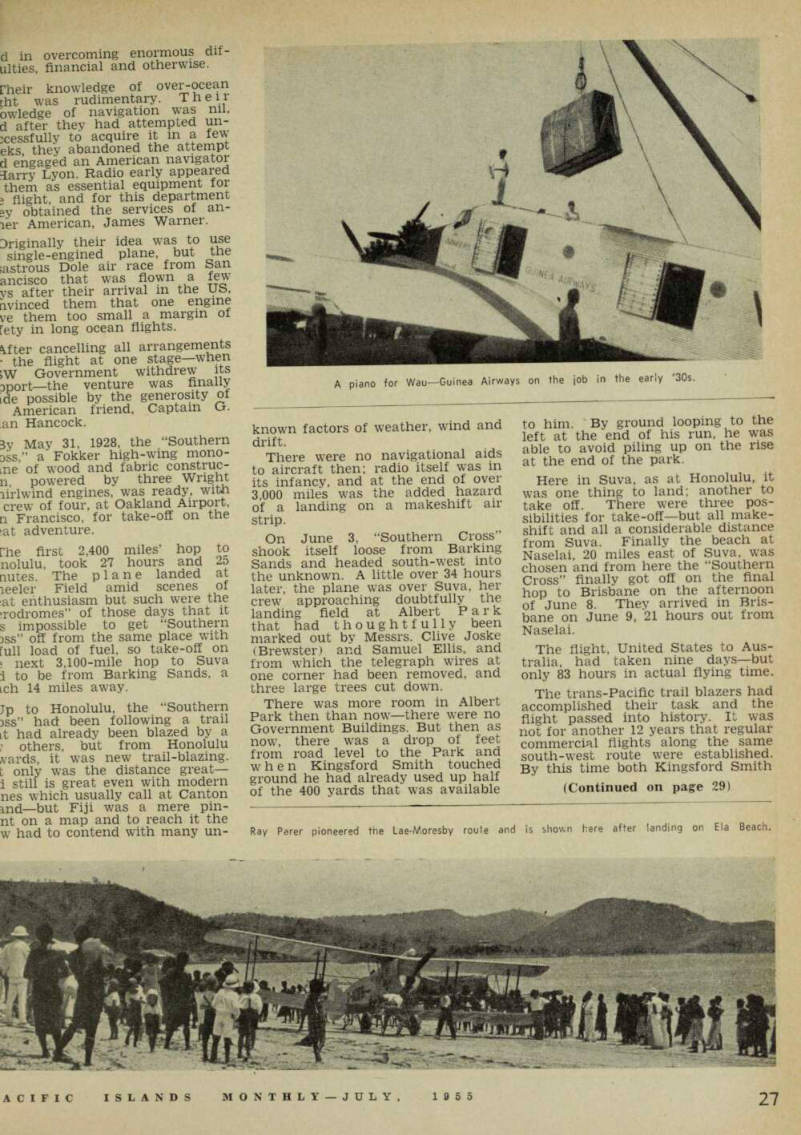
PHOTOGRAPHS: Heading photograph is of one of Qantas' Super-Constellations that fly the trans-Paciflc route. At left: The "Southern Cross" after landing at Albert Park, Suva, in 1928.
d in overcoming enormous dif ulties, financial and otherwise. rheir knowledge of over-ocean 'ht was rudimentary. The i r bwledge of navigation was ml, d after they had attempted un jcessfully to acquire it in a few eks, they abandoned the attempt d engaged an American navigator Harry Lyon. Radio early appeared them as essential equipment for - flight, and for this department ay obtained the services of an ler American, James Warner.
Driginally their idea was to use single -engined plane, but the ;astrous Dole air race from San ancisco that was flown a few ys after their arrival in the US, avinced them that one engine ve them too small a margin of fety in long ocean flights. \fter cancelling all arrangements • the flight at one stage—when >W Government withdrew its Dport— the venture was finally ide possible by the generosity of American friend, Captain G. an Hancock. 3y May 31, 1928, the “Southern dss,” a Fokker high-wing mono me of wood and fabric construc n, powered by three Wright lirlwind engines, was ready, with crew of four, at Oakland Airport, n Francisco, for take-off on the *at adventure. fhe first 2,400 miles’ hop to nolulu, took 27 hours and 25 antes. The plane landed at leeler Field amid scenes of :at enthusiasm but such were the >rodromes” of those days that it s impossible to get “Southern )ss” off from the same place with full load of fuel, so take-off on ; next 3,100-mile hop to Suva i to be from Barking Sands, a ich 14 miles away.
Jp to Honolulu, the “Southern jss” had been following a trail it had already been blazed by a 7 others, but from Honolulu vards, it was new trail-blazing, t only was the distance great— i still is great even with modern nes which usually call at Canton md—but Fiji was a mere pin nt on a map and to reach it the w had to contend with many un-
known factors of weather, wind and There were no navigational aids to aircraft then; radio itself was in its infancy, and at the end of over 3 000 miles was the added hazard of a landing on a makeshift air strip « j, On June 3, ‘ Southern Cross shook itself loose from Barking Sands and mto the unknown. A little over 34 horns later, the plane was over Suva, hei crew approaching doubtfully the £ n< ? m g iv l H b ,,iiv P hPPn that had thoughtfully been marked out by Messrs. Clive Joske (Brewster) and Samuel Ellis, and from which the telegraph wires at one corner had been removed, and three large trees cut down.
There was more room in Albert Park then than now—there were no Government Buildings. But then as now, there was a drop of feet from road level to the Park and when Kingsford Smith touched ground he had already used up half of the 400 yards that was available
he was &k P **“ . ..
Here in Suva, as at Honolulu, it was o ne thing to land; another to take off. There were three pos sibilities for take-off—but all make shift and all a considerable distance from guva F i na n y the beach at Naselai 2 0 miles east of Suva, was chosen and from here the “Southern CrOSS ” finally got off on the final h to Brisbane on the afternoon of p June 8 They arrived in Bris bane on June 9, 21 hours out from N , ;
JNasei<u *
The flight, United States to Aus tralia, had taken nine days—but only 83 hours in actual flying time, The t rans -p ac ific trail blazers had aC complished their task and the flight passed into history. It was not for an other 12 years that regular commercial flights along the same SO uth-west route were established, Bv th is time both Kingsford Smith J
(Continued on page 29)
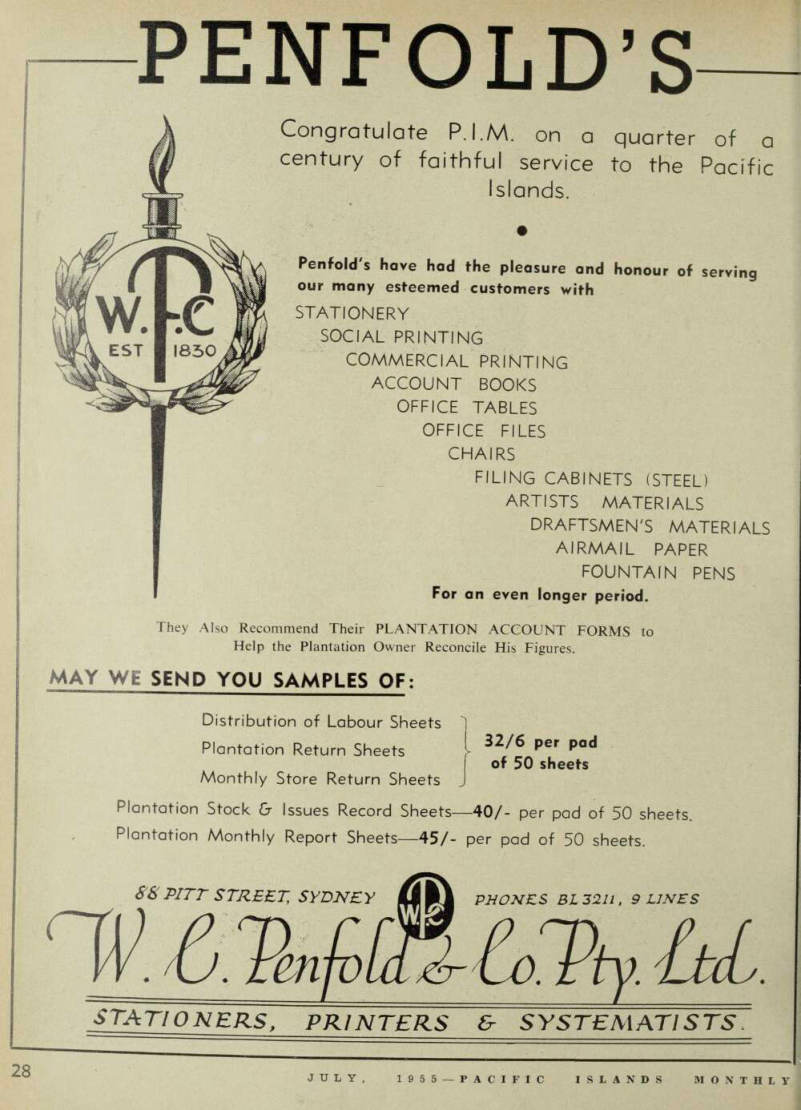
A piano for Wau—Guinea Airways on the job in the early '30s.
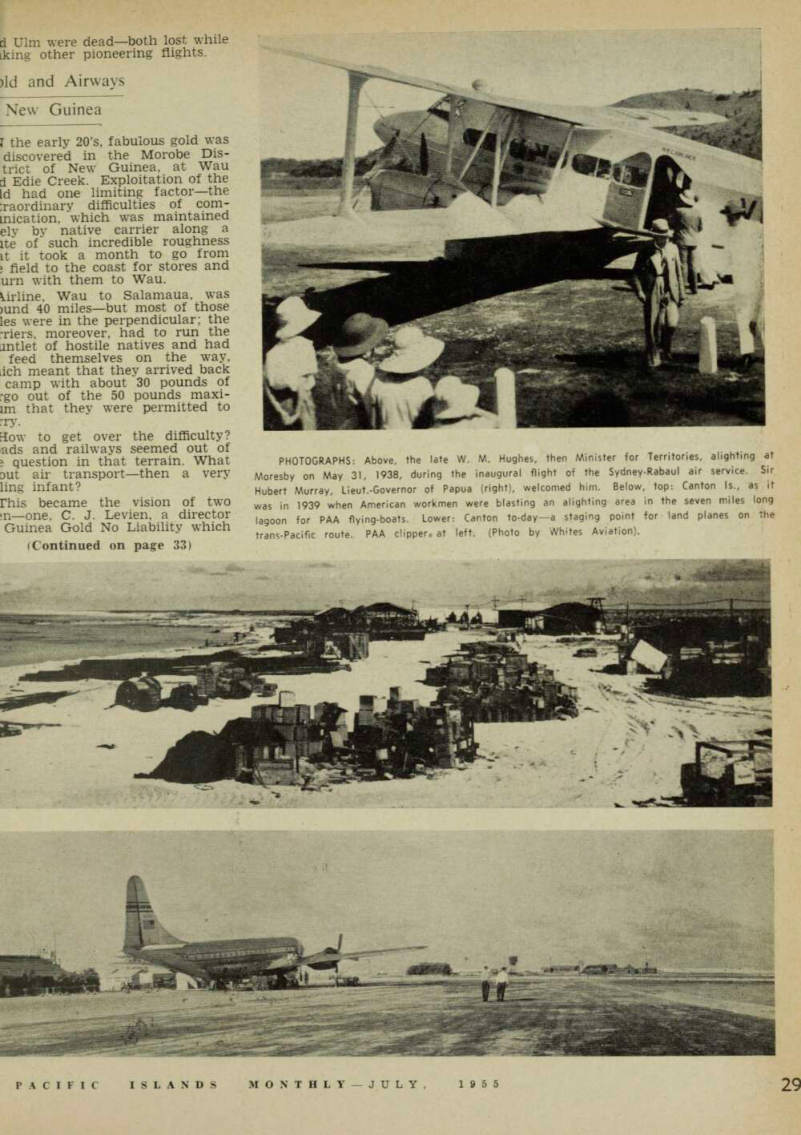
Ray Parer pioneered the Lae-Moresby route and is shown here after landing on Ela Beach.
d Ulm were dead—both lost while
iking other pioneering flights.
)ld and Airways
New Guinea
T the early 20’s, fabulous gold was discovered in the Morobe Dis trict of New Guinea, at Wau d Edie Creek. Exploitation of the Id had one limiting factor —the ;raordinary difficulties of com inication. which was maintained ely by native carrier along a ite of such incredible roughness it it took a month to go from ; field to the coast for stores and urn with them to Wau.
Virline, Wau to Salamaua, was )und 40 miles—but most of those les were in the perpendicular; the Tiers, moreover, had to run the antlet of hostile natives and had feed themselves on the way, iich meant that they arrived back camp with about 30 pounds of :go out of the 50 pounds maxi im that they were permitted to :ry.
Row to get over the difficulty? ads and railways seemed out of 3 question in that terrain. What aut air transport—then a very ling infant? rhis became the vision of two ;n—one, C. J. Levien, a director Guinea Gold No Liability which
(Continued on page 33)
PHOTOGRAPHS: Above, the late W. M. Hughes, then Minister for Territories, alighting at Moresby on May 31, 1938, during the inaugural flight of the Sydney-Rabaul air service. Sir Hubert Murray, Lieut.-Governor of Papua (right), welcomed him. Below, top: Canton Is., as it was in 1939 when American workmen were blasting an alighting area in the seven miles long lagoon for PAA flying-boats. Lower: Canton to-day—a staging point for land planes on the trans-Pacific route. PAA clipper, at left. (Photo by Whites Aviation).
er sold its interests in the Bulolo ts to Placer Development, who ;dged them through the operat ; company, Bulolo Gold Dredging.
Che other was an airman who i already gained considerable ne when, in company with Intosh, he flew a marathon race ; from England to Darwin in a ,zy old war plane in 1920. His me was Ray Parer.
Both men went into action in •ly 1927. >uinea Gold bought a DH37 me from the Department of iation in Melbourne and hired aest (“Pard”) Mustar, ex-AFC, ■RAAF to fly it. Parer bought old DH4 ex-war machine. In ; next few months it became a uggle between the two flyers to i who would be the first to fly in ? Territory. 3 arer had booked space for his me on the BP ship Melusia, in ril, 1927—but he had financial üble, and by the time this was aightened out, his option on the dusia space had expired, and it d gone to Mustar, who had hi lled thereon his DH37 and umphantly sailed away leaving rer lamenting in Sydney, rhere was, at this time, no aero jme in either Papua or New
for^fn”^Sdlo
h w the plan ° was in Rabaul. „ t Rabaul Mustar went—and used mos t 0 f the three weeks’ lead he jT ad over Parer in buying coconut t from the local natives and having a landing strip made. He also 6 visited Salamaua, and was taken by Levien across the Huon Gulf to where, near the present site of Lae, Levien had had an area of 500 yards by 100 yards cleared of timber. This was to be the coastal “aerodrome” for flying operations into the goldfields.
A few days before Mustar was rea dy to fly to Lae. Parer arrived.
However when he unpacked his DH4, one of the tyres was found to be perished and useless-and he had no spare. This Parer mishap cost him any chance m t race to the goldfields, as he had to wait three weeks for the next ship to bring new tyres.
T he flight from Rabaul to Lae took Mustar five hours (a Qantas DC3 now halves that time) and by mid-April he was ready to try the seemingly impossible—fly over the 8,000 feet coastal range and pmpoint a rough clearing in the middle
of unmapped mountains. No de tailed maps existed of the area and. to follow the foot trail was impos sible as it soon disappeared into jungle. . . The smoky fires that Levien had. promised to have lit were no help in identification either, as every native village over the range appeared to have smoky fires per petually burning.
BUT the seemingly impossible was finally accomplished on April 18, after Mustar had spent three days of continual back and-forth. flying trying to locate the landing ground. , . Immediately he had located Wau the serious business of air-freight ing cargo began immediately. Six 100 lb bags of rice were flown in in the first freighting trip—an amount that would have taken 20 boys a fortnight to bring from the coast by the trail. Thereafter, four trips, on each of which the capacity load of 600 lb was carried, were under taken every day. A few weeks after Mustar, Parer began flying.
But Levien and Mustar were already looking ahead. The old DH37 fabric and wood plane, with its limited carrying capacity, was unsuitable for the tropics and the job it was called upon to do.
Their interest centred on a Ger man Junkers plane of metal, and with a carrying capacity of 1.800 lb,
(Continued on page 153)
at was being used in Sweden and nland. At the end of 1927, a parate company, Guinea Airways, is formed with a capital of 9,000, and Mustar went to Europe see the Junkers for himself.
By April, 1928, the first Junkers 34, a low-winged monoplane of rrugated duralumin, with one gine, was in service for Guinea rways in New Guinea, and by 29 three other W34s had joined it.
'J HEN Placer Development took r over the option on the Bulolo valley leases from Guinea Gold J feasibility of the venture hinged whether or not any aircraft sted that was capable of trans rting the largest single piece of edging machinery that would be pessary—a tumbler-shaft that ighed 6,950 pounds. This was far fond the capacity of a single jined Junkers, but after much in stigation, it was shown that a ikers G3l, a three-engined interpart of the W 34, could do i job—with about 150 lb. to spare. 7he transportation of dredging chinery from the coast to Bulolo :an in April, 1931, and in the :t 12 months 2,500 short tons of ivy machinery had been safely ded at Bulolo. The first dredge,
assembled on the spot, went into operation there in March, 1932.
In the years after 1927, many air freighting companies and many pilots followed the pioneers. It was calculated that in the first seven years, over 50 types of aircraft were used on the goldfields. By the early thirties residents of New Guinea had become the most air-minded
people in the world. They took a plane with less thought than the suburban dweller takes a bus.
By the middle thirties, the various air transport companies were flying to 35 aerodromes in Papua and New Guinea—and more were being added each month. Prospectors and Ad ministration officials pushed out into unknown country, set up a base camp and built a landing strip.
Within days, there would be a plane landing on it.
With competition, fares and
ight rates came down. In 1927, en passengers were actively dis iraged, the fare from Lae to Wau 3 as much as £33; later it was uced to £25 in and £15 out; in next few years it fell to £5 in, I 30/- out. Freight rates that i started at 1/6 per pound in 7 were down to 3d in 1935. [y the time the first PIM (eared, Ray Parer had pioneered first service from Salamaua and u to Port Moresby. As a photo ph (page 27) shows, he used the leer airman’s usual landing and — the beach. In a PIM of ly 1931, our notes from Papua itioned a landing strip that was ing some use at Kila Kila but, said, “Parer prefers to use a :e salt pan at Galley Reach, west 5 ort Moresby.”
Services Bridge
Oceans
* May 30, 1938, after much delay, the Sydney-Rabaul air service was inagurated. The contract gone to WRC Airlines, who I a de Havilland 10-seater bi le of metal construction and i four engines. The service was ‘-weekly, later increased to twice week. Leaving Sydney at 7 am i Tuesday, the aircraft reached imaua at 4 p.m. the following day on the Thursday, went on to aul.
About the same time, Pan Ameri can Airways became interested in a San Francisco-Auckland (NZ) ser vice with giant flying-boats, but fol lowing a fire which destroyed the “Samoa Clipper” at Pago Pago on January 11, plans had to be re organised.
This was a period of great ex pansion along international air routes. As a logical continuation of the Sydney-UK flying-boat route, British Imperial Airways was plan ning a Sydney-Auckland link, later expected to extend to Suva, Fiji.
The Tasman link was forged in 1940, but the war put an end to the Suva extension.
Meanwhile, PAA had laid down bases at Canton Island and Noumea and by the end of 1939, unscheduled flights were taking place. There was considerable speculation as to whether PAA would obtain from Australia permission to extend its service to Sydney—but this was not forthcoming.
Although both BIA (its Tasman link was called Tasman Empire Air ways, and Imperial Airways, Qantas and Union Airways were all financially interested) and PAA were ready to operate their chosen services, many months of delay ensued and in April, 1940, PIM said they were “still at the mercy of politicians and bureaucrats” and that the whole position was becom ing farcical. TEAL did not get the all-clear signal until April, 1940.
Pan American finally got started in July of the same year, the route from America being via Honolulu, Canton Island and Noumea to Auck land.
In November, 1941, after further delay, Suva was included in the route but the following month came Pearl Harbour and the end
of that particular phase of com mercial aviation across the Pacific.
TEAL’S Tasman service was con tinued throughout the war, for “priority” passengers.
The War Was Not All Loss AIR transportation received a great stimulus from war-time development in aircraft con struction, and the fact that during the war, aerodromes had been built on Pacific islands which never be fore warranted expenditure of that sort. These factors set the stage for a giant leap forward when hostil ities ceased.
The end of the war brought with it in British countries, a mad splurge of nationalisation—and air ways were high on the priority list of power-hungry “new world” socialists. British airlines were nationalised right and left, and no international airline was permitted to exist that did not belong to a government. NZ nationalised her ..eternal airlines as well and Aus tralia attempted to do likewise, but failed.
Australian National Airways, which pioneered the trans-Pacific route from San Francisco to Sydney with landplanes (DC4s), was soon superseded by British Common wealth Pacific Airlines, owned by the Governments of New Zealand,
Australia, and the United Kingdom.
Imperial Airways was nationalised and BOAC resulted.
Qantas was first partly, and then wholly, taken over by the Australian Government. New Zealand National Airways Corporation took over the services which had been established during the war by the RNZAF and
provided services between New Zea land and Fiji, Western Samoa, Coo!
Islands and Tonga.
WRC Airlines did not re-ente the Sydney-New Guinea service am this was run by Qantas, and late extended through Bougainville am the Solomons to Honiara.
Pan American Airways resume
s trans-Pacific service—this time ith Sydney as southern terminal— l 1947, about the same time as NA began flying the route. Some me later the American and Aus alian operators were followed in ie Pacific by Canada, with madian Pacific Airlines Ltd. All ree airlines used land planes—at •st DC4’s, to be followed by DC6’s, id now Boeing Stratocruisers and iper-Constellations.
The entry of governments into e international airways scene did mething that private enterprise uld not —it established services in eas that, in the commercial sense, ire unprofitable and thus brought rmerly isolated islands into close mmunication with the outside irld. [n the light of bitter experience, each year’s deficit piled upon 5 last, these Governments no jbt wished that they had not been 2h enthusiastic showers of the g—but once an air service was ;ablished it was withdrawn only ;er bitter argument.
During a complete reorganisation all New Zealand, Australian and itish airline interests in the uth Pacific in 1954, Qantas took 3r BCPA’s operations. At the ne time, TEAL, which had added INAC’s Islands’ routes to its orations some years before, and lugurated the Coral Route from ckland to Tahiti, changed over m flying-boats to land planes all but its Fiji-Samoa-Cook ands-Tahiti service.
'n mid-1955, Qantas was in pro s of changing from flying-boats landplanes on its New Hebrides w Caledonia-Fiji route. Although ssengers generally lament the >sing of the big flying-boats, on ise routes of low passenger isity and long hauls they have >ved uneconomic. and New Guinea are still ss-crossed by air routes as in the 5, the services being supplied by ntas, Mandated Airlines or by irter flights by a number of aller companies. tfter an abortive attempt to rt internal airlines in Fiji in the ly 30’s, a company called Fiji ways, owned by Mr. Harold Gatty, o negotiated Pan American Air ys’ agreement with the New aland Government in 1937, be ne firmly established in 1951.