There would be no
pp. 8-9 · Read in the full issue
PIM without our
When the Pacific Islands Monthly, Number One, Volume One, first emerged to face an uninterested world, it was August, of the Depression year 1930. That issue contained 12 pages; and it carried 13 advertisements. Two of those advertisements eventually became “bad debts”.
AT the end of the first year, No. 12, Volume 1, had increased its pages to 16, and there were 59 individual advertisers. From that point, for the first decade of its life, PIM went on winning more staunch advertising friends, most of whom are still with us to-day.
“Popular” magazines and news papers are only as strong as the support given them by advertisers.
And in this department we have been singularly fortunate loyal advertisers have helped us to prosper in the good years and en abled us to survive in the bad years.
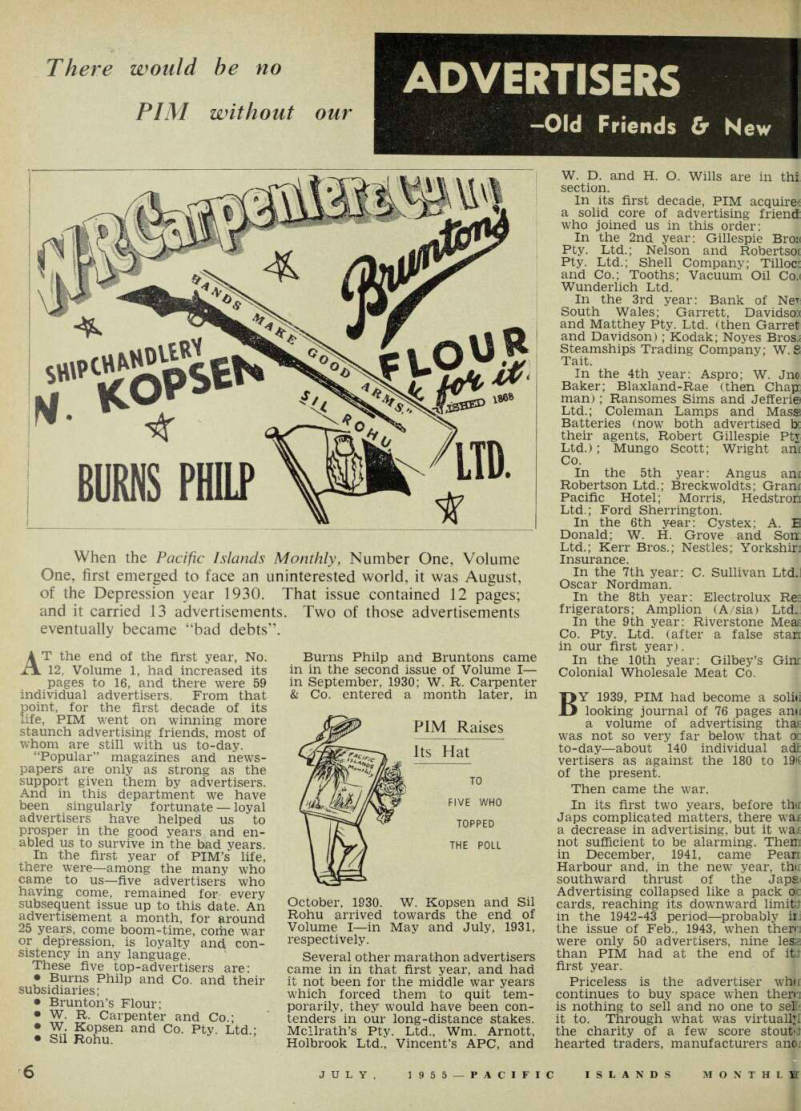
In the first year of PlM’s life, there were—among the many who came to us—five advertisers who having come, remained for every subsequent issue up to this date. An advertisement a month, for around 25 years, come boom-time, come war or depression, is loyalty and con sistency in any language.
These five top-advertisers are: • Burns Philp and Co. and their subsidiaries: • Brunton’s Flour; • W. R. Carpenter and Co.; • W. Kopsen and Co. Pty. Ltd.; • Sil Rohu.
Burns Philp and Bruntons came in in the second issue of Volume l— in September, 1930; W. R. Carpenter & Co. entered a month later, in
PIM Raises
Its Hat
TO
Five Who
Topped
The Poll
October, 1930. W. Kopsen and Sil Rohu arrived towards the end of Volume I—in May and July, 1931, respectively.
Several other marathon advertisers came in in that first year, and had it not been for the middle war years which forced them to quit tem porarily, they would have been con tenders in our long-distance stakes.
Mcllrath’s Pty. Ltd., Wm. Arnott, Holbrook Ltd., Vincent’s APC, and
W. D. and H. O. Wills are in thi section.
In its first decade, PIM acquirer a solid core of advertising friend; who joined us in this order: In the 2nd year: Gillespie Bro« Pty. Ltd.; Nelson and Robertsoc Pty. Ltd.; Shell Company; Tilloc: and Co.; Tooths; Vacuum Oil Co.( Wunderlich Ltd.
In the 3rd year: Bank of Nev South Wales; Garrett, Davidso* and Matthey Pty. Ltd. (then Garret and Davidson); Kodak; Noyes Bros,* Steamships Trading Company; W. 8 Tait.
In the 4th year: Aspro; W. Jno.
Baker; Blaxland-Rae (then man); Ransomes Sims and Jefferi© Ltd.; Coleman Lamps and Mass Batteries (now both advertised be their agents, Robert Gillespie Pty Ltd.); Mungo Scott; Wright am Co.
In the sth year: Angus am Robertson Ltd.; Breckwoldts; Gram Pacific Hotel; Morris, Hedstron Ltd.; Ford Sherrington.
In the 6th year: Cystex; A. H Donald; W. H. Grove and Son: Ltd.; Kerr Bros.; Nestles; Yorkshire Insurance.
In the 7th year: C. Sullivan Ltd.] Oscar Nordman.
In the Bth year: Electrolux Res frigerators; Amplion (A/sia) Ltd.,J In the 9th year; Riverstone Meais Co. Pty. Ltd. (after a false stan in our first year).
In the 10th year: Gilbey’s Ginr Colonial Wholesale Meat Co.
BY 1939, PIM had become a solfii looking journal of 76 pages anti a volume of advertising thaE was not so very far below that oc to-day—about 140 individual ad£ vertisers as against the 180 to 19<€ of the present.
Then came the war.
In its first two years, before thir Japs complicated matters, there wa£ a decrease in advertising, but it wa£ not sufficient to be alarming. Them in December, 1941, came Pean Harbour and, in the new year, thtr southward thrust of the Japs* Advertising collapsed like a pack o cards, reaching its downward limits! in the 1942-43 period—probably ii the issue of Feb., 1943, when then were only 50 advertisers, nine less than PIM had at the end of itf first year.
Priceless is the advertiser who continues to buy space when then is nothing to sell and no one to sell; it to. Through what was virtual!:! the charity of a few score stout-; hearted traders, manufacturers anc
rchants, we were able to keep )at during the worst of the war its, and were thus enabled to •vide a useful news service to the usands who had been scattered m their homes in the Pacific by Japanese invasion.
Lmong those who advertised dur this lean period—apart from the ) Five—were Jno. W, Baker;
sman Lamps; Cystex; A. B. laid; Electrolux; Garrett and ddson; Gilbey’s; Robert Gillespie; espie Bros.; Grand Pacific Hotel; H. Grove and Sons; Nelson and >ertson; Noyes Bros.; Riverstone it Co.; Wunderlich Ltd.; C. ivan; Tillock and Co.; Steam > Trading Co.; Yorkshire Insur -5; Colonial Meat Co.
EM’s hat comes off for these, here were, of course, numerous and post-war casualties. Amal lated Wireless of Australasia was outstanding of these. AWA e to us with the first issue of [ and remained for every issue 1 well into the war years—until, act, radio communications were onalised and Overseas Tele munications took over AWA’s o network. KLM, the Dutch ping line, was another casualty. j company’s ships no longer call slands ports in the SW Pacific.
atiful :e ace brought industrial unrest; iblic, which had been deprived pods for years, clamorous for hing and everything that could ireduced; and plants geared to and not peacetime production, ddition, millions of tons of ship had been sunk, thus severely icting distribution.
Ivertising volume increased dur
ing this period—but it was an ticipatory rather than as an instru ment in an active selling campaign.
It was towards the end of the second half of this post-war decade that the matters of supply and de mand began to cancel themselves out and it was against this back ground, and as a reflection of a period of boom, that advertising volume began to increase and assume its present proportions.
Twenty-five years is a long time in the course of human affairs, and it was inevitable that changes affecting the whole field of trading in the South Pacific should occur in that period. Increased buying power in the hands of native peoples, and such people as the Indian community of Fiji; the high post-war prices received for all Pacific Islands products; and the demands of re-construction in the Territories of the SW Pacific, have been factors that recently have made the South Pacific Islands, as a group, a most lucrative field for overseas trade.
The extraordinary growth of air transportation has given us such advertisers as Qantas Empire Air ways, TEAL, BOAC, the NZ National Airways Corporation.
The destruction of so many Islands small-ships during the war gave an impetus to Australian small ship building and brought into the pages of PIM Captain Kennedy, Gardner engines, Thornycroft, Lars Halvorsen Sons Pty Ltd. (who came to us originally in the 30’s) Bjarne Halvorsen, etc.
Better radio reception in the Islands and, in some cases, the establishment of local radio stations, the development of tele-radio and the installation of radio in even small-ships, have given a fillip to the radio industry; and this in turn is reflected in advertising from radio suppliers, and especially Crammonds, of Queensland.
A desire to get away from the unnecessary hardships of pioneering, and to find some means of over coming post-war labour shortages, has been reflected in the develop ment of labour-saving devices such as horn e-lighting, refrigeration, mechanised agriculture, improved copra driers, etc. In this advertis ing field have came Dangar Gedye and Malloch (who as Dangar Gedye were with us for some years in the 30’s), Tyneside Foundry, Braybon, and others.
Some Islands firms which in creased their activities after the war—such as Colyer Watson Ltd are now advertisers, although they were not with us before the war.
Because of the wholesale destruc tion of buildings in the SW Pacific during the war, there has been much advertising of building materials, prefabricated houses, paints, etc. On the debit side there is now little
or no call for mining gear, and advertisers of this line of merchan dise have dropped out.
Thank You
ON this, our 25th anniversary, we would like to thank all our advertisers —whether they joined us last month, or in 1930. Although old friends are a matter of con siderable pride to us, without our new friends who have joined us in the post-war decade, we could not continue to live or to grow—and it is about you new advertisers that we probably shall be writing a story for our Half Century issue in August, 1980!
All our advertisers —old, new, large, small —are equally valuable to us. So—thank you for coming; thank you for staying. We hope to see more of you in the 100 years ahead.