Why and how I established
pp. 6-41 · Read in the full issue
the Pacific Islands Monthly
By R. W.
Robson
IT was May, 1914. With Fred Twiss, a New Zealand Government official, I was walking down to HMGS Tutanekai, moored in Vavau Harbour, Tonga. We had been to an official party, mixed British and German, held to celebrate some Germanic occasion.
I was thinking aloud. “Fred, did you notice how eager those fellows were for some news of what is hap pening in Fiji, Samoa, Rarotonga— they don’t even know how things are in their own capital of Nukualofa.”
Fred agreed. “They get the world news every week or two,” he re marked, “but they don’t know for months afterwards what’s happen ing in the group next door.”
Thus was born the idea of the Pacific Islands Monthly —a news ex change for residents of the South Pacific Islands groups. 1 liked the idea. That was the first time I had seen the Islands; but already I was a walking Islands encyclopaedia. From when I first could read, in the depths of the New Zealand bush, I had been fascinated by the history of the Islands, and the widely varying accounts of life and conditions there; and I then had a phenomenal memory.
I went back with that NZ official party to my reporter’s job on the New Zealand Herald. In the ensuing 15 years, I was in the service of leading Australian newspapers, in Sydney and in London. But I never forgot that Islands newspaper plan, and when I returned to Australia, to try to establish myself as a
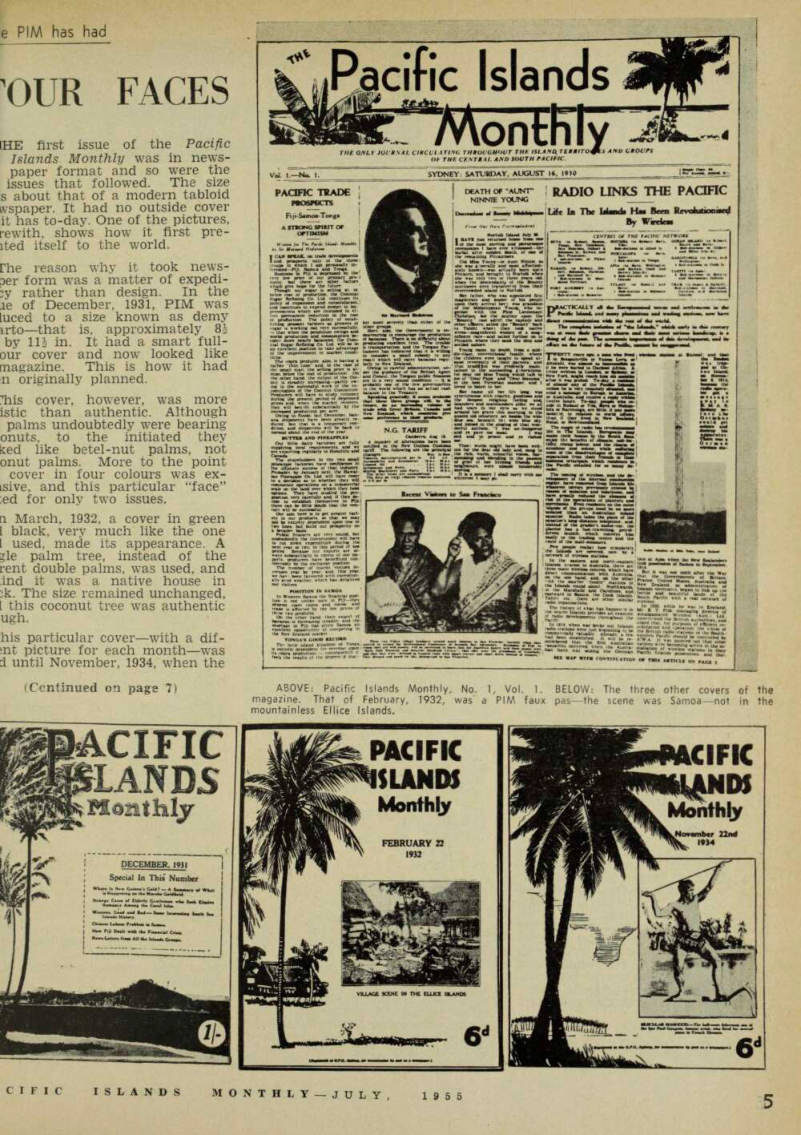
publisher, the publication of the Pacific Islands Monthly, in August, 1930, was my first real effort.
The Great Depression
The fact that August, 1930, was the dead centre of the Great De pression is the measure of my optimism.
The League of Nations now was seen as a hollow sham; consequently, politico-economic relations between nations were in a deplorable condi tion, and pessimism governed the outlook of most intelligent men.
Pacific Islands producer s—and especially coconut planters—were close to the breadline.
Australian publishers generally live on the sale of their by-product —advertising space. Who in those days would want to buy space wherein to direct sale messages to Islands residents, who had no money anyway? No wonder my candid friends said I was crazy.
Pale and under-nourished, my publishing enterprise staggered along for a year or two, but some how stayed alive.
I could not live on the PIM, and so I held down a couple of other salaried jobs, connected with news papers. One of these jobs called me away to Colombo, Cairo and Lon don only four months after the PIM was started. This seemed a calamity. Actually, it provided the turning-point.
While I was in London, I made a personal investigation of the background of the world’s copra markets —of the causes of the strange fact that, although every ton of copra produced found a buyer, the price paid rarely rose above starvation rates.
The explanation, of course, was the international control of world copra prices by a ruthless combine called Unilever. Uniliver had (a) an independent organisation in every big country and (b) a staff of highly skilled technologists, who had learned how to purify and de odorise such hitherto unpleasant things as tallow and whale oil and coarse, highly flavoured vegetable oils, so that they could compete with copra in markets which the coconut always had regarded as its own.
Dominating the markets where all these substances were in demand, Unilever held prices just where it wanted to. The various producers were allowed to make a living, but Unilever got most of whatever big rewards were around. (Unilever maintained its position unchallenged, as world dictator of the vegetable and animal oil markets, until World War 11. Then, under w T ar-time powers, the com
bined Western Governments asE sumed control of these market! (with one of Uniliver’s heads a* chief confidential adviser!) Since the war, owing to factors that ma;j not be described here, Unilever— although very much in the picture —has not yet exercised the sanw dictatorship over the markets.)
1930-40: Battling Along
In a short series of articles, pub< lished between December, 1930, an«j March, 1931, I tried to explain Unilever and the new technologicaf processes to the half-starved ano. resentful coconut-g rowers ano, traders.
This, apparently, was exactly wha* the embattled South Seas people! wanted. The circulation of the PI M bounded forward into figures whicH established the journal as a per' manent institution.
But my real troubles had onl;J commenced. I had not nearly enougfi money to finance this healthy ano rapidly growing enterprise. CasH from sales and advertising came in slowly—those were days of long; credit—but my printing bill had to be paid every month. Just when it seemed that I should have to sell a large part of the enterprise, ano thus virtually give up control, a NG gold-mining man whom I hao known only a little while offeree: me a loan of a couple of thousano. pounds, without any written security whatever.
With this aid, my little show madt* sound, solid progress. Within two years, I had brought out the first edition of Pacific Islands Year 800 l (now established throughout thej world’s libraries as the top-rankingj book of reference on the Pacifies Islands). By 1937, I had acquired a small interest in, and the managing-’ directorship of, the old-establisheo; Sydney & Melbourne Publishing Cod Pty., Ltd., and thus had my own printing-office.
Arrival Of W/War 11.
By 1938, the PIM and I were doings well; but, as a former newspaper; foreign correspondent, I was moste uneasy. In Europe, in the ’Twenties?, I personally had seen the virtuae collapse of the League of Nations; In the ’Thirties, I watched the rise? of the semi-lunatic Schickelgrubeis (otherwise Adolf Hitler); and I knew the meaning of the new Rome- Berlin-Tokio Axis, The threat of war lifted the coprs price substantially in the ’Thirties.2 but there was little comfort in thatr.
Persistently, in my PIM, I published reports of Japanese penetration ole
(Continued on page 38)
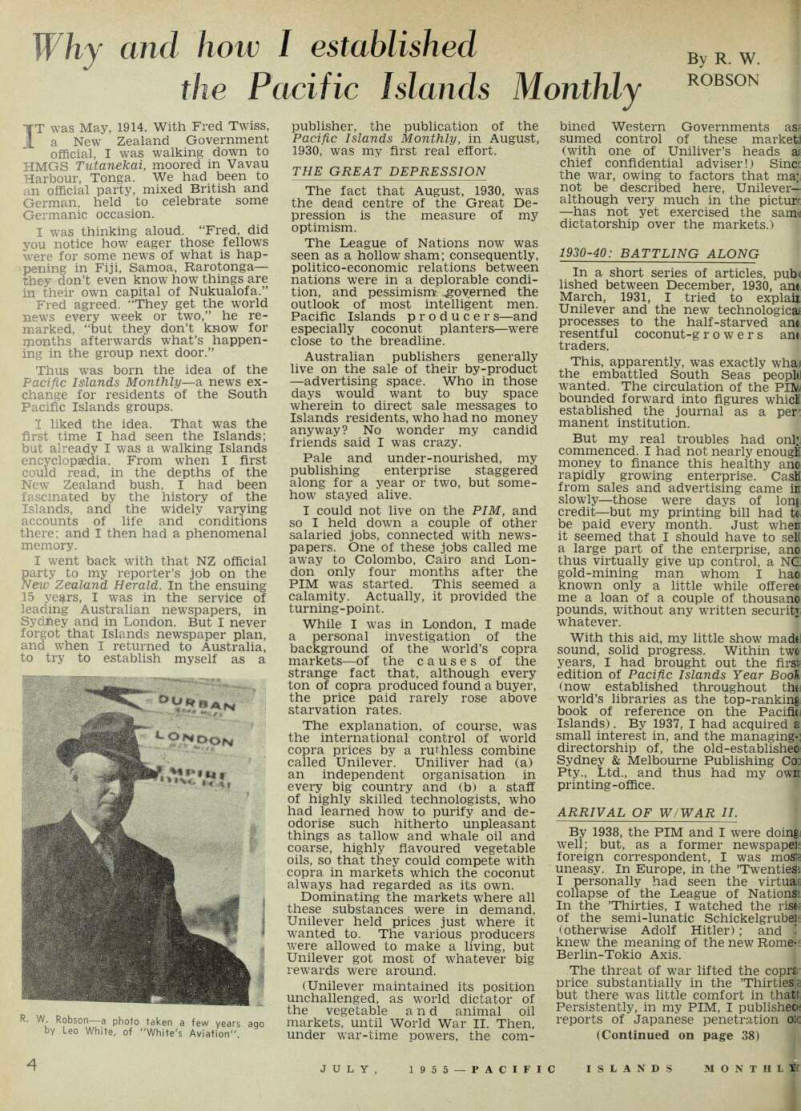
R. W. Robson a photo taken a few years ago by Leo White, of "White's Aviation".
the Pacific Islands, and what that horror of a second World War while the Western nations still needed copra, sugar, cocoa, gold, and so forth, all the countries which produced those things still were able to produce, and the market was over-supplied.
Shrinking, also, was the manufacturers’ and traders’ capacity to sell to Islanders. Economically, we of the South Pacific were more and mo i’ e I_ei?lbarrasS6d 1 ei ?l barrasS6d - We were half in and half out of the war.
Japanese Invasion
k Within a few days, we of the South bv C fhe ?an fl e n«p de ° P6n to - invasion
lippSw
Hsss
to the four
£« Csas
tr «“ y f ased - ' hnv d <^^i Ser^ no longer wanted to • , ery one of my young wl?rt St S n ?~ mclu ? mg Selw y n Hughes ™° Pad corae to me years before w n n° ce b ° y > and was now my W? lieutenant—was called to war 1942 ’ as if 1 ™ old up tbe PIM > n °t wanted
any more
. But I thought I might still give ser vipe, by telling the Pacific Islanders about their angle on the war and about what was happening to their thousands of men and women who For some reason that I never understood—but valued" none the ■}«?:
S&SSgiE
now were available, so sought a woman assistant. I di<? covered in Melbourne a former Ner Guinea woman, with literary talenij Krnm JUdy Tudor - I induced her tc fe 1 ® my assistant, in Sydney That was one of my happiest diss (To-day, she is Assistan Editor, frequently visits the Groupc Sfe Wr P ter and Photographer, anu acts when required as Editor) So we survived the war. But wr had some lively problems Because we had Islands circular affiiHm £ n K yed the un >'emittin 8 attention of the censors. Actually ' was my own strictest censor—noth jf? B a^ Vei got past me which woulo m any way aid the enemy. Bu y Sw? Uam People with a censor’s authority occasionally saw things ahnn7/h 6 ' 1 CoUld Write a book about the occasions when they made us delete quite harmless things. Soi on a number of occasions, just for my own satisfaction, I would put into type things which would have be fn of great help to the enemr get the censor’s approval stamp on out l P1 S?n S ’ h nd th PP throw them proofs Stlll have those stamped JJ Pwific Islands Monthly now w as in limited demand, that could! not be said of the Pacific Islands i Year Book. Every military and civil organisation with wartime jobs im the Islands wanted this Island^ fn Cy^ lopaed !f ’ and we tried to meet the demand. But there just was, not enough paper available then to
the printing. I was compelled to 1 the overseas copyright to a sat American house; it was rated” before the American pub lers got out their edition; and ; wartime sale of the Year Book, ich might have returned a little tune, provided a most modest )fit. ‘‘San Fairy Ann, ’ as the diers said.
Ie Great Inflation
n 1945, with war past, and men urning to their jobs, our business ike tens of thousands of others— mn to return to normal. All med merry and bright. And then re troubles came thick upon us.
Vestern civilisation had partly anced the war by issuing jmissory notes on the future. In ler words, it had trebled the iknotes issue by merely printing 1 issuing notes, without backing gold and goods. Naturally, the ue of money decreased by two rds. People still profess to be azed and doleful over Inflation, tually, it is the plainest and iplest proof of the soundness of ; economic law that you cannot ie banknotes without backing i expect them to hold their ninal value. )ur business —the PIM, and six ier monthly journals, and various riodi c a 1 s passed the 1939 ndards, and grew rapidly. It ;ded much new capital. But as t as we got additional funds, lation ran the value out of them, i chased our tail, in ever-widen circles ifter three or four years, Inflation wed down, and we caught up ,h ourselves. r inally, in the course of arranging • financial structure, Pacific blications Pty. Ltd.—the modest le company I formed 25 years ago hold PIM and Year Book—pur ised outright the Sydney & Mel anie Publishing Co. Pty. Ltd., ;h its land, buildings, plant and blications; and thus we settled vn to our present condition.
Jd The “Cold War ”
With this backing, we hope to e many more years of service to 3 communities of the South cific Islands. We have the means, d the times present the oppor lity. [f they are allowed, Australia, w Zealand and the South Pacific ands have a future comparable th the West’s achievement in irth America in the last hundred ars.
But the ’Fifties, like the ’Thirties, 3 uneasy times. Just as the sakdown of the League of Nations owed the Nazi-Fascist Axis to row the world into World War 11, e failure of the Western Powers the late ’Forties either to shackle destroy Muscovite Communism 3ms to be driving civilisation into orld War 111.
Western statesmen now are striv l with all they have to find a lution short of the use of atomic
weapons. We fear they may be ten years too late. Meantime, we can but wait and hope—and, maybe, pray.