Papuan Wedding at Port Moresby
pp. 137-141 · Read in the full issue

ort Moresby has nothing so fancy a new power house—an old tin i on the waterfront suffices—but of its six engines broke down denly one night because a cold o (cold for Moresby, that is) put too great a strain. eak-hour rationing was introed and threatened to last for a ith until a seventh engine from ain could be installed. efore any screams could go up n the rest of the Territory for , machine, engineers began workovertime to get it safely tented into the floor. lectricity supplies for the Busulahang area, Lae, could not be ranteed after June 30, residents e told last month. Following this ice a petition bearing the signa- 5 of 60 Lae citizens was subted to the Lae Town Advisory ncil’s May meeting together with ers from some private companies ch are interested in this area. he petition asked the Council to e the Government to maintain plies in the area and stated that the electricity were not mainled many of them would suffer dships.
Lodification Of Native
Curfew
Iterations to native curfew hours all Territory townships will be °tted shortly. The new curfew irs will be from 11 pm to 5 am, ;ead of from 9 pm to 6 am as at sen t further amendment provides for
control between the hours of 9 pm and 6 am over the making of any noise which constitutes an un warranted disturbance or nuisance to residents.
The change in the evening curfew hour from 9 pm to 11 pm is being made as a trial to ascertain whether curfew can be relaxed progressively without adverse effect on any section of the community, including the natives themselves, The change takes into considera tion the fact that many natives have taken up educational and recreational interests, SU9II as the Boy Scout and Girl Guide move ment, evening study classes attend ance at clubs operated for the native people, and going to picture shows which necessitate their being out after 9 pm.
Further, there are others holding positions of trust and responsibility in industry, commerce and Govern ment departments, and already well advanced towards European living standards, to whom the 9 pm curfew appears as an unjustifiable restnc tion on the personal freedom of in dividuals whose record has won them recognition as persons of good repute and responsibility.
Another factor influencing the in troduction of a trial period of 11 pm curfew is that th e native people should have the oppor tunity to emerge gradually from re strictions which limit their S9ope to demonstrate capacity for wise use of greater personal freedom,
(Continued on Page 137)
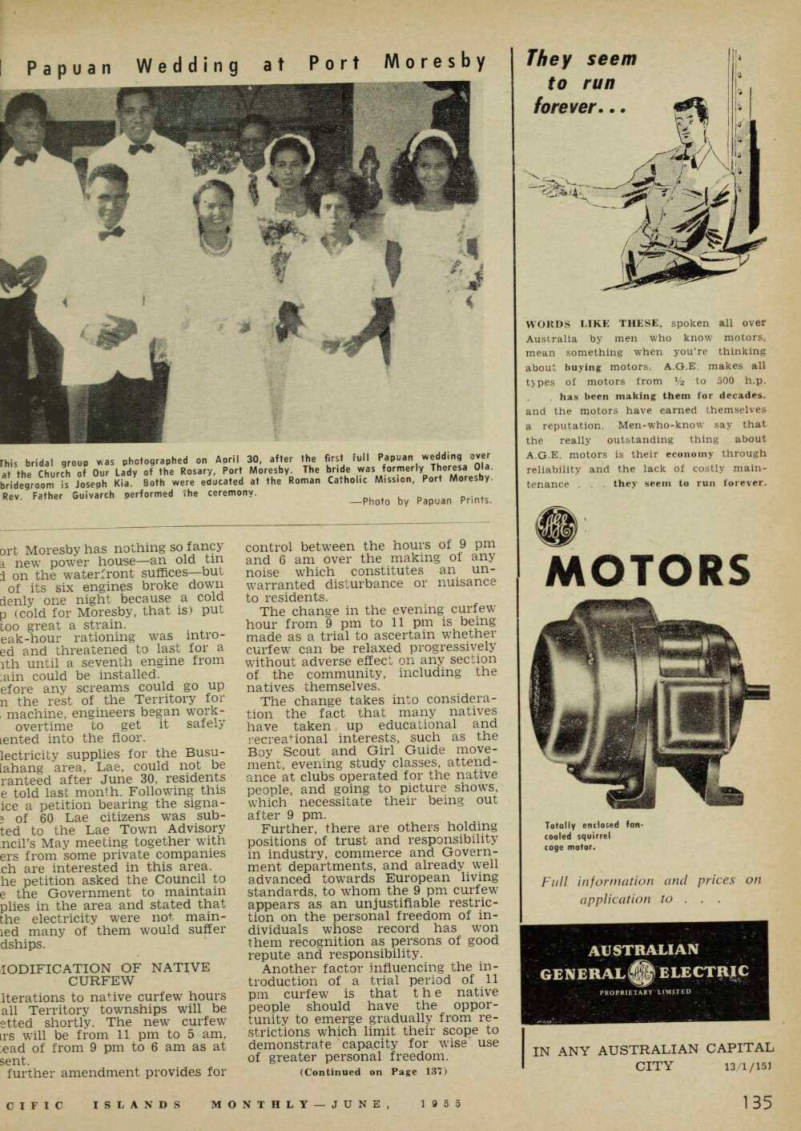
This bridal group was photographed on April 30, after the first full Papuan wedding ever at the Church of Our Lady of the Rosary, Port Moresby. The bride was formerly Theresa Ola. bridegroom is Joseph Kia. Both were educated at the Roman Catholic Mission, Port Moresby.
Rev. Father Guivarch performed the ceremony. - photo by Papuan Print s.
Laotic Conditions At
Lae Wharf
; inadequate storage facilities ; Lae Customs shed have been
jly criticised.
company director, Mr. Arthur said that conditions at the ifharf after the Bulolo had dis ed were chaotic, the latest meeting of the TAG, [arold Hindwood described the liti o n s at the wharf as
lutely disgraceful.”
i cargo from three ships, the Sinkiang and Bulolo was ;d ceiling high in the shed and jnors had an almost impos task clearing their consign ew days after the Bulolo de i, the Shansi arrived and to the confusion by discharg -10 tons of cargo into the shed. of Lae’s businessmen agreed :he situation was serious and that situations like this cost ,e enterprise many hundreds unds each time large ship were landed at Lae.
May meeting of the TAG was :hat £40,000 was included in raft programme for a 100 ft >ion to the wharf, t Council members agreed that ft extension was useless be the fact that it would allow -hatch ship to work all holds 3 time. yiously the Morobe District :il had recommended that a extension to the wharf was ed, plus all storage facilities, they made their submissions e three-year plan, ice we made that recommend the position has become more iss,” the chairman of the Council, Mr. Bretag, said. A i was carried urging the Gov nt to reconsider the original ition. ’ was a busy month for ship is eight ships arrived.
Delos loaded the largest ship to leave the port since the 1,440 tons of scrap metal and ;. Aboard the vessel were 200 of scrap metal consigned to cope with shipping at this he Lae wharf requires three the present storage space,” cott said. jAE personal notes District Commissioner, Mr. H. was accompanied by his wife he left on leave by the Bulolo, y. During Mr. Niall’s absence losition of District Commis will be filled by Mr. Les ms. ;rican anthropologists Dr. and Jim Watson returned to ca aboard the Thorsisle last l They had been engaged on york in the Kianantu area. On turn to America Dr. Watson
will occupy a senior position at the Washington State University.
Kpithpr Oporffp Bernardino was
HO Lae resldents t?
the RSL Hall recently. Father Bernarding has been posted to the Madang District. He was the Catholic priest at Lae for three years and took a very active interest in both
social and sporting activities of the community.
District Commissionei Mr. Les Williams made a presentation to Father George fi o m the Lae clt J? e f £ s pr F Mi ik hac . been Jf'vich il a r Q p D 88 n appointed parish pnest at Lae.
(Continued on Page i3B)
Wong-Low
Wedding
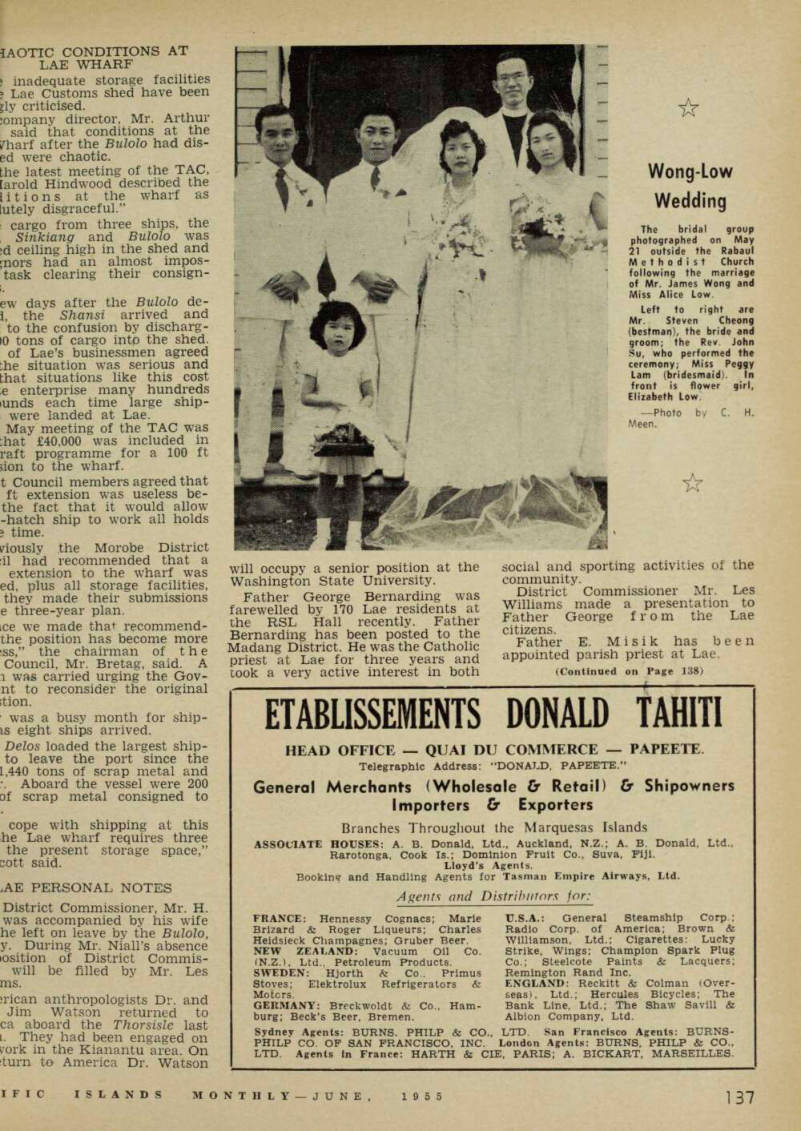
The bridal group photographed on May 21 outside the Rabaul Methodist Church following the marriage of Mr. James Wong and Miss Alice Low.
Left to right are Mr. Steven Cheong (bestman), the bride and groom; the Rev. John Su, who performed the ceremony; Miss Peggy Lam (bridesmaid). In front is flower girl, Elizabeth Low. —Photo by C. H.
Meen.
Overcrowded School
A spokesman for the Lae Parents and Citizens Association said this month that his association was alarmed at the overcrowding of the European Primary School.
“One hundred and twenty-five children are attending this school and they are accommodated in four classrooms, each 24 ft by 24 ft,” the spokesman said. “One classroom has to seat 49 students.
“In 1953 there were 50 students at the Primary School here and it was impossible to anticipate the present large increase. The situa tion will become progressively worse.
Seven additional students will be enrolled at the start of next term.
The Lae pre-school play centre caters for nearly 40 children and at least 16 are awaiting admittance.
“The primary school will be ex pected to accommodate children leaving the kindergarten at the end of this year.
“Extensions to the school were given a very low priority in the three-year plan recommendations.
“Our association considers that the extensions should receive prompt action before the situation becomes worse.”
Lae Airstrip Improved
Lae people are hopeful that the Sky master service carrying passeng ers and freight from Australia will again terminate at Lae following
improvements which have been made to the Lae airstrip.
The improvements entailed the removal of all grass from the main runway surfaces and complete regravelling. The project was started in the middle of May and at the end of the month it required only the assistance of rain to complete the £6,500 project.
The work was carried out by the Department of Works, and to ex pedite the reconditioning the de partment operated two shifts be tween 6 am and 10 pm, the night work being carried out under flood lighting A senior official with Qantas said
at Lae that the Skymasters from . tralia would again terminate inr when the strip became service; and after sufficient time had elae to enable the company to reao timetables and internal organisat The last Skymaster landed ati in August. Since then the se:j has terminated at Port a shuttle service of DC3 airr has been ferrying passengers e New Guinea from Port Moresb: Lae.
Control Of Malaria If
Territory
The Minister for Territories,, Paul Hasluck, said on May 25 t as a further move in the ss malaria campaign in the Terri of Papua and New Guinea, he approved the creation of a 5 tion of Malaria Control Officer the Territory Department of He} and of thirteen positions of Mai Control Assistant. Applications wv be called for eleven of these n tions by public advertisement i month.
Malaria was the disease of mr importance in the Territory and!
Director of Health, Dr. Jod Gunther, had reported th a M malaria were eradicated, it etc be anticipated that the inli mortality would be halved, and i expectation of life doubled.
Possibly in fifteen years, as result of both these changes, I population of the Territory cc increased by 100 per cent.
The accepted policy was that ; problem of malaria control music tackled by the education of people and the awakening of a sire to establish their own cc: munity control.
The Territory Health Depsc ment had already established} Malaria School at Minj, in Western Highlands, where courses—one for Health officers i one for Native Affairs officers—l - been successfully conduce These officers were now applying ■< lessons in their daily work.
It was the object of the depst ment to establish in each district Malaria Control Assistant, m
Brilliant Ini
Student
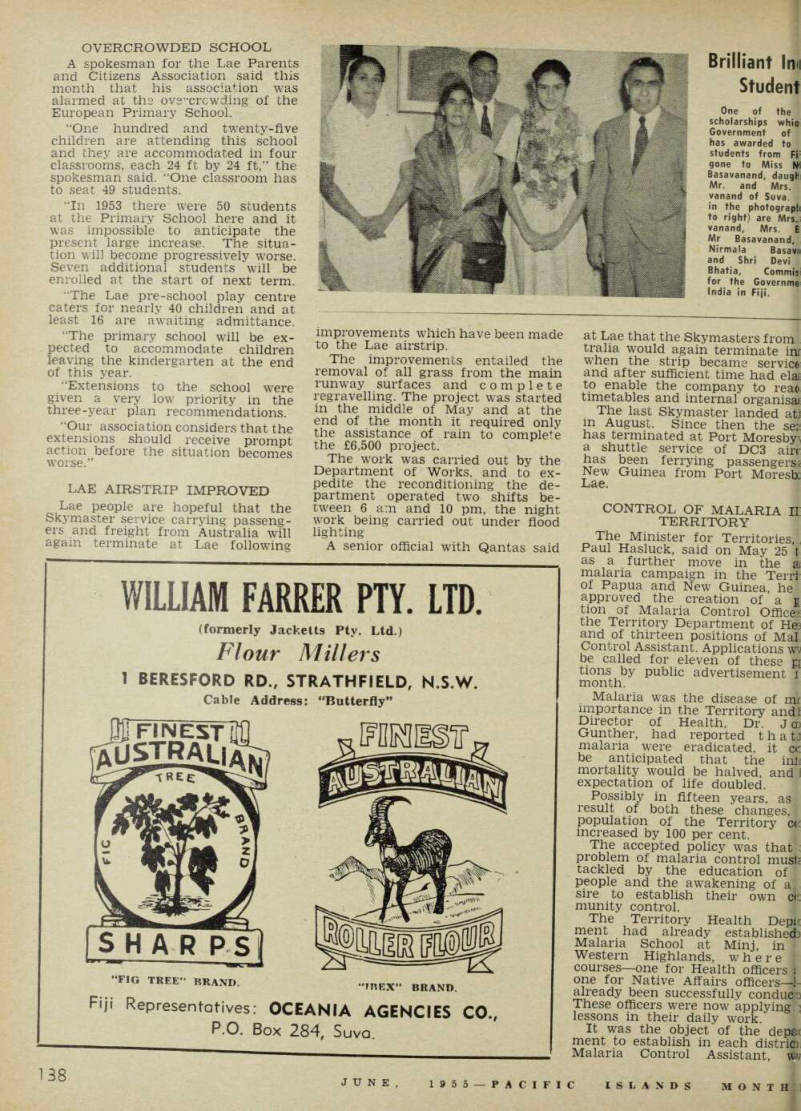
One of the
scholarships whio[?]
Government of has awarded to students from Fi[?] gone to Miss [?]
Basavanand, daugh[?]
Mr. and Mrs. vanand of Suva, in the photograph to right) are Mrs. vanand, Mrs. E Mr Basavanand, Nirmala Basa[?] and Shri Devi Bhatia, Commis[?] for the Governme[?] India in Fiji.
ler the direction of the central laria control authority, would anise local measures and travel ough the district bringing about co-operation of the native pie in measures for community trol of malaria. tecent research had encouraged view that residual spraying, viously thought as a result of "time experience to be ineffective, jld now be successful. Their -k would be assisted by the dical Assistants and local Medical cers who were already engaged this work. ’he plans of the Director of jlic Health also envisage the jointment of a medical specialist Malariologist and, under his >ction, the Malaria Control Officer ild be engaged in research as 1 as directing control work oughout the Territory.
European Population
Increases
’he Minister for Territories, Mr. sluck, said on May 22 that the ults of the June, 1954, census ich had recently been analysed a bulletin issued by the Com nwealth Bureau of Census and itistics showed that since 1947 the i-indigenous population of the -ritory of Papua and New Guinea i risen from 9,439 to 17,755. Of s total, 6,313 were in the Terri y of Papua and 11,442 in the ist Territory of New Guinea, nnong some of the changes in ; character of the population re; — * in increase in the percentage of Idren, there being 21 per cent, ier 10 years of age in 1954 com ■ed with 15 per cent, in 1947; ?he percentage of females to the al population increased from 32 • cent, to 38 per cent; [lie percentage of married people reased from 41 per cent, to 43 per it; increased proportion of persons British allegiance. )f the total non-indigenous popu ion of 17,755, a total of 13,787 were ti in Australia, the Territories or w Zealand, making 76 per cent, the total. Of the remainder, 2,249 d their birthplace in Europe and 28 in Asia, including 754 whose thplace was China, rhe census table setting out the tin groups of industry showed that *re was a total in the work force 10,281. rhe largest industry group in the rritory was “Public Authority ot elsewhere included) and Pro ssional Activities,” which accounted ’ 36 per cent, of the total work -ce. This was followed by the ransport and Storage” group, iresenting 12 per cent, of the work fee, the “Commerce” group, (12 r cent.) and the Building and instruction group (11 per cent.).
This means that the Common ;alth Government is s f ill the •gest employer in the Territory.
Since 1947 the number of persons
engaged in the Territory in primary production has more than doubled, rising from 402 to 829, while the in crease in manufacturing has been even greater, rising from 288 to 77/.