Retirement of Popular
p. 64 · Read in the full issue
Desmond Fahey
Retirement of Popular Radio Man
By Jack Thornton
WELL-KNOWN in the Cook Islands and Western Samoa, genial Mr. D. (“Des”) Fahey, Superintendent of the Telecom munication Radio Station at Apia retired in March after 24 years’ service in the islands with New Zealand’s Post & Telegraph Depart ment, and sailed with his wife on the Matua to New Zealand, where the couple plan to settle in Dannevirke.
Mr. Fahey joined the P. & T.
Dept, as a messenger boy in 1922 and was seconded in 1931 to the Cook Is. as a radio operator. His • inol rom Wellington joined him in 1938.
During his service in the Cook Is. Fahey visited all of the Southern Cooks on numerous occasions, and in 1940 installed the radio station on Palmerston Island.
An amusing sidelight concerning the erection of a radio station at Palmerston Is. was related to me by Mr. Fahey in Apia recently “When we were digging ‘ the foundations for a concrete water tank we came across successive layers of square gin bottles—each h P ve been cove red by sand driven by storms,” said Mr. original th ? original william Marsters must have been responsible for depositing
the cache of dead marines. He found a headstone for Marsters’ grave lying in a building at er , s^on s - had it erected at the head of the grave.
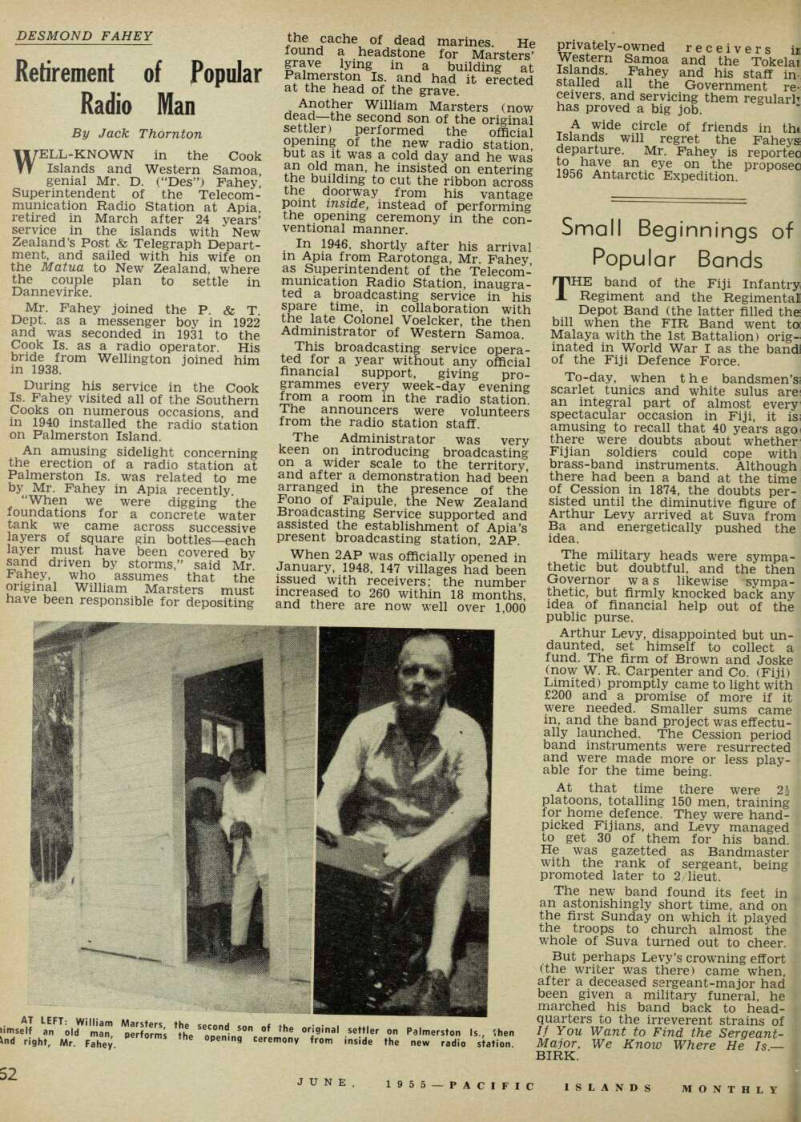
Another William Marsters (now dead—the second son of the original settler) performed the official opening of the new radio station, but as it was a cold day and he was an old man, he insisted on entering building to cut the ribbon across the doorway from his vantage point inside, instead of performing the opening ceremony in the con ventional manner.
In 1946, shortly after his arrival in Apia from Rarotonga, Mr. Fahey as Superintendent of the Telecom munication Radio Station, inaugra ted a broadcasting service in his spare time, in collaboration with the late Colonel Voelcker, the then Administrator of Western Samoa.
This broadcasting service opera ted for a year without any official financial support, giving pro grammes every week-day evening from a room in the radio station.
The announcers were volunteers from the radio station staff.
The Administrator was very keen on introducing broadcasting on a wider scale to the territory and after a demonstration had been arranged in the presence of the Fono of Faipule, the New Zealand Broadcasting Service supported and assisted the establishment of Apia’s present broadcasting station, 2AP.
When 2AP was officially opened in January, 1948, 147 villages had been issued with receivers; the number increased to 260 within 18 months, and there are now well over 1,000
privately-owned receivers ir Western Samoa and the Tokelat I fands. Fahey and his staff in stalled all the Government re ceivers, and servicing them regularh has proved a big job.
A wide circle of friends in th< Islands will regret the Faheyss departure. Mr. Fahey is reporteo to have an eye on the proposeo 1956 Antarctic Expedition.
AT LEFT: William Marster, the second son of the original sttler on Palmerston Is., then himself an old man, performs the opening ceremony from inside the radio station.
And right, Mr. Fahey.