Timber Trade Pioneers
pp. 62-63 · Read in the full issue
Adventure Story About Vanlkoro
The pioneering of the timber industry at Vanikoro, BSIP bv San Cristoyal Estates Ltd. 1923-24, had strong elements of adventure and drama writes Mr. Frederick Ashby, one of the pioneers, who now lives at Nadanvatu, Fiji).
IN 1923, the company bought the topsail schooner Houtu in NZ, and the writer, whose job was to buy milling and logging machinery and provisions for Vanikoro, was at Auckland to load the gear and then to sail with it to the Solomons.
The company engaged 11 first class kauri bushmen from North Auckland and sent them ahead via Sydney to Tulagi, the then BSIP capital.
After delays, I got the gear aboard only to find myself shut out. as one schooner had no passenger licence. Captain Broadhouse (since deceased) overcame this and other red tape by signing me on as purser at 1/- a month. The Houtu, 1 think, must have been the only topsail schooner (crew of five) ever to carry a purser.
With two semi-diesel Scandia engines, the Houtu was scheduled to sail to Tulagi in nine days. We had a Navy man as engineer—but he jlew the heads off both engines before we were 300 miles from Auck land.
Having no tropical experience, we .eft Auckland at the start of the hurricane season, and it seemed that we met every adverse wind that
,^ ow - The schooner, being
nat-bottomed, rolled with the best s ? lls were ri PPed to shreds off Walpole Island. The scheduled nine days voyage lasted for six weeks, H™^ e , ?r , n J ed a , l Tula « i to And the Hou J, u 'jsted as lost with all hands. f -My brother and the other men from NZ had been helping Mr A/ra B i n^ n t0 u recruit labour g from Malaita. About 75 men had been engaged, SCE paying £2O a head.
Overloaded when she left Auckland, the Houtu now carried -. m uaddition 75 boys, plus 11 hefty bushmen, for the 500 miles
from Tulagi to Vanikoro. An 18-ft launch was towed. The weather was fairly good and we reached Vanikoro in a week.
At one stage there was a minor not among the Malaita contingent apparently because of an earlier feud with Svensen during recruiting in Malaita. . In early January, 1924, we landed m a lovely bay, about five miles from the present Vanikoro settle ment, and found only a handful of diseased people who were dying out rapidly. At that time few people were interested in the Solomons, and 1 doubt if there were more than 30 Europeans, scattered between Rabaul and the New Hebrides.
The company’s plan was to land us at Vanikoro with a few weeks’ provisions. The schooner was to re turn to Tulagi for a full load of stores.
All went well ashore and, thanks to the experienced bushmen, we soon had all the logging and milling machinery installed. Then the Houtu sailed for Tulagi; and for six months there was complete silence.
The story goes that when the Houtu was about to load at Tulagi a mysterious fire broke out. The schooner was gutted and sank in the harbour.
The company then chartered the bi g schooner Mascot (Captain Buckley). She sailed for Vanikoro m February (still the hurricane season), struck a reef near Utapua Island, within 70 miles of Vanikoro, and sank with all our stores. Cap tain and crew got ashore in the small ships boat; and thus they and we were marooned within 70 miles of one another.
AT Vanikoro nearly all of us, Euro peans and Islanders, suffered from malaria. However, we managed to erect a village of pre cut timber (brought from NZ) and had about 600,000 ft of kauri logs m the lagoon for shipment. Our doctor (Dr. Mitchell, aged about 75) was responsible for saving all our lives, although two of our men died after returning to NZ.
One day a small boat containing four men was sighted coming up the bay. It was the Mascot’s boat, and the men had braved the 70 miles to seek food—from us, of all people.
We then held a general confer ence.
With our party from NZ were two
Maoris, whose bravery will live i my memory long after I have foi gotten the fools who still some times allege that the Polynesiai has no courage.” At the confer ence these two men volunteered tt take the 18-ft launch, with all th petrol it would hold, and attemn to reach Tulagi.
The tiny craft, with no more thaj 18-m. freeboard and a 5-hp Anden son motor, had been built at Christ) church, NZ, many years ago. Tlr magneto fired when the mood seize; With no sextant and no compass; the Maoris set out on the 500 mile: (m one direction or another) t-c Tulagi. They had a full load oc petrol and water, but only a scant; supply of food.
Those men reached Tulagi in 1 days. They told me later that at night they steered by the stars.
When the news reached the heao. office (then at Melbourne), thu company chartered the small cuttc; Niue, operated by one of the Austin brothers, who ran a plantation somewhere in the Solomons. Ttw Niue picked up our fever-stricken gang at Vanikoro, and the New Zealanders later went home bv way of Sydney.
BEFORE ending this story, I musi< add that at Vanikoro we were' visited by a Jap pearler with s small lugger and half a dozen diverse Now history relates that Ls Perouse lost his ships among the reefs at Vanikoro in 1788 (in recent] years somebody found a big anchor( in the lagoon), and it is also said) that La Perouse carried a large; store of gold and Spanish coins. which he deposited at the island.
Among the kauri we found a clean, space of about ten acres, which wo were led to believe was cleared byj the Frenchmen when they built as boat to escape from Vanikoro.
I find it hard to believe that they;
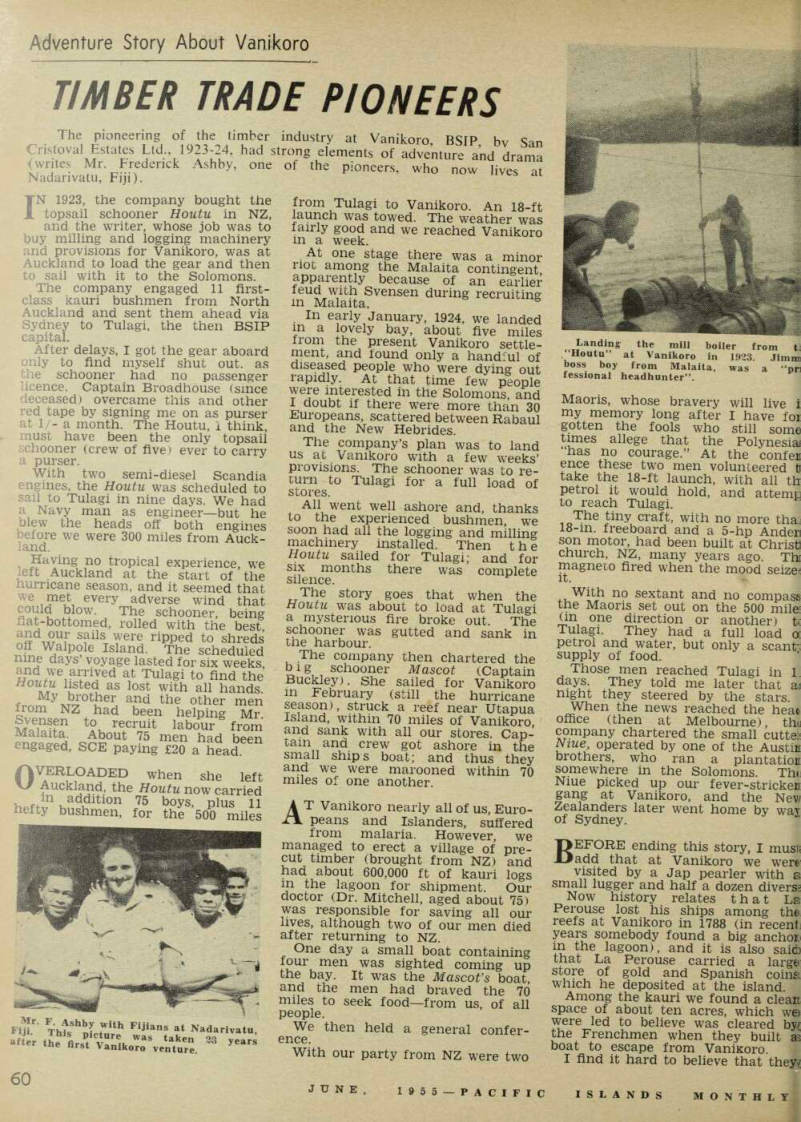
Mr. F. Ashby with Fijians at Nadarivatu, Fiji. This picture was taken 23 years after the first Vanikoro venture.
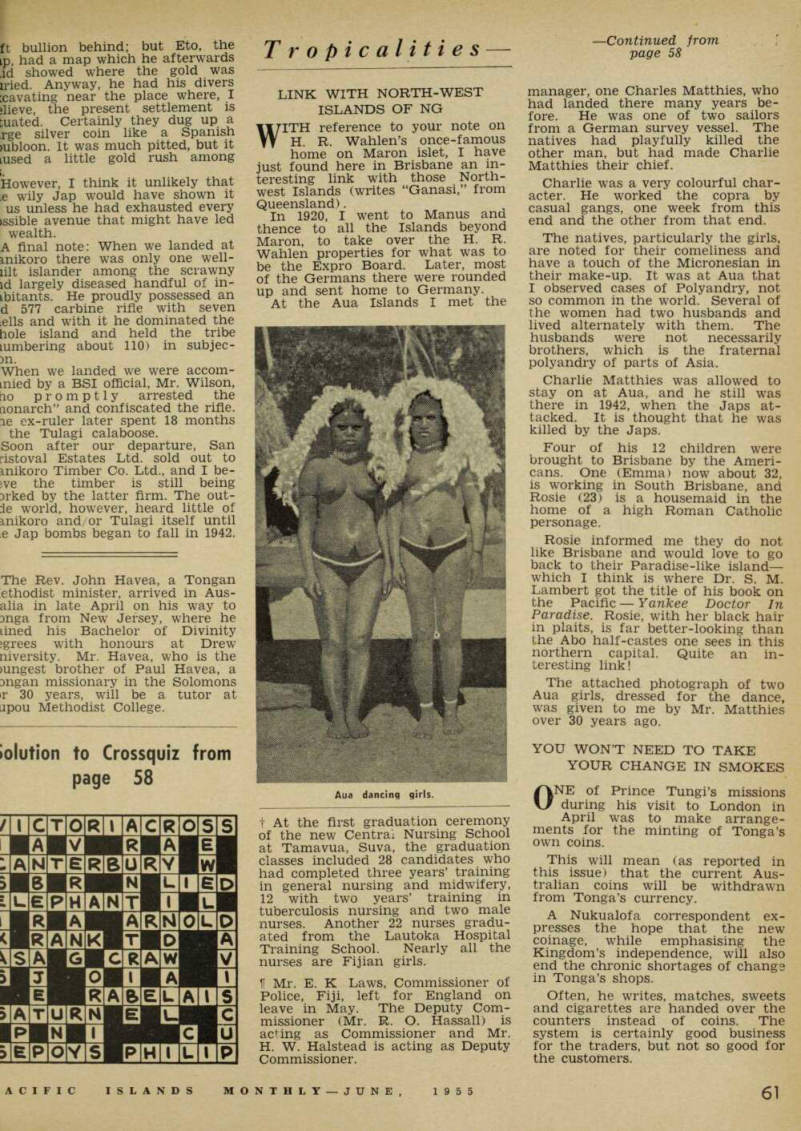
Landing the mill boiler from t [?] "Houtu” at Vanikoro in 1923. Jimm boss boy from Malaita, was a ”pr [?] fessional headhunter”.
ft bullion behind: but Eto, the ip, had a map which he afterwards id showed where the gold was iried. Anyway, he had his divers :cavating near the place where, I dieve, the present settlement is tuated. Certainly they dug up a rge silver coin like a Spanish >ubloon. It was much pitted, but it Lused a little gold rush among However, I think it unlikely that e wily Jap would have shown it us unless he had exhausted every issible avenue that might have led wealth.
A final note: When we landed at mikoro there was only one well lilt islander among the scrawny id largely diseased handful of in ibitants. He proudly possessed an d 577 carbine rifle with seven idls and with it he dominated the hole island and held the tribe lumbering about 110) in subjec m.
When we landed we were accom mied by a BSI official, Mr. Wilson, ho promptly arrested the aonarch” and confiscated the rifle, le ex-ruler later spent 18 months the Tulagi calaboose.
Soon after our departure, San ristoval Estates Ltd. sold out to mikoro Timber Co. Ltd., and I be ;ve the timber is still being Drked by the latter firm. The out le world, however, heard little of mikoro and/or Tulagi itself until e Jap bombs began to fall in 1942.
The Rev. John Havea, a Tongan ethodist minister, arrived in Aus alia in late April on his way to Dnga from New Jersey, where he lined his Bachelor of Divinity ;grees with honours at Drew niversity. Mr. Havea, who is the lungest brother of Paul Havea, a Dngan missionary in the Solomons r 30 years, will be a tutor at apou Methodist College.