of Visual Aids
pp. 52-55 · Read in the full issue


Educating The
Pacific Islander
SPC Tackles Problems of Visual Aids
HOW, within the limitations of finance, can the basic education of the Pacific Islander be speeded up?
A search for the best answers to this question is one of the principal projects of the South Pacific Com mission. In addition to many people in the Pacific area being illiterate, there is the problem of wide diversity of language and customs.
Visual methods of education appear to be the answer, but far from a simple answer.
The picture story that will be understood and absorbed by the people of Samoa might fall very flat in Manus, and the methods of meeting a problem which the picture story wishes to convey might have to be very different.
Subjects selected for experiment by the Visual Aids Officer of SPC in Sydney have so far been under the following heads: coconut culti vation, soil erosion and conserva
tion, mosquito-borne diseases, and general village health and hygiene.
Many different methods are be ing experimented with—coloured cartoons, cartoons for colouring in by school children, film strips for
projection by school and village projectors, black and white photos* posters, “flannel-graphs.”
Obviously, to serve their purpose these visual aids must be interest! ing, and, where possible, amusing
If they are merely educational they are unlikely to hold the attention of the people, and their lesson would probably not readily be absorbed.
A typical example of the method of approach is seen in two coloured cartoons that have already been issued. In both is an amusingly stupid character named Henry— though his name may take a dozen different forms in different Island Groups.
There is “Henry and the Rhino ceros Beetle” for example. In 35 pictures guaranteed to interest even
the most educated, the complete story of rhinoceros beetle detection and eradication is told through the antics of Henry and the explana tions of the Agricultural Officer.
Even without captions the story could be understood by most people.
Captions are, of course, a problem.
The language problem prevents standardisation for use throughout the South Pacific. So captions may be added locally to posters.
In the case of movie films, there has been a technical development of great importance to a project of this nature during the past couple of years. With the development and popularisation of the magnetic tape recorder there has also come a system of adding a magnetic strip along the margin of the now popular
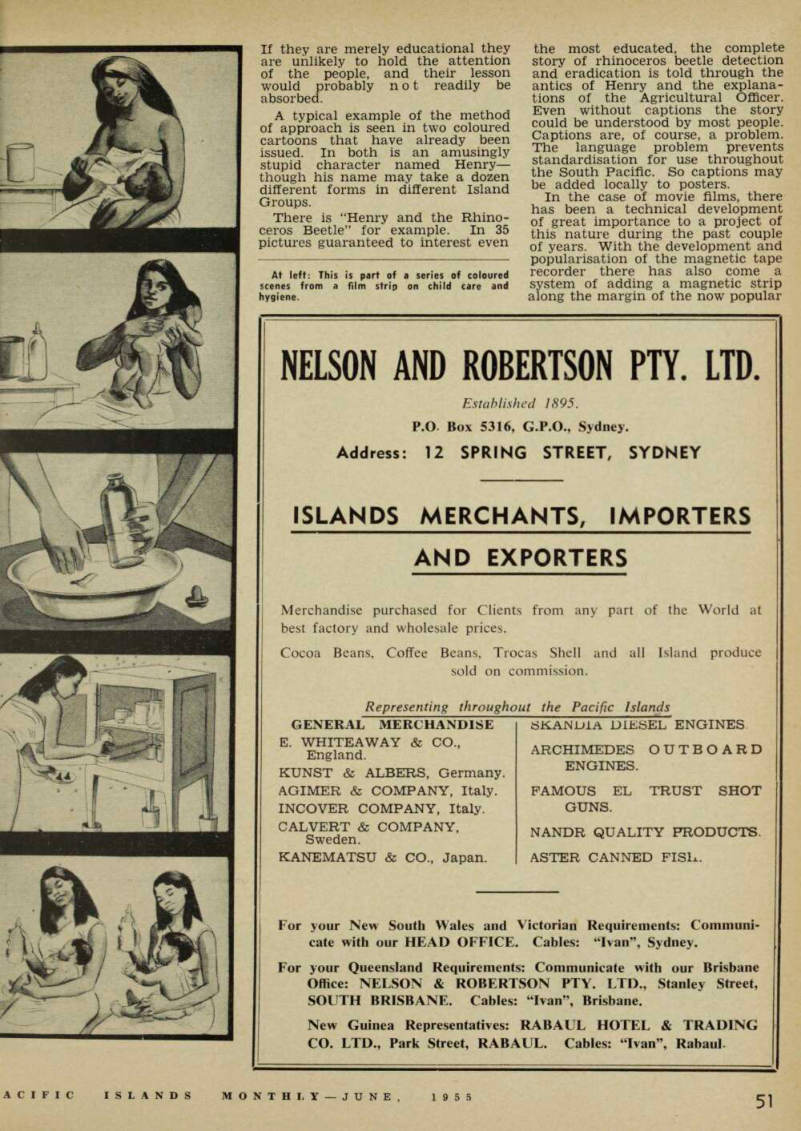
At left; This is part of a series of coloured scenes from a film strip on child care and hygiene.
lillimetre film. This means that jommentary may be dubbed [ly, in any desired language, to lund film, if the equipment is land. A person understanding ish and the local language can nge a local-language script to ;he scenes of the film. Later commentary may be “wiped” i the sound track of the film (as sound may be wiped from re er tape or wire) and one in her language substituted. This ns that even the smallest uage-minorities may now be hed by means of sound films tieir own language. It is a de pment of considerable signific ; in the educational field in the ids, where so many languages involved. iptions to posters, where called will still have to be added in local languages to the standard ares, where only a minority of ons speak English or French. le Visual Aids section em sises that the work is still very h in the experimental stage, h will depend on local advice comment on the effectiveness naterial already issued. 3 C has now issued a Film and istrip Catalogue listing material lable from the SPC library (3/per copy from Visual Aids jer, PO Box 5254, Sydney). Also lable is a manual (2/6 Stg.) on to make film strips, intended
as an aid to local educational authorities. No great technical skill is called for in this direction and the local production, perhaps more applicable and better understood by the local people, is often the most effective. The Commission’s own film strips, complete with printed commentary in English, are avail able at 30/- Australian currency.
SPC is also building up a library of native songs, musical dances, ceremonies, important speeches, etc., in co-operation with Island radio stations. Copies will be made on disc or tape as required and will be sold at cost to radio stations in other areas of the Islands where they will promote better inter- Pacific understanding. Copies will also be sold to outsiders. No catalogue has been issued as yet, but the availability of such record ings should be of great interest.
In May, Mrs. Nancy Phelan, SPC Visual Aids Officer, left Sydney for the Gilbert and Ellice Islands Colony in continuation of her research into the local problems of visual and aural education in the South Pacific. t A processional service was held at the Vavau Roman Catholic Church, Tonga, in honour of St. Peter Chanel, famous French priest canonised last year. Of special interest to Poly nesian congregations, St. Peter Chanel performed his life work at lonely Futuna Island.