Editorial ...
pp. 15-16 · Read in the full issue
50 Million Chinese Are Pressing Southwards
A Despatch
From
R. W. Robson
tNGAPORE, May 30.—Here, where only a few days ago Communist led mobs of Malayans and tinese students were savagely at ;king the city’s police and British »ops directed by the Governor (Sir bn Nicoll, lately Colonial Secre ■y in Fiji), I have just read that jarty of selected Parliamentarians being sent by the Australian mmonwealth Government to see ■' themselves what really is hap ling in and around Southeast ia. fhat sort of announcement irally makes one sick. It indicates it, even yet, Australia cannot be re that the roof of her precious ise, resting on Indonesia, is in iger—is actually smouldering.
Joscow-directed Communists have ir-run all Eastern Asia; their in mce is dominant now in Indo ina and Indonesia; they have in rated deeply in Malaya, Burma 1 Siam; and yet Australia (the iural protector of all the South bfic Islands) thinks she has time i opportunity to build a Welfare te around a 40-hours’ week, ntless State lotteries, whimsical ocations of major industries by tist union leaders, and indiffer e to world affairs! /hat is the use of sending Parlia itarians to this area, already vulsed by pro-Red and anti opean developments which are ling steadily in strength and erness? What is to be achieved providing Australian politicians inety per cent, of whom are in able of intelligent observation, way—with a glorified picnic in Far East? too much has been lost, already. The coming of this thing was seen clearly back in 1945-50 period, when Russia iched her great plan of crippling Western Powers by “Communis- Asia and Africa and turning n against the Europeans. An est over-all survey to-day will /ince anyone that the Red plan been working perfectly for ■s. have just come from Indonesia, re, I experienced for myself the •ed of the official, semi-educated inese for all Europeans, and cially the Dutch, be condition of the Dutch is r tragedy. In 350 years’ occupa ■» they transformed the East es from a haphazard collection nsignificant communities, ruled :ountless petty tyrants, into the nshing, well-fed, well-ordered nre of the Netherlands Indies.
When the Japanese invasion came, there were there some 50,000 Dutch, 200,000 Du t c h-Indonesians, and Dutch investments worth many hundreds of millions of pounds.
United States and Britain, after the war, deserted the Dutch, and allowed a Jap-inspired gang of Javanese politicians to seize admin istrative control of the whole region (population at least 80 millions).
They call it “the Republic of In donesia.” And you should see it now!
THE real rulers of the country are the 2 i million Chinese merchants, traders, artisans, ship-owners. They do not appear in politics—but they unquestionably direct the Communist Party (20,000, officially, and growing), and the Reds quietly control the so-called Government.
Recently, the Indonesian Govern ment became quite aggressive and insisted (atfer friendly parleys with the Reds in Peking!) that the Chinese within six months choose
between Indo nesia and China (Communist China) citizen ship. The Indo nes i a n Chinese are not perturbed —they know how to get over that one.
Meanwhile the Indonesian officials are dis playing in every possible way their hatred of the Dutch, and their uncompromising determination to drive out not only the full-blooded Dutch, but also the Dutch-Indo nesians. There are at least 200,000 of them the products of mixed marriages which have been taking place for some 300 years. These folk always have enjoyed Dutch status and the choice forced upon them by the relentless officials —lndonesian or Dutch citizenship —is cruel. If they
choose Dutch, they will surely be driven out. If they go Indonesian, they are subjected to all sorts of humiliations and civic injustice.
The Dutch, and the Dutch- Indonesians who are retaining their status, are leaving the country in a steady stream, abandoning most of their possessions. As they move out of their old-established homes and businesses, the Chinese and the Indonesians move in.
At first, I was puzzled by the extraordinary black-market demand for Western money—especially Aus tralian and English notes. If you can smuggle notes past the port officials—you are searched with dis concerting and disrespectful thoroughness—you can get, in the debased rupiahs, four or five times the official rate of exchange. That is because the outgoing Dutch are pre pared to do almost anything to re tain some fragment of their personal wealth, which they can carry out in carefully concealed Western money.
The rupiah is practically valueless outside Indonesia Nothing gives these Indonesian officials greater pleasure than to witness the departure of the Dutch men beggared and humiliated.
TRAVELLERS are urgently warned against wandering around in Indonesia without protection
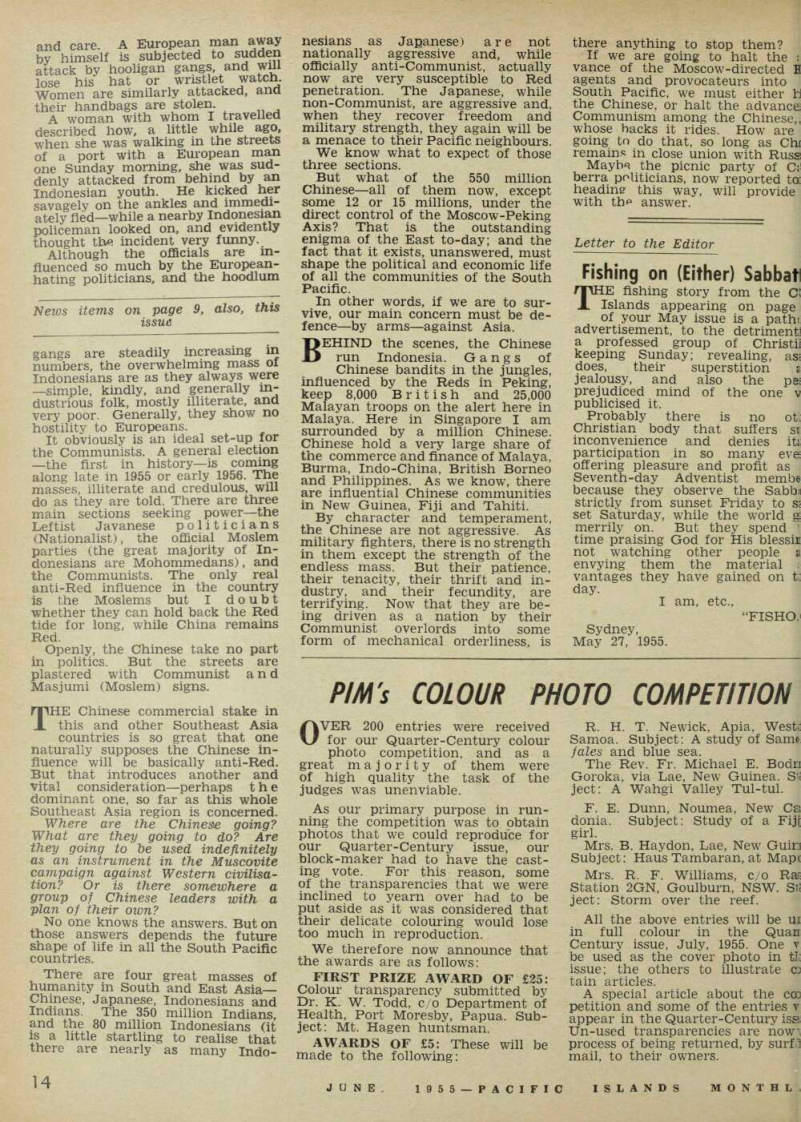
THE DOC. (who has objected to Australian troops going to Malaya): “No, no—do nothing until they actually land, and don’t shoot until you see the whites of their eyes!”
and care. A European man away by himself is subjected to sudden attack by hooligan gangs and will lose his hat or wristlet watch.
Women are similarly attacked, and their handbags are stolen, A woman with whom I travelled described how, a little while ago. when she was walking in the streets of a port with a European man one Sunday morning, she was sud denly attacked from behind by an Indonesian youth. He kicked her savagely on the ankles and immedi ately fled—while a nearby Indonesian policeman looked on, and evidently thought the incident very funny.
Although the officials are in fluenced so much by the European hating politicians, and the hoodlum
News items on page 9, also, this issue
gangs are steadily increasing in numbers, the overwhelming mass of Indonesians are as they always were —simple, kindly, and generally in dustrious folk, mostly illiterate, and very poor. Generally, they show no hostility to Europeans.
It obviously is an ideal set-up for the Communists. A general election —the first in history—is coming along late in 1955 or early 1956. The masses, illiterate and credulous, will do as they are told. There are three main sections seeking power—the Leftist Javanese politicians (Nationalist), the official Moslem parties (the great majority of In donesians are Mohommedans), and the Communists. The only real anti-Red influence in the country is the Moslems but I doubt whether they can hold back the Red tide for long, while China remains Red.
Openly, the Chinese take no part in politics. But the streets are plastered with Communist and Masjumi (Moslem) signs.
THE Chinese commercial stake in this and other Southeast Asia countries is so great that one naturally supposes the Chinese in fluence will be basically anti-Red.
But that introduces another and vital consideration—perhaps the dominant one, so far as this whole Southeast Asia region is concerned.
Where are the Chinese going?
What are they going to do? Are they going to be used indefinitely as an instrument in the Muscovite campaign against Western civilisa tion? Or is there somewhere a group of Chinese leaders with a plan of their own?
No one knows the answers. But on those answers depends the future shape of life in all the South Pacific countries.
There are four great masses of humanity in South and East Asia— Chinese, Japanese, Indonesians and Indians. The 350 million Indians, and the 80 million Indonesians (it is a little startling to realise that there are nearly as many Indo
nesians as Japanese) are not nationally aggressive and, while officially anti-Communist, actually now are very susceptible to Red penetration. The Japanese, while non-Communist, are aggressive and, when they recover freedom and military strength, they again will be a menace to their Pacific neighbours.
We know what to expect of those three sections.
But what of the 550 million Chinese —all of them now, except some 12 or 15 millions, under the direct control of the Moscow-Peking Axis? That is the outstanding enigma of the East to-day; and the fact that it exists, unanswered, must shape the political and economic life of all the communities of the South Pacific.
In other words, if we are to sur vive, our main concern must be de fence —by arms—against Asia.
BEHIND the scenes, the Chinese run Indonesia. Gangs of Chinese bandits in the jungles, influenced by the Reds in Peking, keep 8,000 British and 25,000 Malayan troops on the alert here in Malaya. Here in Singapore I am surrounded by a million Chinese.
Chinese hold a very large share of the commerce and finance of Malaya, Burma, Indo-China, British Borneo and Philippines. As we know, there are influential Chinese communities in New Guinea, Fiji and Tahiti.
By character and temperament, the Chinese are not aggressive. As military fighters, there is no strength in them except the strength of the endless mass. But their patience, their tenacity, their thrift and in dustry, and their fecundity, are terrifying. Now that they are be ing driven as a nation by their Communist overlords into some form of mechanical orderliness, is
there anything to stop them?
If we are going to halt the i vance of the Moscow-directed H agents and provocateurs into South Pacific, we must either hi the Chinese, or halt the advance Communism among the Chinese,, whose backs it rides. How are going to do that, so long as Chi remains in close union with Russ the picnic party of d' berra politicians, now reported toe headim? this way, will provide with tho answer.