Gustav Mara Hennings
pp. 131-133 · Read in the full issue
Ni Sa Moce
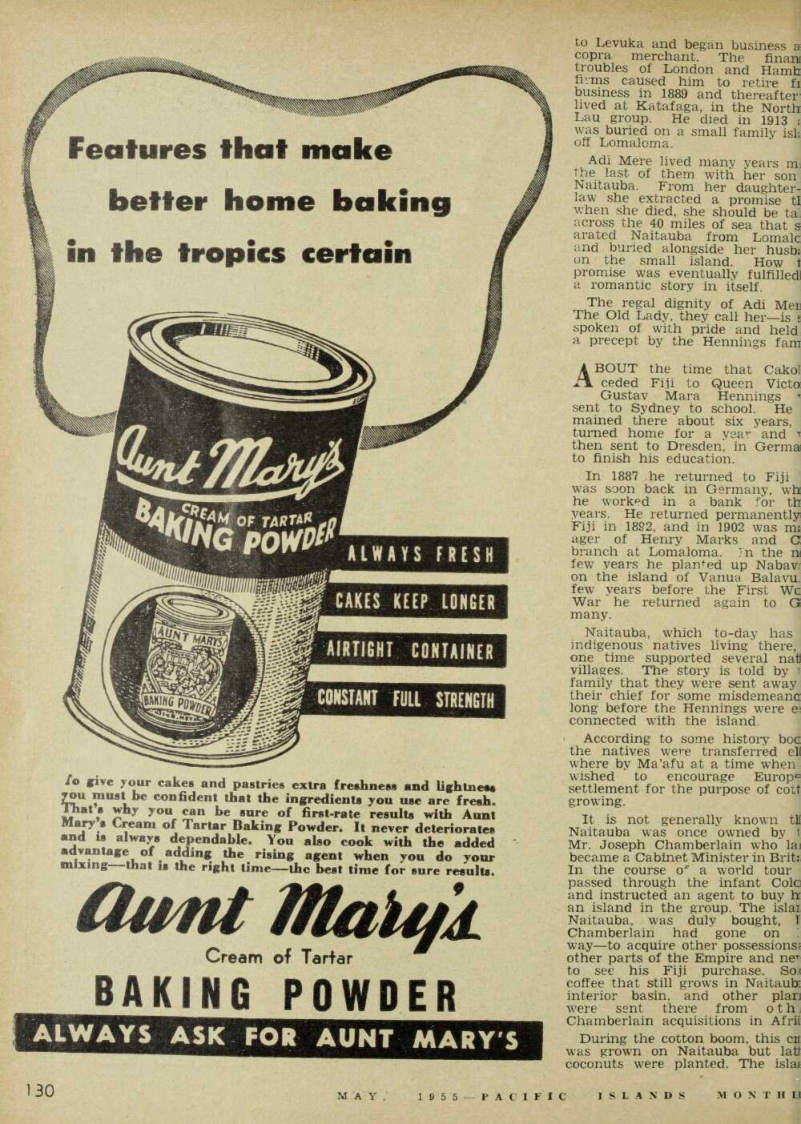
THE whole of Fiji’s modern history was encompassed by the life of Gustav Mara Hennings, who died at his plantation home, Naitauba Island. Lau, on April 17.
He was born before Cession, in 1868: was a child of six when Cakobau gave Fiji into the keeping of Victoria: and by birth and in tellect, and by the long years of his life, was a repository for Fiji’s traditions and the story of Euro pean penetration of the Colony.
Unfortunately, as in the case of other pioneers, much of this history —or many of the small facets that turn history from a dry record to a human document —has gone un recorded and will likely be lost.
Throughout Fiji, he was known simply as Gus. By his daughters, by the young man who lived in his house, by most of the older residents of Fiji. Perhaps there is a Fijian reason for this; but, if so, I do not know it. The Pacific does not lack for men who are known by a Christian name. Mostly they are the sort of men whom one regards with tolerant affection. Tolerant affection is not a phrase that could be applied to Gustav Hennings in any circumstances; he was, always, the grand seigneur. His greatest condemnation of anyone was that he was “not a gentleman.”
He was born in Lakeba in De cember, 1868. His father was Mr.
William Hennings, one of four brothers who went from Germany, via Australia, to settle in Fiji about 1860. His mother was Adi Mere, a Lauan lady of high rank, daughter of Ratu Mara and a niece of Ratu Cakobau. William Hennings and his brothers established the cotton industry in Fiji and, at one time, their firm was one of the most im portant in the group Scarcely an
island exists in northern Lau which has not belonged to or has been connected with the Hennings family at one time.
After the slump in cotton in the 70’s, the brothers dissolved partner ship and William Hennings went
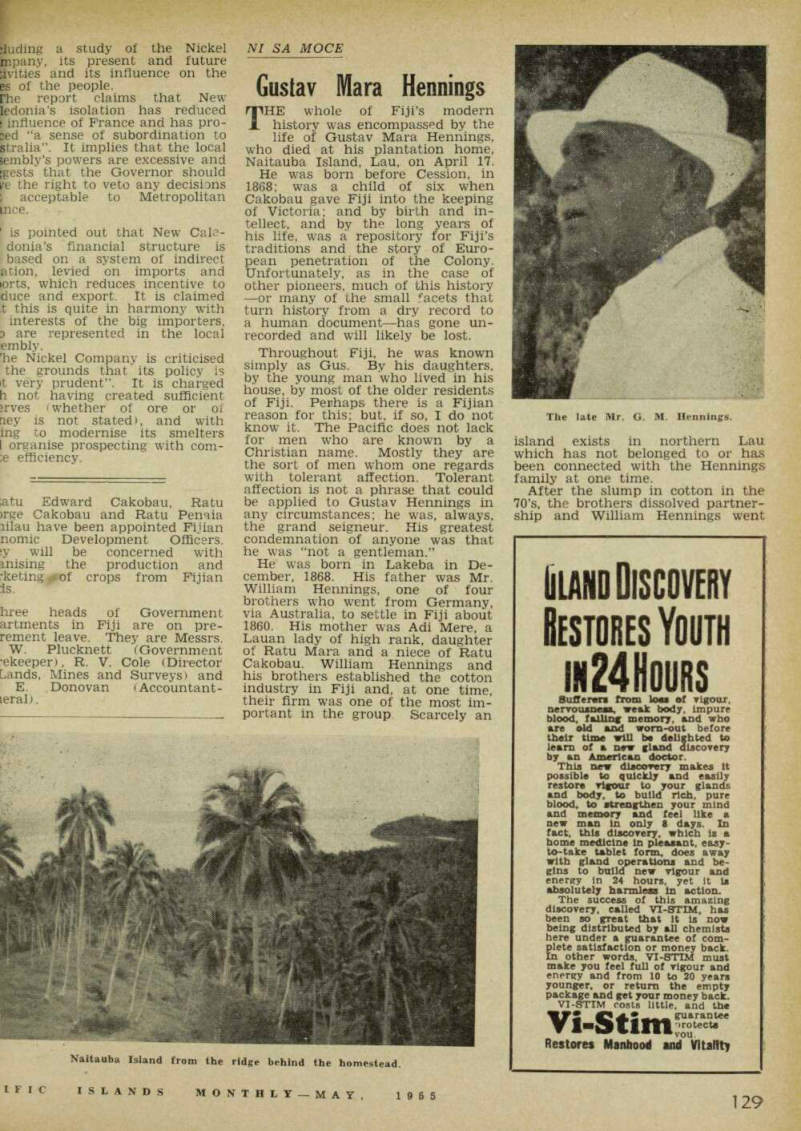
The late Mr. G. M. Hennings.
to Levuka and began business a copra merchant. The finani troubles of London and Hamh firms caused him to retire fi business in 1889 and thereafter lived at Katafaga, in the North Lau group. He died in 1913 s was buried on a small family islj. off Lomaloma.
Adi Mere lived many years mj the last of them with her son Naitauba. From her daughter law she extracted a promise tl when she died, she should be tal across the 40 miles of sea that s arated Naitauba from Lomalc and buried alongside her hush on the small island. How t promise was eventually fulfilledl a romantic story in itself.
The regal dignity of Adi Men The Old Lady, they call her—is s spoken of with pride and held a precept by the Hennings farrr A BOUT the time that Cakol ceded Fi.ii to Queen Victa Gustav Mara Hennings T sent to Sydney to school. He mained there about six years, turned home for a year and i then sent to Dresden, in Germaf to finish his education.
In 1887 he returned to Fiji was soon back in Germany, whi he worked in a bank for th years. He returned permanently Fiji in 1892, and in 1902 was ms ager of Henry Marks and C branch at Lomaloma. In the m few years he planned up Nabav: on the island of Vanua Balavu. few years before the First Wc War he returned again to G many.
Naitauba, which to-day has indigenous natives living there, one time supported several nati villages. The story is told by i family that they were sent away their chief for some misdemeanor long before the Hennings were e; connected with the island.
According to some history boc the natives were transferred ell where by Ma’afu at a time when wished to encourage Europe settlement for the purpose of cott growing.
It is not generally known tM Naitauba was once owned by 1 Mr. Joseph Chamberlain who lai became a Cabinet Minister in Brits, In the course o J a world tour passed through the infant Colo and instructed an agent to buy hr an island in the group. The islai Naitauba. was duly bought, T Chamberlain had gone on way—to acquire other possessions? other parts of the Empire and ner to see his Fiji purchase. So.( coffee that still grows in Naitaub: interior basin, and other plan were sent there from othj Chamberlain acquisitions in Afrii During the cotton boom, this cn was grown on Naitauba but latf coconuts were planted. The islaf
; first leased by Mr. Chris mings. brother of William, and >r purchased by him from imberlain’s agent. At Mr. Chris mings’ death, the property went his nephew, Gas, and it was le Mr. Gus Hennings was in ■many settling Chris Hennings’ ghter in school there, that he Elizabeth Vogel, who shortly be ie his bride. They returned to in 1912. [rs. Hennings often tells how, iming of Fiji as a land of lush dripping tropical fruit, she red at Nabavatu at the end of of the worst droughts in the ory of the Lau Group. Scarcely jreen thing remained on the itation, and she waited months aste her first tropical fruit. ; that time, and until after the t War, the Hennings spent only ew months of each year at auba. The heat during the hot on was considered too great, huge mango trees that now shadow and bring coolness to homestead were either not then ted or only small saplings, is has always been a lover of s and there were few years in life when he had not owned a eful vessel of some kind. Right he end, he subscribed to ship yachting magazines and pored drawings and photographs with enthusiasm of a youngster, man of culture, of wide vision brilliant wit, he was also a ,n chief. Sometimes, all Fijian Amongst the numerous ites to-him that we received :one wrote that he was “a king lis own island.” Perhaps this so—but he was a king always 5 conscious of his obligations of his privileges. The Fijian iy system works both ways and nfluence with his Lauan people, his solicitude for them, were lly great. rhaps more than anything else, ras a great cosmopolitan. He I to talk of his student days ■ermany, long before the First d War and thought at one time •ining the German Navy, until as discovered that his British mality. disqualified him. To brought up in a period when i are inevitably international lies” and “baddies,” to hear of rid back before rabid national book control, is shattering. But agine that the world of young av Mara Hennings was very i more “One World” than that i his grandson faces —in spits le efforts of legions of well ling present-day propagandists. . Hennings is survived by his v and three daughters— beth, who is at present living aitauba; Sophie (Mrs. C. M. ington-Richards) of London; Mara (Mrs. R. J. Miller) of ;a Wagga, NSW; and by his it grandson, Donald Gustav r life held full measure of joy, w, tragedy, disaster, fulfilment,
happiness; it was lived at a period that, in human affairs, has had no equal; few lives have been as in teresting.—JT.