The Fat Ladies Go Duva Fishing
pp. 123-124 · Read in the full issue
the Fijians of the Lau Islands, a pleasure excursion means an expedition for food. So, when et out to go around Naitauba in plantation launch, the half n Fijians on board were more •ested on what lay under the r, leaving me to look at the »ry. We chased a turtle; and t an hour bobbing about while dived down 20 to 30 feet jgh clear turquoise water to r up giant clams, or to spear jow-hued fish with long spears, t the expedition with the Fat es was designed for provision purposes, and to show me how ; fishing was carried out in arly all the Lauan ladies on luba qualify as Fat Ladies, and put a lot of thought into keep ;hemselves that way: With every that passes some of them are ed in the flat-bottomed dinghy near the reef dangling at the of a fishing line —and with tordinary success. Some of the in ladies are good fisher en, too —but not even Naitauba seems to make an Indian a mder in the Fat Lady stakes. iva fishing is certainly more itic than line fishing—but the ts are more quickly achieved.
And it is a community effort and good fun. First requirement is a supply of duva —derris root, to you —which looks like a long srtick, an inch or so thick and several feet long. It is broken up in short lengths and pounded to a stringy
pulp by bashing it with a piece of coral rock. Then a suitable por tion of reef is located, a cork net is unrolled to form a circle, the pounded derris root is drawn back and forth in the encircled patch of water and after a few moments the excitement begins.
The fish do not float belly-up wards on the surface of the water
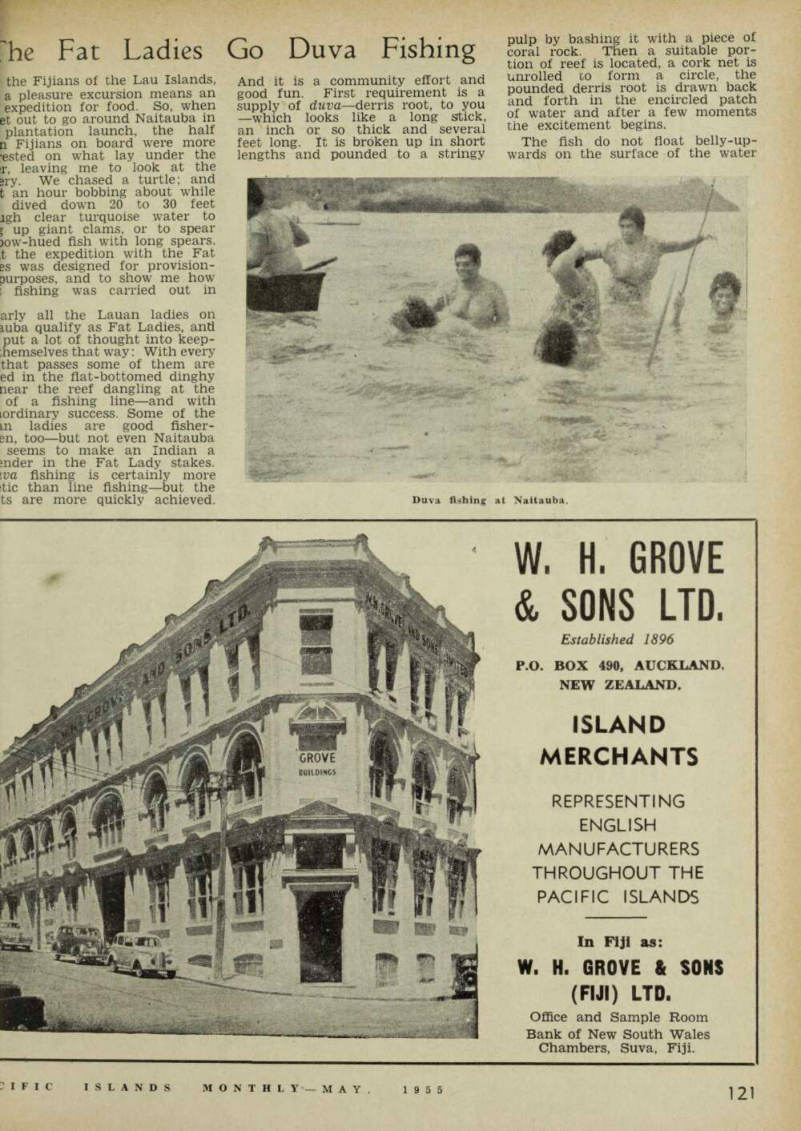
Duva fishing at Naitauba.
and the surface of the water. They make no attempt to escape and can be caught easily with the hands or a fish spear. After one portion of reef is fished out the party moves off to another section and the performance is repeated.
All this was interesting; but even more so were the Fat Ladies themselves. All of them are am phibious—but by no stretch of the imagination can they be called graceful swimmers. They propel themselves through the water with ease but they would win no prizes at the Olympics for style.
Being first of all modest, they go into the water fully dressed and they adopt the easiest method pos sible for getting their 16-stone apiece into the sea. Usually they simply sit on the side of the launch, put their heads down and topple in. No —they don’t hit the water like a tidal upheaval. The whole performance is more like the slow submergence of hippopotami.
And they adopt much the same procedure when they are catching the fish. First, under goes the head, then a very broad behind, covered with gaudy print, hovers, half awash, on the surface, then it too disappears leaving only a pair of bare heels to thresh the surface. Then the whole thing in reverse—heels disappear—bottom comes up—then Fat Lady’s torso and face, complete with diving goggles, said face working over time while Fat Lady’s hands wave
aloft in triumph yet another fish.
This will always be my memory of duva fishing.
The photograph shows some of the triumphant Fat Ladies. I got some very good movies of the whole duva process—but a bobbing dinghy is not the best place to take still photographs and the Fat Ladies are not presented here as well as they might be.—J.T. if Mr. and Mrs. John Watts, who were married in Sydney in April, will live at Penang, Fiji. Mrs. Watts was formerly Miss Beverley
McKellar, only daughter of the Mr. W. E. McKellar, of Lindfl NSW, and of Mrs. H. S. McKe of Lindfield, NSW. Mrs. F. Ke of Fiji, was matron of honoui the wedding.
H Mr. Henri Bonneaud, Geni Manager of Establissements I lande, of Noumea, and a mem of the New Caledonia Conseil G eral, returned to Noumea late April after visiting Europe Japan M. Bonneaud was repo: to have arranged the sale of 35C tons of nickel ore to Japan w, in that country.