News Of The Small-Ships
pp. 103-116 · Read in the full issue
[• Happened In May;—When
th Pacific Airlines start their LOlulu-Papeete service this year, •e is likely to be renewed in st in Malden, Vostock, and t, which lie at points along the ct route south. So it is interest to recall that the 3-masted, 1 net-tons iron barque John ray (ex Loch Ryan ), bound from Francisco to Australia, crashed he reef at the north-east corner Vlalden in the early hours of ’ 22, 1918. The vessel, after a : period of idleness, had been missioned by the Australian ernment to meet wartime ship ; needs, and was on her first id trip to the States when she her end at 41 years of age. ■om observations the previous ling, Captain George Vaughan estimated that Malden would ighted about 8 am. The wreck rred about 3.30 am, shortly after nset. Fortunately, weather con ms were good and the 28 men ning the boats, made a safe ing at daybreak, to find the id inhabited by a Mr. Grice, of Melbourne firm of Grice, ner & Co., and 15 Cook Island engaged in digging guano, me hours after landing, a fall spar detonated the explosives on ;, blowing the ship apart. Had
that not happened it is possible that contact with the outside world could have been made by the radio transmitter and electric power plant which had just been installed 17 days earlier at ’Frisco —though no radio operator was carried.
As it was, Malden had not had a ship for a year, and was not ex pecting one for some months. No guano had been exported since 1914.
It was being stockpiled, and some 10,000 tons was at the loading point.
A few days after the wreck, a 4-masted barquentine passed close to Malden but did not respond to signals. Then, on June 9, the men woke to find the 500-ton 3-masted Honolulu schooner Annie Larsen parked on the reef within a stone’s throw of the remains of their own ship. Little damaged, but firm on the reef, she, too, became a write off, and from her trooped ashore Captain Verzon, his wife, two chil dren, and nine seamen to join the band of castaways. Stores, and urgently-needed water, were salvaged from the schooner.
As there seemed little hope of early rescue, and as friction soon developed between the three groups at the island, Captain Vaughan and two of his men set out for Fanning in a boat from an earlier wreck, the Fram, reaching there safely 13 days
later. Australia was advised of the situation by cable.
Those at Malden, doubtful of the success of that voyage, made other plans, and when no ship had arrived by July 27, the mate of John Murray, Mr. Chugg, set sail with two more seamen for Penrhyn in
one of the John Murray’s boats — arriving there 4i days later.
On August 7 the Howard Smith vessel Macedon, south-bound from ’Frisco, arrived off Malden. She had been on the point of sailing from ’Frisco when word came from Mel bourne of the wrecks.
Macedon landed cargo for Grice, replacing that used by his un expected visitors, and the vessel de parted with the castaways aboard.
The Americans were landed at Suva to catch a northbound vessel for Honolulu.
Arriving at an Australian port, the John Murray men found Cap tain Vaughan on the wharf. He had caught a Cable Co schooner from Fanning to Honolulu, and a mail ship south. But Mate Chugg had
to wait some time at Penrhyn be fore a schooner finally arrived from Rarotonga.
Some time later, Grice and his Islanders abandoned Malden to the sea-birds when another schooner called from the Cooks.
Captain Vaughan was acquitted of responsibility by the Marine
Court investigating the John Mm wreck. How Captain Verzon f;: is not known. But we do know tt before these two wrecks, Maj had claimed at least ten otli most of them while loading gu at the dangerous open roadsteae
Navua Coming: — Navua,
USS Co. fruit vessel of 2,000 •
KOBO, latest of the popular Bjarne Halvorsen-built 56 ft. copra scows to go to the Islands from Sydney. KOBO joined the STC fleet at Port Moresby (see last month).
idweight, was launched In Feb ,ry at a Scottish shipyard.
JACK TO WORK:—The hurri le season ended and the vessels rhauled, Charlotte Donald has arned from Papeete and Inspire m Auckland to resume duties in Cooks inter-island trade. In re, converted Bri’xham trawler, I her hatch enlarged!, a new and ?er motor installed, and her fts and propellers replaced at ;kland.
Vhy Freights Are High:
i they complain that the freight 5S to Lord Howe and Norfolk are essive?” said Captain Emile roie, of Noumea, to a PIM rep 3ntative some time ago. “Mon ir, I tell you that those places terrible! First it is calm. Then, I! It is blowing a gale. Or there no wind but the swell is im sible. First we anchor here, then re, then we put to sea. Non, i, non, Monsieur. No rate is too h for those places!” laptain Savoie should know, for ; of his vessels was wrecked at d Howe last year, and another I a very narrow escape there. n March Maria del Mar, the roie flagship, was in trouble at :folk. The vessel was loading pty drums. Bad weather came and the master decided to put sea, but in the heavy swell the idlass carried away. Eventually cable had to be buoyed and iped. The vessel departed >ing to recover the anchor some er time.
In route to Noumea, Maria del r, for whom hurricanes appear have a penchant, received an er battering as a storm moved m into the Tasman.
'IRST SUB;—First submarine to [ at Pago Pago since the war, USS Tirus paid a brief visit in ril.
’Onga Keeps Guard:—Nu
ilofa Radio is to be congratulated the first Islands station to estab -1 a distress watch on the inter ional R/T distress frequency of 2 kc/s. Ship watch is now being intained from 1740 to 0940 GMT ly. holidays included. ydney, and the three New Zea d coast stations, are the only
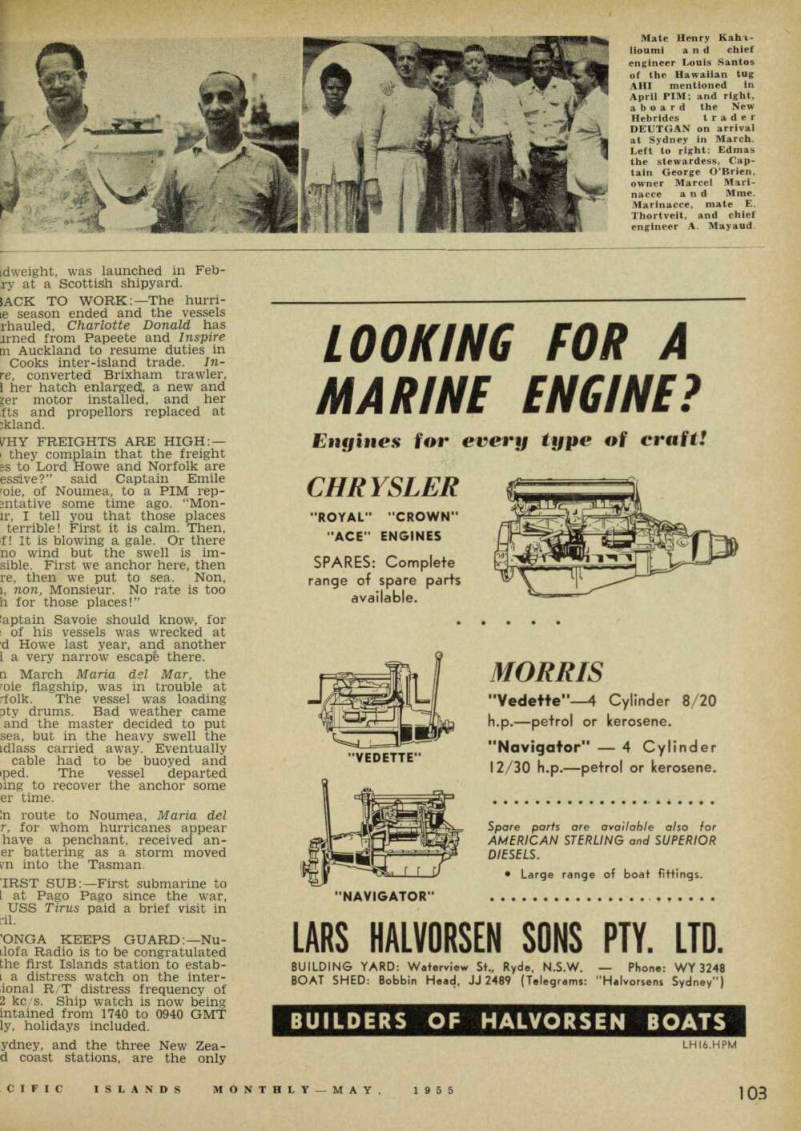
Mate Henry Kaha lioumi and chief engineer Louis Santos of the Hawaiian tug AHI mentioned in April PIM; and right, aboard the New Hebrides trader DEUTGAN on arrival at Sydney in March.
Left to right: Edmas the stewardess, Cap tain George O’Brien, owner Marcel Mari nacce and Mme.
Marinacce, mate E.
Thortveit, and chief engineer A. Mayaud.
r South Pacific stations comply with international requirements lis respect. Other coast stations any one of a dozen unstandard uencies, suitable for local re sments, but of little use to a
yacht or other internationally equipped vessel in distress in their vicinity.
AS IS, WHERE IS:—Two vessels were offered for sale, “as is, where is” in April.
One was the Japanese tuna ves sel Daikoko Maru No. 3 as she lies on Uwero Reef, east coast of Bou gainville, in the hands of the New Guinea Receiver of Wrecks. She was abandoned by her crew when they were picked up by another Jap vessel after she went ashore some months ago.
The other was the standard Aus tralian-built 300-tonner, Rannah, high and dry and not greatly
[?]dalay”, ashore on the south coast of Santo March 11, but since salvaged.
Photo: R. Discombe.
damaged, sitting on Rarotonga’s foreshore “about 45 yards inside reef” —offered by the insurance brokers. (See photo Feb., p. 113.)
Wants Smaller Ship:
Master Mariner the Rt. Rev. A. F.
Hill, Bishop of Melanesia, considers that the Anglican Melanesian Mis sion would be better served by a smaller vessel than the Southern Cross VII, now retired and for sale in Sydney.
The Mission authorities in Eng land had claimed the right of se lecting the design in the past, be cause they had provided most of the funds, but this time New Zea land was providing the lion’s share and some Mission authorities there felt that they should have more say in the matter. The Bishop con siders a vessel of 70 or 80 tons as suitable. Southern Cross VII is 298 tons gross.
Bishop Hill, bound for England, said he was also going to press that the vessel be built in Aus tralia or New Zealand.
The Captain Swore:—When
the 300-ton Italian-built wooden vessel Vasu, which was advertised in April for £NZ3O,OOO, arrived at Aitutaki with a cargo of aviation gasoline, flour, and sugar in mid- March, there was some soft swear ing on the bridge as the hatches came off. A leaking drum of gaso line had contaminated 20 tons of the urgently-needed flour and 3
tons of sugar, which were towed out to sea in a barge and dumped soon after Vasu resumed her voyage to Niue and Suva. She was expected back in Auckland in late April. ,SMP KO: — Rcs Nareau, one of the GEIC Government’s little ves
sels which tramp from Christrm the Solomons, was expected at hna, NSW, late in April, ui command of Captain W. C Fau for her annual refit. Most of] Western Pacific High Comj sioners charges go to Ballinai major work, though some go to a when facilities are availt
•eau should return to her wan ings by late June.
[Osquito Fleet:—Ten 20-Ft
an cabin launches are at present ig built in Sydney by Vincent s for delivery to Andrews & >erts Ltd., of Port Moresby, as t of their fleet of hire-launches, i launches are sturdily built and powered with Vincents “Vinco” p petrol motors. The first five be shipped north shortly, he same firm has already de red somewhat similar launches customers in the Solomons and
Or Samoa Flag?:—The 300-
ner Vasily mentioned elsewhere, j change to Apia ownership if a reports eventuate. Mr. J. Paul Mr. A. MacDonald, of Western 10a, were in Suva recently look the vessel over as she sat on ipway there. It is believed that, purchased, she would be used nly on the Suva-Apia run, clear the constant accumulation of a transhipment cargo which ves in Suva from overseas. 0 A NEW LlFE:—Fairymead ar Go’s well-known Solomons ler Ruena, a wartime-built den GPV, for sale at Sydney for ly months, has been purchased ;he Commonwealth Government. will shortly sail for the Anda -1 Islands in the Indian Ocean, ing been presented to the aorities there as a gift medical •ol boat under the Colombo
3Eking Shells;—Mr. W.
b. a war-time midget sub •iner, and Mr. R. Bunting of larai have joined forces in fit out a trawler for shell diving 'ations in New Guinea waters, r. Tebb, a Londoner who has i working in New Guinea for ;ral years, took part in midget narine operations against the ntz in a Norwegian fiord during war. The attack was unsuccess and he and a companion were :ured. They saved their lives by ,ping. According to schedule i would have been shot as spies.
VALEETA:—This Noumea ves which sunk at her moorings in Mary River, northern NSW, last istmas Day, was again in the s in April when her master, itain James S. Lynch, was fined ». aptain Lynch had failed to meet toms regulations when he led and sold ship’s equipment— adio transmitter and a diesel or—some time before the sink- O-OP. VESSEL: —Skippered by Ivan Champion, Chief Native d Commissioner in New Guinea, manned also by six Madang i, the 35-ton Brisbane-built isip was delivered to New Guinea April. The vessel has entered service of the Madang Native operative Society, one of the ly prosperous native co-opera s now operating small vessels in i Guinea waters.
ACK AT WORK:—The well
known 180-ton twin-screw Papeete passenger and cargo vessel Hiro, badly damaged by fire last September, has been repaired and was ready to resume service in April.
Much of her hull planking had to be replaced on one side.
FROM WHERE?:—A 27 ft white and grey painted wooden mast, complete with a cross-tree and masthoops for rigging of sail, was found on a beach at the extreme northeast of New Caledonia in April.
There was evidence that it had been in the water for a long time. Identity could not be discovered by the New Caledonia fleet.
NEW WHARF:—A new wharf has been completed at Abau, south coast of Papua. Built by District
Services under the supervision of ADO F. G. Driver, the wharf is 54 ft long—l 6 ft longer than the old structure which it replaces—and has a low-water depth of 24 ft at the outer end. It will thus accom modate any of the New Guinea coastal fleet. In the construction 18 piles were driven to a depth of 14 ft.
SEEN A LAUNCH?:—The Tonga Copra Board was recently offering a reward of £3O to any person locat ing and being instrumental in the recovery of a small launch belong ing to the board’s A’omu. The launch broke adrift from mooring buoys during a gale at Nukualofa on March 9. A’oniu went south to Auckland for refit in April.
IQUEL: —As a sequel to the loss ire of the launch Destiny at ang on January 30 (photo ;h PIM, p. 103), a European, C. le. operator of the vessel, has committed for trial on a ee of arson. The 38-ft crash was owned by Mrs. E. Gilmore ie Madang Hotel. It was burnt le waterline and sank in 8 ft ater. ,SE CLOSED: Furnishings sundry equipment salvaged the ill-fated Philante 11, ted in the Loyalties in the Feb j hurricane, were sold in tiea by the insurance brokers ig April. (Photo April PIM, L)
[Assis Always Wins:—
e is a tradition that Greek- Argentine-naturalised mil ire Aristotle Onassis always s out on top in his nautical les with international Drity. When his Panama tered whaling fleet was >ed, seized, and heavily fined illegedly venturing within 200 ; of the Peruvian coast some hs ago, it was Lloyds who paid nore than £1 million fine. w it appears that Lloyds, too, receive their money back, •et talks” between Lloyds, the sh Foreign Office, the US State rtment, and the Government gru, have been going on since ine was paid on December 13. ere has been very strong oppo i to Peru’s claim to 200-mile
control of territorial waters. There has also been evidence that at least some of the vessels were well be yond that distance from shore at the time they were attacked. It appeared that the pressure might force Peru to review the Onassis case, if not the whole question of the 200-mile control.
Look Out For Rafts:—The
Pacific rafting season has opened again. By the time this appears the South Equatorial Current should be bearing the first one westward for Polynesia from the popular jumping off point, Callao, Peru.
Balsa wood has given way to reeds this season. Size and name still unknown. Skipper Wilfrido Castro and one other Peruvian are aboard.
Trials were completed March 30.
By next month it may be known whether this raft carries radio, and whether she has actually sailed. A faster voyage than the 1954 Willis effort is forecast, as the 1955 models are said to ride higher and blow more easily than the now obsolete balsa jobs.
At San Francisco, however, some thing more in keeping with the American way of life is favoured.
There H. Devere Baker, whose crew panicked and deserted ship on the high seas last July, quit Lehi No. 2 30 miles off Monterey on April 5, when they reported she was break ing up in heavy weather.
Meanwhile Lehi No. I has been reported as still drifting the sea lanes somewhere off the Pacific Coast.
Baker’s drift-plans have religious rather than scientific significance.
His first target is Hawaii—if the cash for his raft is forthcoming— thence westbound to Africa, maybe.
Baker rejects reeds and balsa for good sawn timber and double-bot toms, but favours austerity in the culinary department—sea water, plankton, and fish when they can be caught. His last crew was
reared on red steaks. Belts were drawn to the last notch when the SOS went forth. Spirits, rather
than Lehi, were sinking.
News of Cruising Yachts
This month the news is largely one of marine disasters in the yachting world. • WINDJAMMER, as surmised in January PIM, was wrecked and looted at Easter Island last August 24. News of the disaster reached our Balboa corres pondent in December and came to PIM just too late for April issue.
This internationally known 57 ft. centre board cruiser, owned by American Peggy Poor and navigated by James L. Cox, with a British West Indian, Gordon Nicol- Sey as forward-hand, had cleared the Galapagos last July 29, reaching Easter Island after a very tough 26-day passage.
Her sails and gear were in poor condition, and further bad weather, which caused the yacht constantly to nut to sea from its poor anchorage during August, caused deterioration.
For a 10-day period Miss Poor had to be left ashore while the yacht circled the island awaiting an opportunity to pick her up. Radio contact could not be made from shore, though radio schedules had been arranged. It was assumed that the yacht may have foundered as it was out of sight of land.
Miss Poor therefore requested assistance from the US Navy and Air Force at Panama and an aircraft was about to
leave there when the yacht hove in sight again. Anchor was again dropped on August 20, but Cox and Nicol-Sey were exhausted.
In the early hours of August 24 a sudden squall caused the anchor to drag and threw the yacht onto rocks. Salvage of equipment was begun but was hampered
by bad weather. Then, when the we improved two days later a hord about 60 islanders thundered up on 1 back, leapt from their mounts and out to loot WINDJAMMER. Accordii a report published in Panama, “lai ness and anarchy reigned at I Island from August 25 until nothin
ed of the vessel itself, equipment, sions, and personal possessions The excuse given by the iry governor and other members of Chilean Navy at the island was that ntright rebellion would occur if any lining action were taken.’’ i castaways were taken to Chile by >ply vessel months later. Miss Poor itill there in December, but the other had signed on the freighter FRI IG TRADER there to work their ges back to the US. »iDJAMMER was expected to show up ihiti this winter.
BOUNTY, Ken Furley’s home-built t. cutter from Auckland, added er page to her chequered career she limped under jury rig into Harbour, NSW, on April 13. [JNTY had cruised to Tonga, Fiji, few Hebrides, and New Caledonia in 14, coming to Australia late last She was dismasted at Tonga and when an earthquake and seismic struck Suva. This time, clearing Howe Island March 10 for Auckland, acht was in sight of New Zealand she was again dismasted in a squall 30 p.m. on March 18, while sailing f. There was chaos on board as acht almost turned turtle. mast—she was originally a wish ictch but after the second dismasting ;onverted to a cutter—still fast to igging, was trailed for days as the drifted westward. Eventually it ut in pieces and worked aboard, a rig being fixed from the wreckage. was no hope of making New id and as the wind held in easterly ;rs the vessel slowly drifted towards ilia. sight of Norfolk, a storm struck, damage. When the cutter finally ;d Coff’s Harbour 33 days after the sting, skipper Furley and his crew > men and a girl were in poor shape. aboard in addition to Furley were 11 Hibert of NSW, Max Jenkins of nd Miss Joan Kilpatrick of NSW. ley said he would again try to sell icht—she had been for sale in Suva t all points west—otherwise he will her, after earning some more money. ,EDA, in which the Wilson family of md cruised through the eastern : to San Francisco in 1953, will be ibered by many along the route, acht, so far as is known, was still de there when in late April Mr. W. andy) Wilson lost his life as one ; crew of the well-known American SUOMI. The 50 ft. SUOMI, which lue to enter the Trans-Pacific Race winter, had sailed from Santa ra the previous night. She was ed and sunk with the loss of all 1 by the Swedish Trans-Atlantic ter PARRAMATTA which was bound instralia. PARRAMATTA recovered 'ody and put back to Los Angeles the vessel was held under writ ig a marine inquiry. Sandy Wilson, rnalist, had been working on tele programmes. Other members of S crew had earlier returned to New ad. The original intention was to
sell LEDA in the United States if possible. • NORDLYS, 73 ft. American schooner which sailed to Tahiti last year, was in the news in San Francisco in February.
Crew member Daryl Broderick, a 23-year old girl who had been employed by the wealthy owners to look after three children during the cruise, sued owner Walter S. Johnson, Jr., and his wife for $50,000 damages. Daryl claimed that at Clippertown Island she had been thrown onto coral when a dinghy overturned in the surf, leaving a “permanently dis figuring scar” on her left leg, with con tinuing coral poison and fever. Results of the legal action are not known. • ARIES, 93 ft. luxury yacht, should be heading for Tahiti from the Atlantic Coast of the States by now. But mean while American tobacco baron Richard J.
Reynolds, her owner, narrowly escaped with his life when his luxurious 55 ft. fishing cruiser SCARLET O’HARA caught fire, burnt out and sank five miles off Miami while returning from Nassau, Bahamas, Reynolds, his wife, and skipper Arthur Kyle reached shore in a dinghy.
It is understood that Mr. Reynolds will fly to Tahiti to join ARIES which will be delivered by her crew. Mr. Reynolds now owns a valuable property with wharf at Tahiti. • MANDALAY, sold by American James S. Rockefeller to Mr. Claude Giraud of Aore, New Hebrides, last November, has been in trouble. Mr. Giraud resold the 40 ft. ketch to Mr. Peter Morris of Santo who planned an extensive cruise in her, but in mid-March, during heavy weather
the yacht was stranded on south Santo less than 34 hours after changing hands.
Though holed (see photo) the yacht has since been refloated by Mr. Reece Dis combe, a New Zealand salvage expert, who
in the area at the time. MANDALAY not insured.
PRINCESS WYAMIA, earlier reported PRINCESS WAIMAI, was harbour d in Balboa in March. This was the t in which Polish Dr. Bohdon mg. former lecturer at Victoria Uni ty College, Wellington, NZ, was sail rom England to Honolulu on the first s of a big magnetic-survey project December PIM). Our Balboa corres ent says the yacht arrived there a year ago with the crew in cial difficulties. After several weeks, r Cwilong and wife put to sea leaving crew ashore. They were eventually riated by the British Consul. Two 5 later PRINCESS WYAMIA. dismasted, sd back in port in tow of a tuna man. Up to March, 1955, the yacht itill held under writ pending payment 5,000 repatriation-of-crew fees and re charges.
ADIOS, 32 ft. American ketch which d through the Islands west - I. cleared Balboa for San Diego ebruary on the last leg of her ear round-the-world voyage. Thus •s Tom and Joyce Steel enter that company of yachtsmen who “made MOANA (ex LAITA), flying the h flag, cleared Balboa March 15 for stands on a circumnavigatory voyage. >6 footer from Saint Malo is manned crre Pasquier, Bernard Gorsky, Roger e, and Serge Arnoux. Gorsky is the r of three books on marine life, one iterranean Hunter”, having been
translated into English. The cruise, which is running to a tight two-year schedule, allows for no undue tarrying in port. The voyage began last June and is being made under contract to secure underwater movie and still photos. • SEVEN SEAS, formerly named SCALDIS and reported by PIM under that name when she sailed from Holland in March, 1954, cleared Balboa March 14 bound Melbourne via the usual Island ports. Lone-hander Andre Boun Meester, of Scheveningen, 25, sold his engine in the Canary Islands when finances fell low. so he now depends on sail alone for harbour manoeuvres. Meester plans to settle in Australia and will seek work in a boat yard there. • JENCO, 49 footer from Skien. Norway, manned by Jens W. Jenssen, his wife, and two daughters aged 7 and SVz years, dropped the Balboa moorings on February 16 bound for Napier, NZ, where the family have friends and plan to settle. Jenssen is a plumber by trade, and the yacht is a solid fishing vessel. The voyage com menced last August and calls were planned at the Galapagos, Marquesas, Tahiti, the Cooks—the usual ports of call. • SUSAN, 22 ft. Auckland cutter, with Wally Walton and Bob Harvey aboard, reached Lord Howe in mid-April, seven days out of Whangaroa. Bound Sydney, owner Walton plans to take work at ports of call as he cruises the Australian coast —then perhaps head for the Islands.
SUSAN is already known at Norfolk Island where she sailed on a previous cruise.
• MARCO POLO of Auckland, which has been on the Australian coast for some months, was to clear Sydney in April for New Guinea. From there the yacht will be headed east-bound for Panama—unless owner Tony Armitt and his crew tire of heading the 38 footer into the trades before than. (See August, 1954). • QUEST, a 36 ft. Colin Archer ketch, cleared Brisbane in March for the Solomons—plans unknown. Lone mariner Fred Fawcett Kay was described as a former radio script writer and Sydney big-game fisherman. • Law and order should enter the Pacific soon—in the form of four Palermo policemen who deserted the Force to sail round the world last August. Details of yacht and direction of circuit unknown as yet. • SOLVEIG. Hal vorsen-owned Sydney ocean racer, left there in mid-April aboard the Swedish ship PARRAKOOLA as deck cargo, bound for Los Angeles, where the yacht will be entered in the trans-Pacific Race to Honolulu this summer. • Bill Crealock, formerly of ARTHUR ROGERS, which he left at Papeete, re
ported from New Port Beach, Cal., in February that he and a companion were sailing in an unnamed yacht for Honolulu, Guam, and the Palaus, and should reach Honolulu in mid-April. A few more crew men were being sought at that stage.
If Mrs. L. M. White, wife of the new American Vice-C ons u 1 at Noumea, was formerly known as Dagmar Hasalova. She is a pro fessor of Diction, studied at the Charles and Prague Universities and taught at the Conservatorium of Music at Bogota, Colombia. She holds the music diplomas of Kansas University and the Julliard School of Music. As a singer, Mrs White has given concerts at the Carnegie Hall, New York, and the Theatre Colon, Bogota, as well as many radio recitals.
H Reference to the long service given by the City Electrical En gineer, Mr. W. T. A. Nicholson, was made by the Mayor of Suva (Mr.
A. D. Leys) on the occasion of Mr.
Nicholson’s retirement. Mr. Nichol son joined the Council in 1921 and became Electrical Engineer in 1931.
For outstanding services in provid ing power and light to military camps during the war period, with an inadequate plant, he was awarded the MBE, He did excel lent work after the 1952 hurricane and the 1953 earthquake.
t Fijian Rugby Union players will be in Western Samoa in May and June. Twenty-two players, a manager and co-manager have been chosen. Men who have pre viously represented Fiji overseas were not eligible for the tour, which is part of the campaign to foster the Rugby Union game in Samoa.
t Two pedigree boars, a Berk? and a Tamworth, have beenj ported by the Fiji Government Australia as replacement sire studs at the Sigatoka Experimi Station. A third stud, of 1 Whites, is at the Principal Agr tural Station, Koronivia. The , were established to make ped pigs available in Fiji.