Charlie and the Tourist
pp. 83-84 · Read in the full issue
By Bill Gill
IHE small steamer Trepang groaned and creaked at her moorings, threatening to tear ,e spindly jetty up by its piles, as larley staggered up the gangway what was known euphemistically, the “boat deck.”
There was a light in Captain ilssen’s cabin, so Charley opened e door and greeted the occupant a bloodshot voice. “H’ya, you old ellback?” he croaked, with an in atiating leer which ill became his lather-beaten appearance.
Captain Ohlssen was reading in 5 bunk. He betrayed no annoy ce at the rudeness of this in •ruption but answered, in his mild ,y: “Well, Charley, you made it, ? I was afraid you were going miss us. I’m casting off in a aple of hours. Your bunk is in b big cabin aft of mine. There’s stranger in the starboard bunk, Lind for the Laughlins.” ‘The Laughlins?” echoed Charley, iring. “What’s he going there ■?” ‘To mind his own business no jbt,” said Captain Ohlssen, mly. “Good-night, Charley.” • * ♦ :t was still dark when Charley ung his legs out and, sitting on
the edge of his bunk, gazed blearily around.
It was not the motion of the ship that had awakened him. He was accustomed to being pressed by her cockscrew roll, first to one side of his bunk and then to the other. It was nothing strange for him to have his head and his heels altern ately if irregularly elevated, and to see his coat and other hanging objects sweep backwards and forwards through a forty-five-degree arc. Nor was his rest affected by the howl of the wind and the crash and jar of seas striking the ship’s hull.
Charley’s trouble was not from without, but from within. He was suffering from a parched area of in credible aridity, stretching from his jaws to his collarbone which, only a few hours ago, had merely been a gullet pleasantly titillated by the passage of more than a few gins.
He cautiously got to his feet and groped towards his swaying coat in the pocket of which, he knew, was the remedy for his trouble. He found this and applied it; then, with a shudder, he resumed his seat on the edge of his bunk.
Presently the sere rigidity of his throat relaxed, and he was able to
take stock of his surroundings with greater tolerance. Peering obliquely through the porthole, he watched the dark sea, bearing innumerable smudges of ghostly whiteness, grow ing, fading, changing form and position.
Suddenly a higher line of foam loomed on the port bow, borne on a black ridge of water which moved menacingly towards the vessel. She put her bull nose down and bored into it. There was a crashing thud and, as her bows swung up into the sky, the whole ocean seemed to rise in foam above her, then crash down on her fo’c’sle and pour in tons down into her well-deck aft.
A quavering moan from the star board bunk tore Charley’s attention from the lively seascape. He switched on the light and beheld a quivering mass of tousled blanket, from which a large head was thrust.
A pair of pale, myopic eyes gazed at him beseechingly through a film of tears. But its most startling feature was the complete absence of any vestige of hair: it resembled some monstrous turtle’s egg and was yet, somehow, familiar.
“Wh-what’s happened?” a tremulous voice demanded. “Are we sinking?”
“Why, no,” Charley answered re assuringly. “Bit of a joggle, that’s all.”
But his brows wrinkled in per
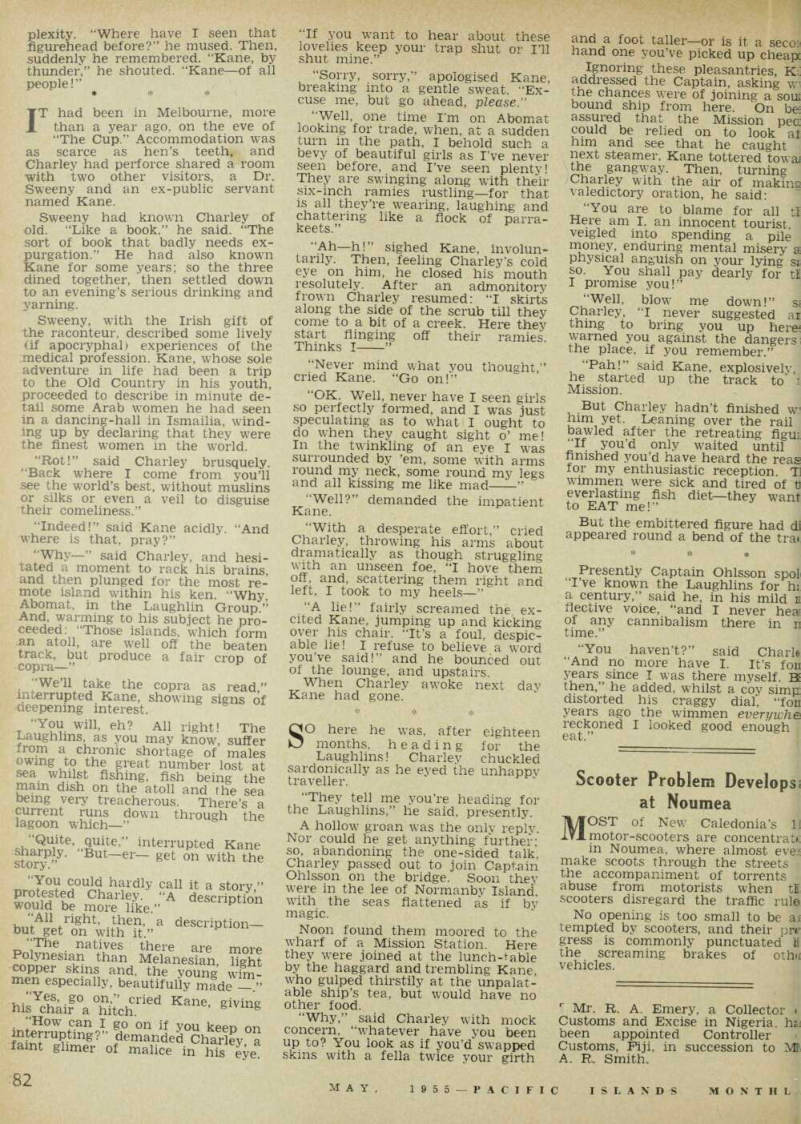
[?]atting like a flock of parakeets . . ."
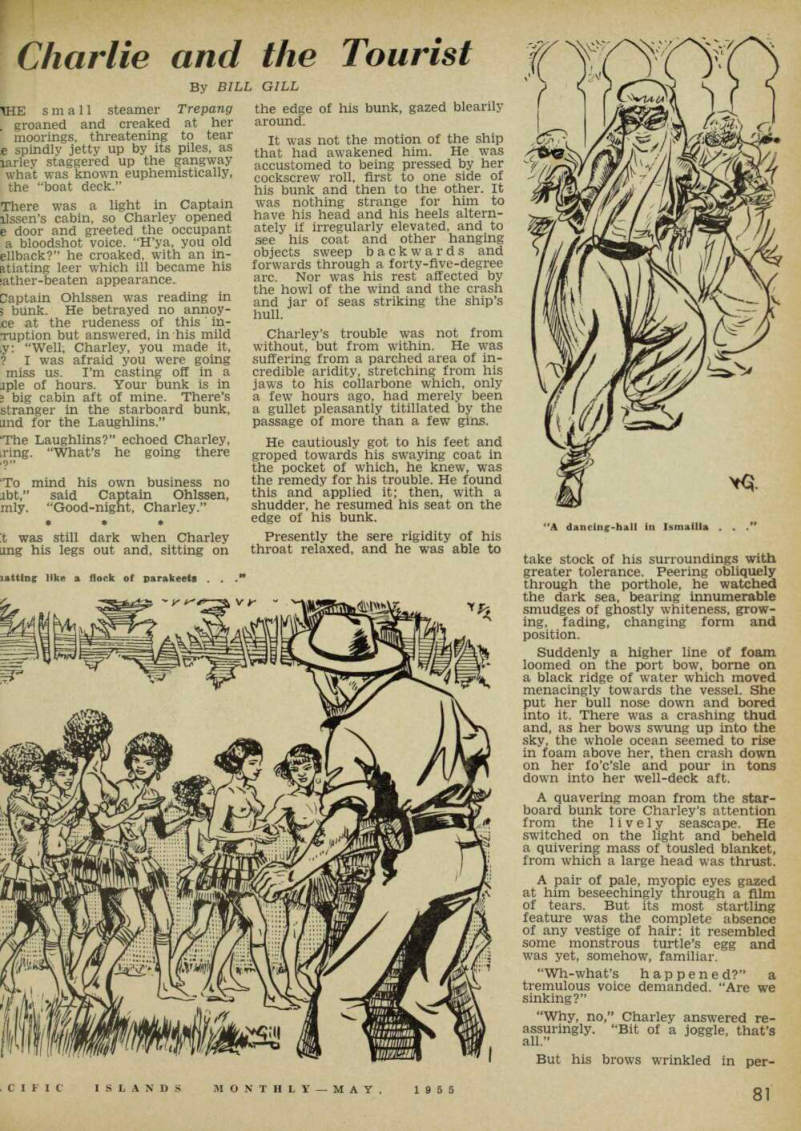
“A dancing-hall in Ismailla . . .”
plexity. “Where have I seen that before?” he mused. Then, suddenly he remembered. “Kane, by thunder,” he shouted. “Kane—of all people!” ♦ * * IT had been in Melbourne, more than a year ago, on the eve of “The Cup.” Accommodation was as scarce as hen’s teeth, and Charley had perforce shared a room with two other visitors, a Dr.
Sweeny and an ex-public servant named Kane.
Sweeny had known Charley of old. “Like a book.” he said. “The sort of book that badly needs ex purgation.” He had also known Kane for some years; so the three dined together, then settled down to an evening’s serious drinking and yarning.
Sweeny, with the Irish gift of the raconteur, described some lively (if apocryphal) experiences of the medical profession. Kane, whose sole adventure in life had been a trip to the Old Country in his youth, proceeded to describe in minute de tail some Arab women he had seen in a dancing-hall in Ismailia, wind ing up by declaring that they were the finest women in the world.
“Rot!” said Charley brusquely.
“Back where I come from you’ll see the world’s best, without muslins or silks or even a veil to disguise their comeliness.”
“Indeed!” said Kane acidly. “And where is that, pray?”
“Why—" said Charley, and hesi tated a moment to rack his brains, and then plunged for the most re mote island within his ken. “Why, Abomat. in the Laughlin Group ”
And, warming to his subject he pro ceeded: “Those islands, which form an atoll, are well off the beaten track, but produce a fair crop of copra—” * “We’ll take the copra as read,” interrupted Kane, showing signs of
deepening interest.
“You will, eh? All right! The Laughlins as you may know, suffer from a chronic shortage of males owing to the great number lost at sea whilst fishing, fish being the mam dish on the atoll and the sea being yeiy treacherous. There’s a current runs down through the lagoon which—”
“Quite, quite,” interrupted Kane sttoy” Y But er get on with the hardly call it a story,” protested Charley. “A descrintion would be more like.” aescil P tlon hn* A iLf r ight’ a description— but get on with it.”
The natives there are more Polynesian than Melanesian, light copper skins and, the young wim
men especially, beautifully mlde —!”
o , n ’'’ cried Kane, giving his chair a hitch. gs “How can I go on if you keen on
interrupting?” demanded Charley 5
faint ghmer of malice in his eye.
"If you want to hear about these lovelies keep your trap shut or I’ll shut mine.”
“Sorry, sorry,” apologised Kane, breaking into a gentle sweat. -Ex cuse me, but go ahead, please.”
“Well, one time I'm on Abomat looking for trade, when, at a sudden turn in the path, I behold such a bevy of beautiful girls as I’ve never seen before, and I’ve seen plenty!
They are swinging along with their six-inch ramies rustling—for that is all they’re wearing, laughing and chattering like a flock of parra keets.”
“Ah—h!” sighed Kane, involun tarily. Then, feeling Charley’s cold eye on him, he closed his mouth resolutely. After an admonitorv frown Charley resumed: “I skirts along the side of the scrub till they come to a bit of a creek. Here they start flinging off their ramies.
Thinks I ”
“Never mind what you thought,” cried Kane. “Go on!”
“OK. Well, never have I seen girls so perfectly formed, and I was just speculating as to what I ought to do when they caught sight o’ me!
In the twinkling of an eye I was surrounded by ’em, some with arms round my neck, some round my legs and all kissing me like mad ”
“Well?” demanded the impatient Kane.
“With a desperate effort,” cried Charley, throwing his arms about dramatically as though struggling with an unseen foe, “I hove them off, and, scattering them right and left, I took to my heels—”
“A lie!” fairly screamed the ex cited Kane, jumping up and kicking over his chair. “It’s a foul, despic able lie! I refuse to believe a word you’ve said!” and he bounced out of the lounge, and upstairs.
When Charley awoke next day Kane had gone. ❖ % % SO here he was, after eighteen months, heading for the Laughlins! Charley chuckled sardonically as he eyed the unhappy traveller.
“They tell me you’re heading for the Laughlins,” he said, presently.
A hollow groan was the only reply.
Nor could he get anything further; so, abandoning the one-sided talk, Charley passed out to join Captain Ohlsson on the bridge. Soon they were in the lee of Normanby Island, with the seas flattened as if by magic.
Noon found them moored to the wharf of a Mission Station. Here they were joined at the lunch-table by the haggard and trembling Kane, who gulped thirstily at the unpalat able ship’s tea, but would have no other food.
“Why,” said Charley with mock concern, “whatever have you been up to? You look as if you’d swapped skins with a fella twice your girth
and a foot taller—or is it a secoi( hand one you’ve picked up cheapc
Ignoring these pleasantries, K;:
fT? dr l ssed the Ca P tai n, asking w. the chances were of joining a soul bound ship from here. On bes assured that the Mission peer amid be relied on to look at him and see that he caught next steamer, Kane tottered towai the gangway. Then, turning Charley with the air of makins valedictory oration, he said: “You are to blame for all tl Here am I, an innocent tourist, veigled into spending a pile money, enduring mental misery a physical anguish on your lying ss; so. You shall pay dearly for tl I promise you!”
“Well, blow me down!” s< Charley, “I never suggested ai thing to bring you up here warned you against the dangers, the place, if you remember.”
“Pah!” said Kane, explosively, he started up the track to' i Mission.
But Charley hadn’t finished him yet. Leaning over the rail bawled after the retreating figuu “If you’d only waited until finished you’d have heard the reas for my enthusiastic reception Tl wimmen were sick and tired of ti everlasting fish diet—they want to EAT me!”
But the embittered figure had df appeared round a bend of the trau * S= * Presently Captain Ohlsson spolt “I’ve known the Laughlins for hsj a century,” said he, in his mild 11 flective voice, “and I never heaE of any cannibalism there in n time.”
“You haven’t?” said Charie "And no more have I. It’s fon years since I was there myself. BE then,” he added, whilst a cov simm distorted his craggy dial' “fon years ago the wimmen everywhe, reckoned I looked good enough eat.”