When England's Young Apollo
pp. 81-86 · Read in the full issue
Memories of Rupert Brooke
Wrote Lyrics In South Seas
By Jack Thornton
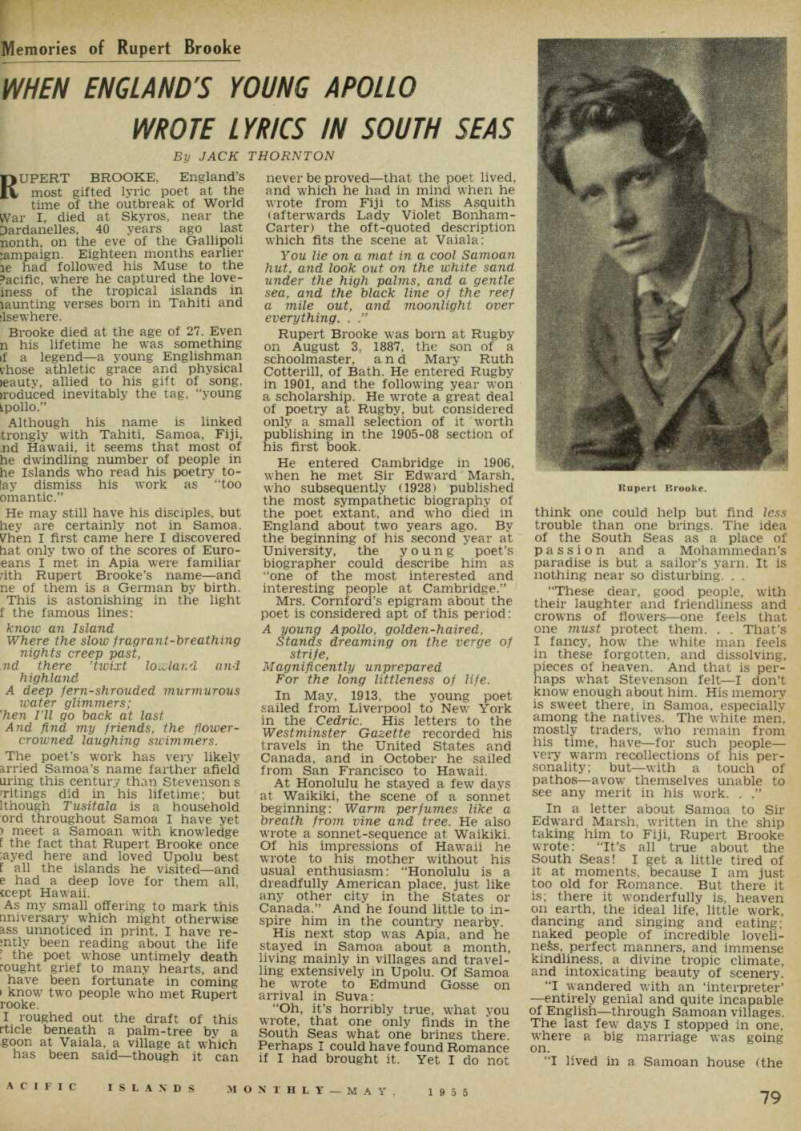
RUPERT BROOKE, England’s most gifted lyric poet at the time of the outbreak of World War I, died at Skyros, near the Dardanelles, 40 years ago last nonth, on the eve of the Gallipoli campaign. Eighteen months earlier le had followed his Muse to the Pacific, where he captured the love iness of the tropical islands in launting verses born in Tahiti and ilse where.
Brooke died at the age of 27. Even n his lifetime he was something if a legend—a young Englishman vhose athletic grace and physical >eauty, allied to his gift of song, produced inevitably the tag, “young ipollo.”
Although his name is linked trongly with Tahiti, Samoa, Fiji, nd Hawaii, it seems that most of he dwindling number of people in he Islands who read his poetry to tay dismiss his work as “too omantic.”
He may still have his disciples, but hey are certainly not in Samoa.
Vhen I first came here I discovered bat only two of the scores of Euro eans I met in Apia were familiar nth Rupert Brooke’s name—and ne of them is a German by birth.
This is astonishing in the light f the famous lines: know an Island Where the slow fragrant-breathing nights creep past, nd there ’twixt lowland and highland A deep fern-shrouded murmurous water glimmers; 'hen I’ll go back at last And find my friends, the flower crowned laughing swimmers.
The poet’s work has very likely arried Samoa’s name farther afield uring this century than Stevenson s citings did in his lifetime; but [though Tusitala is a household ord throughout Samoa I have yet ) meet a Samoan with knowledge f the fact that Rupert Brooke once ;ayed here and loved Upolu best I all the islands he visited—and e had a deep love for them all, tcept Hawaii.
As my small offering to mark this nniversary which might otherwise ass unnoticed in print, I have re mtly been reading about the life • the poet whose untimely death rought grief to many hearts, and have been fortunate in coming • know two people who met Rupert rooke.
I roughed out the draft of this rticle beneath a palm-tree by a goon at Vaiala, a village at which has been said—though it can
never be proved—that the poet lived, and which he had in mind when he wrote from Fiji to Miss Asquith (afterwards Lady Violet Bonham- Carter) the oft-quoted description which fits the scene at Vaiala; You lie on a mat in a cool Samoan hut, and look out on the white sand under the high palms, and a gentle sea, and the black line of the reef a mile out, and moonlight over everything. .
Rupert Brooke was born at Rugby on August 3, 1887, the son of a schoolmaster, and Mary Ruth Cotterill, of Bath. He entered Rugby in 1901, and the following year won a scholarship. He wrote a great deal of poetry at Rugby, but considered only a small selection of it worth publishing in the 1905-08 section of his first book.
He entered Cambridge in 1906, when he met Sir Edward Marsh, who subsequently (1928) published the most sympathetic biography of the poet extant, and who died in England about two years ago. By the beginning of his second year at University, the young poet’s biographer could describe him as “one of the most interested and interesting people at Cambridge.”
Mrs. Cornford’s epigram about the poet is considered apt of this period; A young Apollo, golden-haired, Stands dreaming on the verge of strife, Magnificently unprepared For the long littleness of life.
In May, 1913, the young poet sailed from Liverpool to New York in the Cedric. His letters to the Westminster Gazette recorded his travels in the United States and Canada, and in October he sailed from San Francisco to Hawaii.
At Honolulu he stayed a few days at Waikiki, the scene of a sonnet beginning: Warm perfumes like a breath from vine and tree. He also wrote a sonnet-sequence at Waikiki.
Of his impressions of Hawaii he wrote to his mother without his usual enthusiasm: “Honolulu is a dreadfully American place, just like any other city in the States or Canada.” And he found little to in spire him in the country nearby.
His next stop was Apia, and he stayed in Samoa about a month, living mainly in villages and travel ling extensively in Upolu. Of Samoa he wrote to Edmund Gosse on arrival in Suva: "Oh, it’s horribly true, what you wrote, that one only finds in the South Seas what one brings there.
Perhaps I could have found Romance if I had brought it. Yet I do not
think one could help but find less trouble than one brings. The idea of the South Seas as a place of passion and a Mohammedan’s paradise is but a sailor’s yarn. It is nothing near so disturbing. . .
“These dear, good people, with their laughter and friendliness and crowns of flowers —one feels that one must protect them. . . That’s I fancy, how the white man feels in these forgotten, and dissolving, pieces of heaven. And that is per haps what Stevenson felt—l don’t know enough about him. His memory is sweet there, in Samoa, especially among the natives. The white men, mostly traders, who remain from his time, have—for such people— very warm recollections of his per sonality; but —with a touch of pathos—avow themselves unable to see any merit in his work. . .”
In a letter about Samoa to Sir Edward Marsh, written in the ship taking him to Fiji, Rupert Brooke wrote: “It’s all true about the South Seas! I get a little tired of it at moments, because I am just too old for Romance. But there it is; there it wonderfully is, heaven on earth, the ideal life, little work, dancing and singing and eating; naked people of incredible loveli ness. perfect manners, and immense kindliness, a divine tropic climate, and intoxicating beauty of scenery.
“I wandered with an ‘interpreter’ —entirely genial and quite incapable of English—through Samoan villages.
The last few days I stopped in one, where a big marriage was going on.
“I lived in a Samoan house (the
Rupert Brooke.
coolest in the world) with a man and his wife, nine children ranging from a proud beauty of 18 to a round object of 1 year, a dog, a eat, a proud hysterical hen, and a gaudy scarlet and green parrot who roved the roof and beams with a wicked eye, choosing a place whence to twice a day, with humorous precision, on my hat and clothes. . .
“Can’t you imagine how shattered and fragmentary a heart I’m bear ing away to Fiji and Tahiti? And, oh dear! I’m afraid they’ll be just as bad. . . But if ever you miss me suddenly . . . you’ll know that I’ve got sick for the full moon on these little thatched roofs, and the palms against the morning, and the Samoan boys and girls diving thirty feet into a green sea or a deep mountain pool under a waterfall — and that I’ve gone back.”
One of the old identities in Samoa to-day is Mr. F. M. Jahnke, who lives on a plantation about twenty miles from Apia. He met Rupert Brooke at Mulifanua, 25 miles west ward of Apia, in the house of a trader who had accommodation for boarders and travellers.
Mr. Jahnke recalls that the poet spoke fluent French (most of those present were German) and was very witty; he was an ardent conver sationalist and seemed eager each evening to spend the whole night talking. Though well-built, Rupert Brooke was at that time leaner than most photographs show, and he was completely careless about dress —his trousers were held up with string.
I have not yet met anybody else in Samoa who remembers the poet’s visit.
Of Suva the poet wrote: “. . . a large English town, with two banks, several churches, dental surgeons, a large gaol, auctioneers, bookmakers, two newspapers, and all the other appurtenances of civilisation!” Fiji perplexed him.
In another letter he observed; ‘ Fiji’s not so attractive as Samoa, but more macabre. Across the bay are ranges of inky, sinister mountains, over which there are always clouds and darkness. . . The gloom and terror of those twisted mountains! And the extraordinary contrasts in the streets and the near country—for there are fifty thousand Hindis, indentured labour, here, emaciated and proud, in liberty coloured garments, mournful, stand- SfJ? Ut u^ ong t J hese gay > Pathetic, sturdy children the Fijians.” ms next stay was about three months m Tahiti. After the first month he wrote to Miss Nesbitt: I ve decided to stay another month, very good reasons: (1) ?" ou h m °ney to get th ? t Ive found the most idea! place m the world to live and work in ” The “ideal place” was at Mataiea, cm the western side of Tahiti, opposite to Papeete.
In a house with “a widr verandah nIS-PH S?! g00 ?- he wrote or com pleted The Great Lover (one of his famous poems) and Retrospect
Doubt exists as to whether his beautiful Tiare Tahiti was completed at Mataiea or Papeete.
While recuperating from coral poisoning he wrote to Sir Edward Marsh: “I really do feel a little anchor less. . . All I want in life is a cottage, and leisure to write supreme poems and plays. I can’t do it in this vagabondage.”
In his next letter he said: “The Game is Up, Eddie. If I’ve gained facts through knocking about with Conrad characters in Gauguin en tourage, I’ve lost a dream or two.
I tried to be a poet. And because I’m a clever writer, and because I was forty times as sensitive as any body else, I succeeded a little. . .
I am what I came out here to be.
Hard, quite hard. I have become merely a minor character in a Kipling story.”
Yet when the poet sailed from Tahiti he could still feel “sad at heart,” for the Islands had not made him as hard as he imagined himself to be when depressed by coral poisoning.
Six months later, within a few weeks of the poet’s return to Eng
land, Winston Churchill offered hii a commission in the Royal Nav' Division.
Catpain Hugh Frewen, who well known in Fiji (where he r* cently settled near Levuka) was ah an (Officer in the Royal Navr Division, and still has vivid recoi lections of Rupert Brooke. “He ws like a Greek god,” Captain Frewe told me recently. “No victim of tt First World War was so deep! lamented, owing to his great literal and personal qualities. He was ama of great fascination—a wonderfi scholar deeply versed in classics lore—and with a magnetic person ality that endeared him to a hoi of friends. Much of his poetry, wit: its love of luxuriant vegetation an running water, is reminiscent of th Canadian, Bliss Carmen.”
In February, 1915, after spendin part of his furlough at 10 Downin Street, the poet sailed with th Anson Battalion for the Aegean ani Gallipoli. Early in April Sir la.
Hamilton reviewed the Nava Division at Port Said and afterward reported: “I saw Rupert Brook lying down under a shelter, rathe
(Continued on Page 84)
off colour, poor boy. He had a touch of the sun the prevj day. It was nothing, and essenti he was looking in first-a physical condition.” That even the poet felt ill. He remained un m edical treatment until Aprii when he insisted on embarking w his battalion for the Dardanef On April 17, when the batta'j disembarked for assault training Skyros, Rupert Brooke seemed m\ well. Three days later he fell! again, and the following day stai in bed with severe headache s pams in the back. Next morning condition was much worse, andJ had a high temperature. Doct diagnosed blood-poisoning, and hi ot recovery was abandoned.
On April 23, the day of George and of Shakespeare, mod'J 5 n lan S s “golden-phrased pa died aboard the French ship Diiguay-Trouin. He was bun at Skyros, the island where Thes.< was buried, and whence Achilles a Pyrrhus were called to Troy.
Winston Churchill wrote in 75 Times of April 26, 1915; “Rupc Brooke is dead. A telegram frc rhe A.dmiral at Lemnos tells us tM this life has closed at the mome when it seemed to have reached A voice had becor audible, a note had been strui more true, more thrilling, more al, to do justice to the nobility of a youth in arms engaged in this pr sent war, than any other—more al oo express their thoughts of se‘ surrender, and with a power to can comfort to those who watched the so intently from afar. The vof has been swiftly stilled. Only t.i echoes and the memory remain - lx they will linger.”