Tropicalities
pp. 79-80 · Read in the full issue
Magazine Sec Tion
:he white flesh of the pig [IT’HEREVER I went in Naitauba FT (Fiji) I was followed by hurri canes of giggles from the hired elp. The kitchen girls’ hysteria Imost caused them to fall into the utter-churns; and the male work irce was quite put off its copra cut mg or scrub clearing.
“It’s your white legs,” said Liz. 7hite legs, forsooth! I’d have her now that back home I was cou riered adequately sun-tanned. But othing would persuade her that I as other than lily-white—and she Iso made some other obscure re tarks about Fijians and what they died “white pig.”
After this, I wore jeans for a mple of days, and a dress. But lorts were made for that part of le world—they don’t get wet round the edges or collect grass :eds. So back to the shorts. And lat day I saw a very fat Fijian oman, squatting in a water hole, ire from the waist up, doing the :mily washing.
“Bosoms don’t count,” said Liz, ho wears shorts herself. “Only gs”
Well —for heaven’s sake, since hen? Since a long time, evidently, ack before missionaries; although was informed by this authority i the subject, that Fijian misses ice, way back, wore something >out the size and with the general laracteristics of a pie-frill.
It must have been way back —be- .use not even the oldest illustra ms in the oldest books show Fijian amen looking less dressed than a tiristmas tree. ’ Fiji’s most modern isses around Suva wear an dinary street frock, showing a >od 15 inches of leg—which is pro ess. But still more cling to the iropean dress, under which an ikle-length lava-lava is worn..
All of which leads me to the con asion that Fijians must have em aced the dictum of the missionaries th a great deal more enthusiasm an other Pacific islanders —most whom, while making some con ssion to missionary modesty, at ast keep their legs.—JT.
Of Possible Importance
[THEN the front doorbell of a T Suva club rang persistently a member investigated.
An Indian youth asked for an aer member and was asked in turn the matter were urgent.
“Well, yes, sir,” was the reply. “I ink it might be important, be use his house is on fire.”
Only one thing was wrong. The fire, a small outbreak that was quickly extinguished, was at some body else’s house.
Westminster Chimes For
Nukualofa
MORE than a century ago King George Tupou I modelled Tonga’s constitution on that of Great Britain. And now Queen Salote has gone a step further in the Tongan annexation of West minster.
During her triumphal visit to the United "Kingdom in 1953, Queen Salote fell in love with the West minster chimes —the notes of the great bells which herald the boom ing of Big Ben over the Houses of Parliament.
Seeking an echo for the Tongan capital, the Queen gave an order
to a famous Derby firm for a one ton clock, costing £l,OOO, to be in stalled in the Royal Chapel at Nukualofa, only a few yards from the present palace. Her only specific instruction was that the clock should have Westminster chimes.
Work on the big three-faced clock was started last December and was completed in April, when the clock was ready for shipment.
All the exposed movements are rustproof as a precaution against Tonga’s tropical climate.
School Milk Question
EXCITEMENT over the much publicised supply of free milk to Cook Islands school children has died down, reports a correspondent.
The milk is powdered and usually mixed with cold water, and a pro portion of the little beneficiaries never did like the stuff anyway.
In a land where breakfast is in the petit dejeuner class, and is often so petit as to be non-existent, the idea of a “free school break fast” caused quite a commotion. But when it was realised that a paternal Government was to supply only a ration of milk, without so much as a Government roll or a Government biscuit to go with it, enthusiasm waned. (Continued Next Page)
Sabbath Complexities
BECAUSE the adherents of a certain mission are permitted to fish on Sundays, there has been leartburnmg in Mangaia, Cook islands, and recently there has ieen a suggestion that Sunday fish es by people whose sabbath falls m Saturday should be curbed by )fficial decree. y In Mangaia there is an idea almost a tradition) that although he sea may be terrifically rough >n week-days, it is usually as calm is a millpond on Sundays. Oddly mough there seems to be some bf IS Q° f a kil l d for the belief, and ffU Sunday fi |bermen’s hauls are iften very profitable.
When Saturday fishing gleans nothing and Sunday fishing pro duces (as happened recently) no fewer than 40 a’ai ithe Fijian tuna), there is bound to be some disgruntlement. Further, in the case quoted the successful fishermen did not feel called on to follow Poly nesian custom by sharing the ex ceptional catch with their rivals of another denomination.
Roofless Prosperity
GAPING holes in thatched roofs are common in Mangaia, de spite prosperous times due to pineapple revenue and the earnings of Makatea phosphate workers. (A portion of the wages earned at Makatea is paid to the men’s de pendants at home).
As things are, nobody wants to accept “contract” jobs such as the rethatching of houses with coconut fronds or pandanus. Much of the money coming in is spent on food, clothing and the “makings” for various home-brews, and the condi tion of huts and houses is often poor.
In the Bad Old Days, when no pineapples were exported and when copra brought less than a farthing a pound and oranges about 1 - a hundred, a thatched roof could be kept in excellent order for perhaps £3 .
Now, such workers as will accept the work demand 10 - a day and “found,” and the cost of replacing a thatched roof is about £3O.
No hut is worth this outlay, and so the thatch is left as it is—with miserable consequences in a tropical downpour.
The Waterfall Ithat Wasn’T
ALTHOUGH impressively depicted
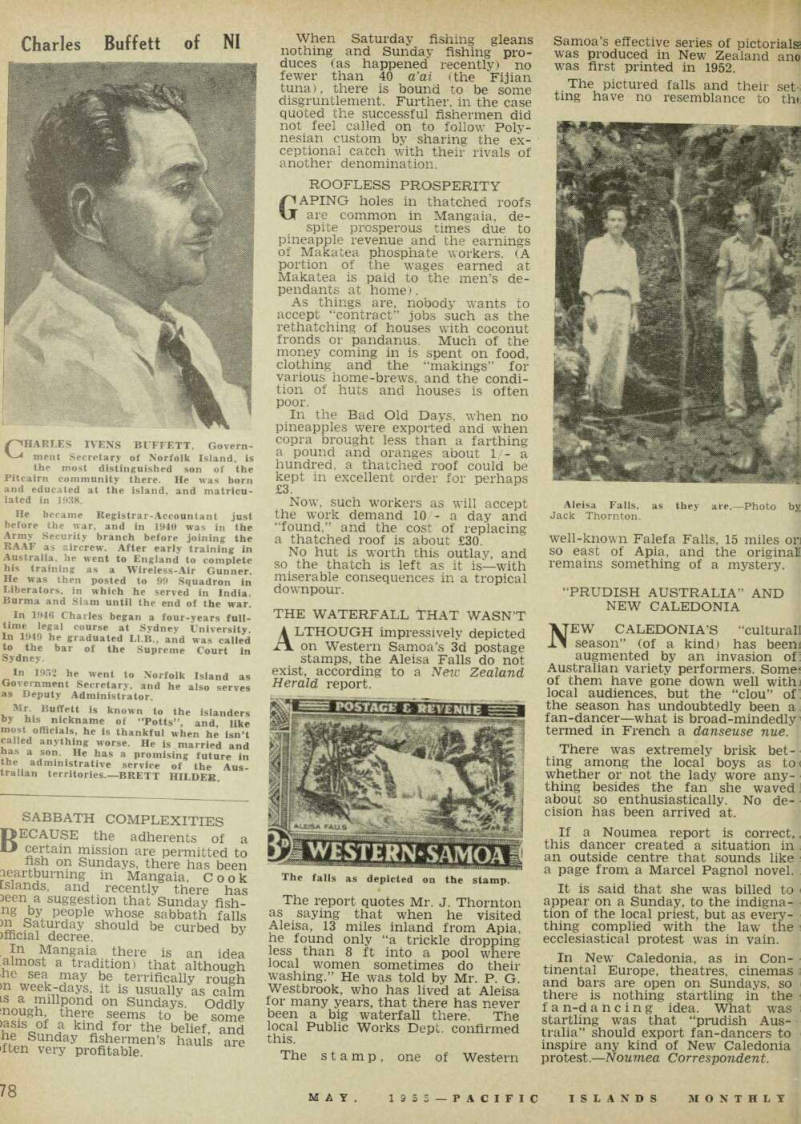
on Western Samoa’s 3d postage stamps, the Aleisa Falls do not exist, according to a New Zealand Herald report.
The report quotes Mr. J. Thornton as saying that when he visited Aleisa, 13 miles inland from Apia, he found only “a trickle dropping less than 8 ft into a pool where local women sometimes do their washing.” He was told by Mr, P. G.
Westbrook, who has lived at Aleisa for many years, that there has never been a big waterfall there. The local Public Works Dept, confirmed this.
The stamp, one of Western
Samoa’s effective series of pictorials was produced in New Zealand ano was first printed in 1952.
The pictured falls and their set-; ting have no resemblance to tht
well-known Falefa Falls, 15 miles orj so east of Apia, and the original! remains something of a mystery.
‘‘Prudish Australia” And
New Caledonia
NEW CALEDONIA’S “culturall season” (of a kind) has beeni augmented by an invasion ofi Australian variety performers. Some? of them have gone down well withi local audiences, but the “clou” of: the season has undoubtedly been aj fan-dancer—what is broad-mindedly l termed in French a danseuse nue.
There was extremely brisk bet- ■ ting among the local boys as to< whether or not the lady wore any- ■ thing besides the fan she waved J about so enthusiastically. No de- ■ cision has been arrived at.
If a Noumea report is correct,, this dancer created a situation in j an outside centre that sounds like : a page from a Marcel Pagnol novel. .
It is said that she was billed to < appear on a Sunday, to the indigna- • tion of the local priest, but as every- • thing complied with the law the < ecclesiastical protest was in vain.
In New Caledonia, as in Con- • tinental Europe, theatres, cinemas« and bars are open on Sundays, so < there is nothing startling in the * f a n-d anc i n g idea. What was i startling was that “prudish Aus tralia” should export fan-dancers to < inspire any kind of New Caledonia protest. —Noumea Correspondent.
The falls as depicted on the stamp.
Aleisa Falls, as they are.—Photo by Jack Thornton.