[?]Robes
pp. 55-57 · Read in the full issue
[?]Rs. Stevenson's Diary
[?]Us Research
[?]Ailima Life
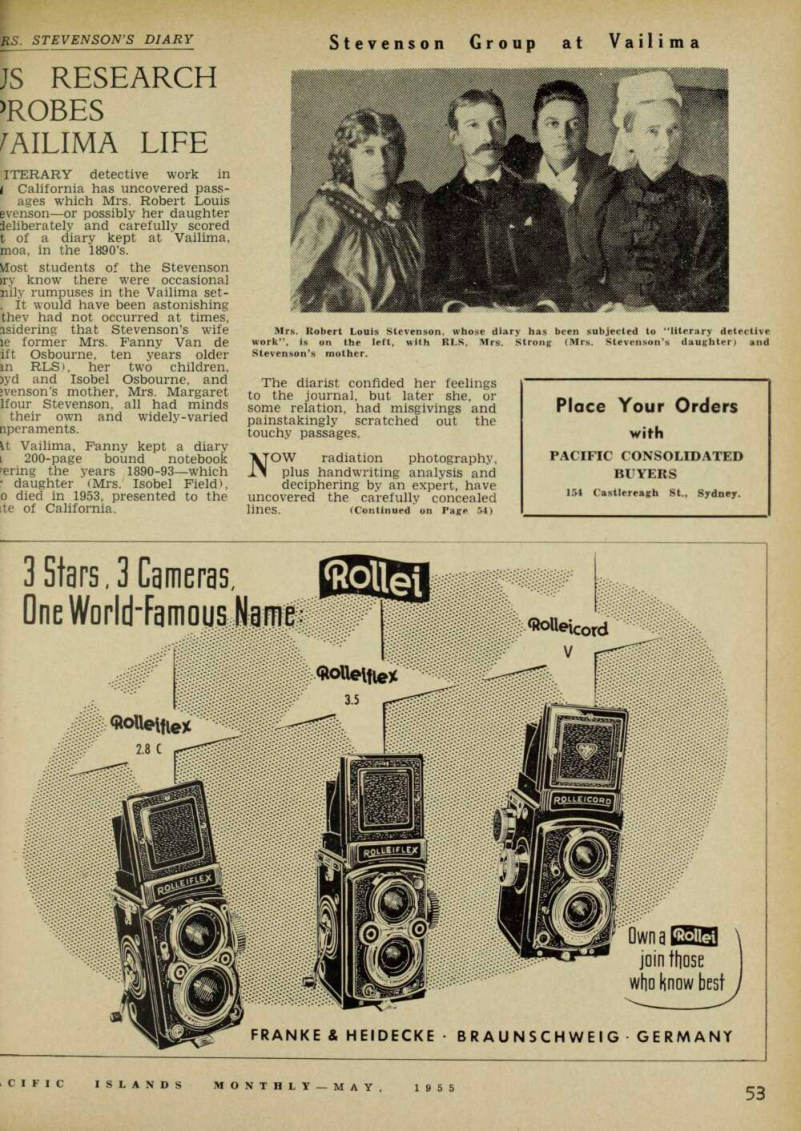
ITERARY detective work in i California has uncovered pass ages which Mrs. Robert Louis evenson—or possibly her daughter deliberately and carefully scored t of a diary kept at Vailima, moa, in the 1890’s.
Vlost students of the Stevenson »ry know there were occasional nily rumpuses in the Vailima set . It would have been astonishing they had not occurred at times, isidering that Stevenson’s wife le former Mrs. Fanny Van de ift Osbourne, ten years older in RLS), her two children, jyd and Isobel Osbourne, and wenson’s mother, Mrs. Margaret hour Stevenson, all had minds their own and widely-varied nperaments.
U Vailima, Fanny kept a diary l 200-page bound notebook rering the years 1890-93—which • daughter (Mrs. Isobel Field L o died in 1953, presented to the ite of California.
The diarist confided her feelings t o the journal, but later she, or some relation, had misgivings and painstakingly scratched out the touchy passages, VTOW radiation photography, JLI plus handwriting analysis and deciphering by an expert, have uncovered the carefully concealed lines. (Continued' on Page -54)
A New York Times report states that the passages “all deal with family frictions that were far from scandalous but nonetheless re vealing”.
One of the references which Mrs.
Stevenson, or perhaps her daughter, considered too personal for posterity concerned a minor skirmish between the British-born RLS and his American-born stepson. It read: “The moment that grace was said, and before dinner had commenced, Louis declared a toast in the voice of one doubtful of being obeyed. . .
It was (to) ‘Her blessed Majesty the Queen.’
“Then in an aggressive manner he turned to Lloyd, saying, ‘You can drink to the President afterwards if you like.’ I’m writing this down hoping that Louis may see it and realise how foolish and childish and in bad taste the whole thing is. . . need to say that Lloyd smiled and did not offer any but a social toast. . .”
ANOTHER section dealt with mother-in-law friction: “There is a big row on hand concerning—prayer! It seems that Lafaele (a Samoan servant) had to be with the wounded horse at prayer timq, and Joe (Joe Strong, Isobel’s first husband) having scalded his right hand very badly, took Austin (son of Joe and Isobel) away to help him with the fowls. All this work MUST be done before the sun gets too hot, and it could not be helped. Unfortunately, Belle (Isobel)
was caught prowling like a cat, with no ostensible —and I fear no real — business on hand, and there was an explosion. Mrs. S. (Stevenson’s mother) considers that she has re ceived a personal insult from them all, and when Austin came to her for his lessons he was sent flying.
“A fight about prayers is really enough to bring a cynical smile to
the lips of a Bishop. Mrs. S. sn she will not be left to pray only w« the servants. I am afraid that c tinction is not made in otl quarters. She dislikes the life hi which we find so enchanting anc disappointed and soured that she not able to persuade ua to thn it all up and go to the colonies
(Continued on Page 55)
“We have given the colonies a ,ir trial and they mean death to ouis (who had tuberculosis), hereas this is life and reasonable faith.”
N the light of the lines which RLS wrote about Fanny (“Teacher, tender comrade, wife”) and lich are carved, with the Requiem, i their joint tomb on Mount Vaea, ove Vailima, Fanny’s notes about ir husband’s opinion of her are lightful: “Louis says that I have the soul a peasant—not so much that I re working in the earth and with e earth, but because I like to ow that it is my own earth that am delving in. Had I the soul an artist the stupidity of ssessions would have no power ;r me.
He may be right. I would as soon nk of renting a child to love as piece of land. When I plant seed or a root, I plant a bit of r heart with it and do not feel it I have finished when I have d my exercise and amusement, t I do not feel so far removed m God when the tender leaves b forth and I know that in a nner I am a creator.”
T this distance there seems to . be little reason why Fanny or anybody else should have been tated about the scored-out isages. There may, however, be mild question about the good te (or lack of it) in publicly dis erring passages which the diarist self, as likely as not, wished to y.