Priorities
p. 32 · Read in the full issue
Citrus On Top
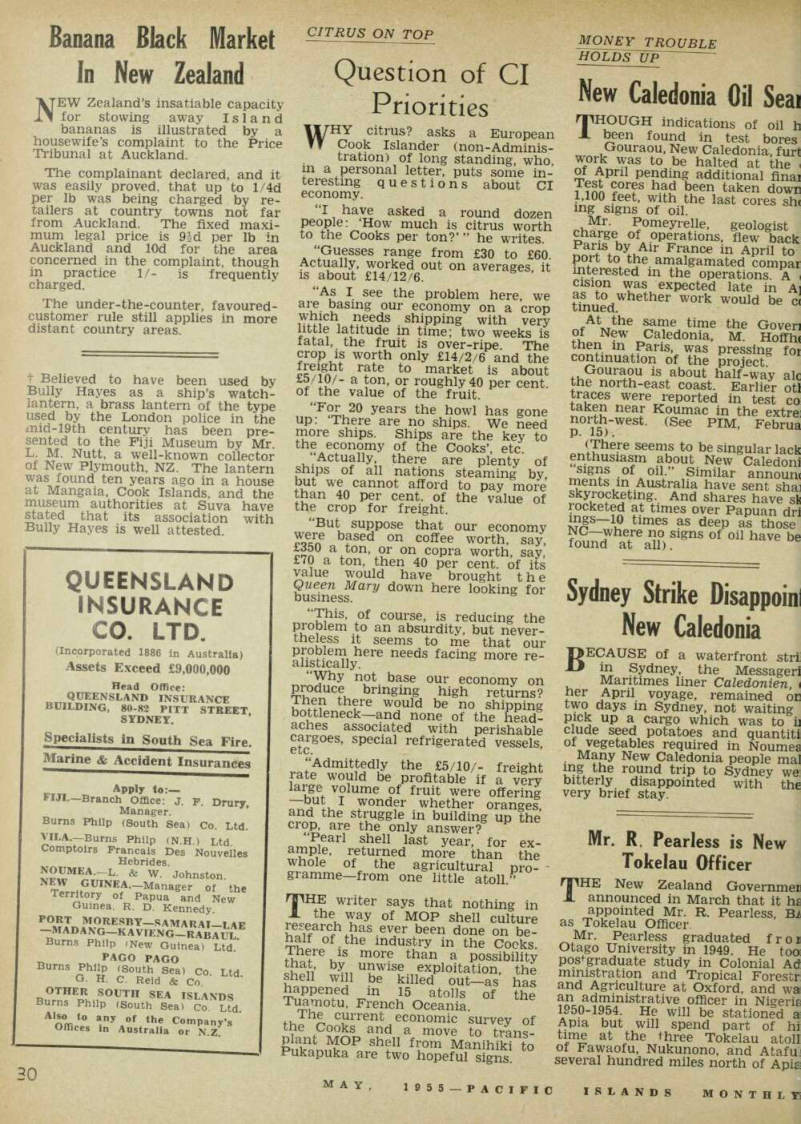
Question of CI Priorities
WHY citrus? asks a European Cook Islander (non-Adminis tration) of long standing, who, in a personal letter, puts some in teresting questions about Cl economy.
“I have asked a round dozen people: How much is citrus worth to the Cooks per ton?’ ” he writes. a “ Gu^ sses range from £3O to £6O.
Actually, worked out on averages, it is about £l4/12/6. l As I see the problem here, we ai is- e asm S our economy on a crop which needs shipping with very little latitude in time; two weeks is fatal, the fruit is over-ripe The crop is worth only £l4/2/6 and the rat e to market is about *®/10/- a ton, or roughly 40 per cent, of the value of the fruit.
F®r2o years the howl has gone up: There are no ships. We need more ships. Ships are the key to the economy of the Cooks’, etc.
Actually, there are plenty of ships of all nations steaming by but we cannot afford to pay more than 40 per cent, of the value of the crop for freight.
But suppose that our economy we re based on coffee worth, say, £350 a ton or on copra worth, say, £7O a ton, then 40 per cent, of its value would have brought th e Queen Mary down here looking for business. s “This, of course, is reducing the problem to an absurdity, but never theless it seems to me that our problem here needs facing more re alistically.
Why not base our economy on produce bringing high returns?
Then there would be no shipping bottleneck— and none of the head aches associated with perishable special refrigerated vessels, Admittedly the £5/10/- freight rate would be profitable if a very large volume of fruit were offering but I wonder whether oranges and the struggle in building up the cr 9,P’ are the only answer?
Pearl shell last year, for ex whSl®’ r f etu ™ ed more than the whole of the agricultural pro gramme—from one little atoll.’’
THE writer says that nothing in the way of MOP shell culture research h as ever been done on be half of the industry in the Cooks.
Hw re u ls mor ? than a possibility cvSv u £ wise exploitation, the shell will be killed out—as has happened in 15 atolls of the Tuamotu. French Oceania. Th c current economic survey of f c ?9j: s and a move to trans- SfiS.ni?£? P Sh 9 n f L om Mani hiki to Pukapuka are two hopeful signs.