New Papuan Tribes Found
pp. 143-146 · Read in the full issue
Outstanding Patrol:
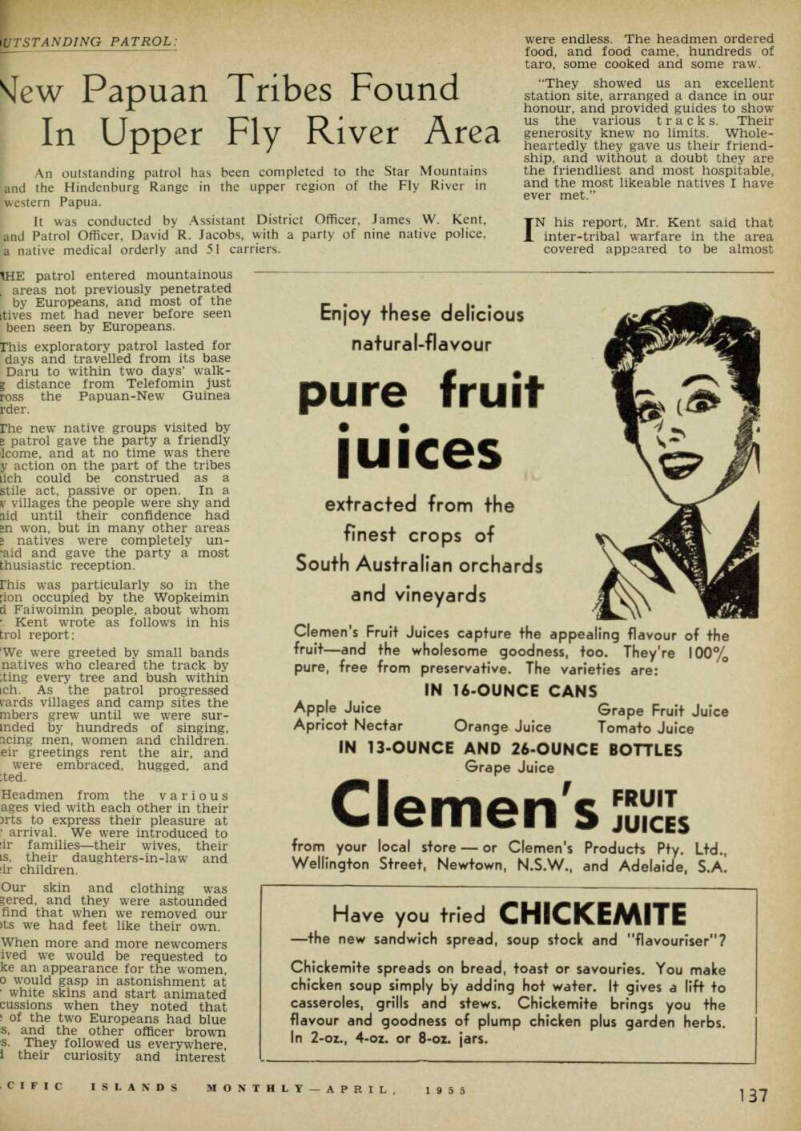
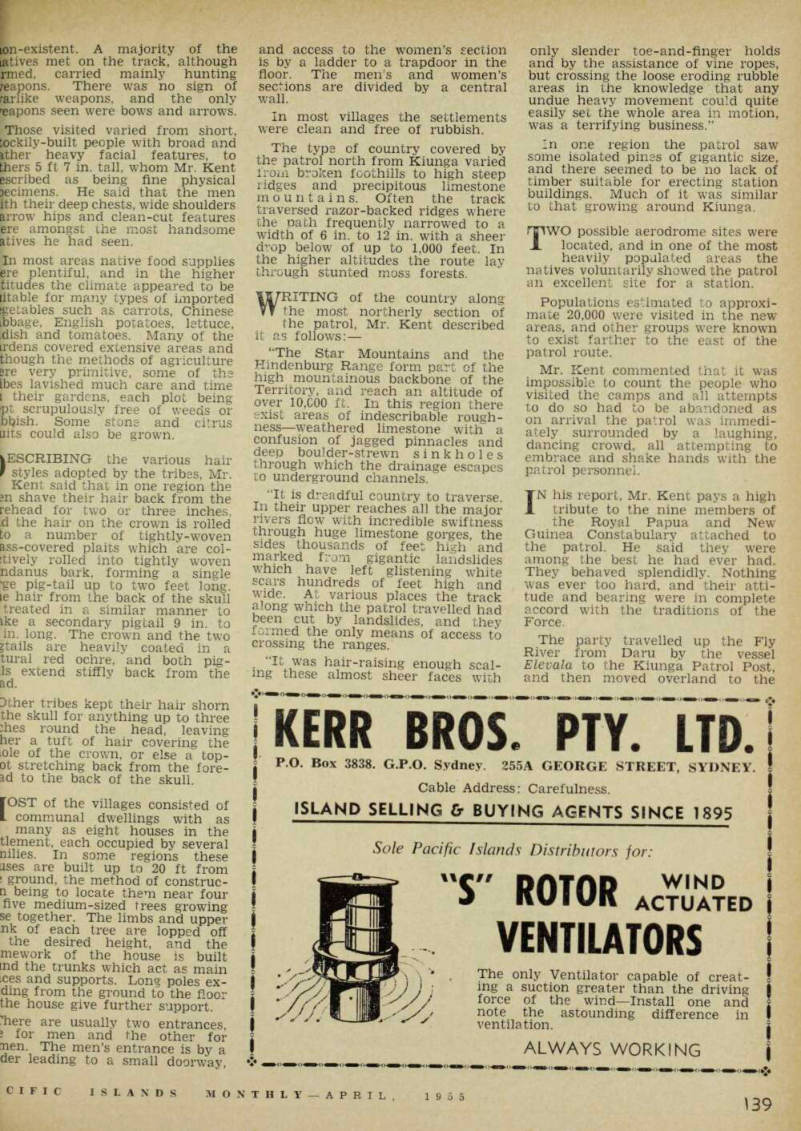
New Papuan Tribes Found In Upper Fly River Area
An outstanding patrol has been completed to the Star Mountains and the Hindenburg Range in the upper region of the Fly River in [western Papua.
It was conducted by Assistant District Officer, James W. Kent, and Patrol Officer, David R. Jacobs, with a party of nine native police, a native medical orderly and 51 carriers.
IHE patrol entered mountainous areas not previously penetrated by Europeans, and most of the itives met had never before seen been seen by Europeans.
This exploratory patrol lasted for days and travelled from its base Daru to within two days’ walk » distance from Telefomin just ross the Papuan-New Guinea rder.
Fhe new native groups visited by b patrol gave the party a friendly Icome, and at no time was there y action on the part of the tribes lich could be construed as a stile act, passive or open. In a w villages the people were shy and lid until their confidence had Bn won, but in many other areas 3 natives were completely un paid and gave the party a most thusiastic reception. rhis was particularly so in the ;ion occupied by the Wopkeimin d Faiwoimin people, about whom •. Kent wrote as follows in his fcrol report: ‘We were greeted by small bands natives who cleared the track by ;ting every tree and bush within ich. As the patrol progressed yards villages and camp sites the mbers grew until we were sur mded by hundreds of singing, acing men, women and children, eir greetings rent the air, and were embraced, hugged, and ;ted.
Headmen from the various ages vied with each other in their )rts to express their pleasure at • arrival. We were introduced to fir families—their wives, their is, their daughters-in-law and sir children.
Our skin and clothing was ?ered, and they were astounded find that when we removed our )ts we had feet like their own.
When more and more newcomers ived we would be requested to ke an appearance for the women, 0 would gasp in astonishment at • white skins and start animated cussions when they noted that ; of the two Europeans had blue s, and the other officer brown s. They followed us everywhere, 1 their curiosity and interest
were endless. The headmen ordered food, and food came, hundreds of taro, some cooked and some raw.
“They showed us an excellent station site, arranged a dance in our honour, and provided guides to show us the various tracks. Their generosity knew no limits. Whole heartedly they gave us their friend ship, and without a doubt they are the friendliest and most hospitable, and the most likeable natives I have ever met.”
IN his report, Mr. Kent said that inter-tribal warfare in the area covered appeared to be almost
ion-existent. A majority of the tatives met on the track, although rmed. carried mainly hunting weapons. There was no sign of rarlike weapons, and the only reapons seen were bows and arrows.
Those visited varied from short, tockily-built people with broad and ither heavy facial features, to thers 5 ft 7 in. tall, whom Mr. Kent escribed as being fine physical jecimens. He said that the men ith their deep chests, wide shoulders arrow hips and clean-cut features ere amongst the most handsome atives he had seen.
In most areas native food supplies ere plentiful, and in the higher titudes the climate appeared to be litable for many types of imported sgetables such as carrots, Chinese tbbage, English potatoes, lettuce, dish and tomatoes. Many of the irdens covered extensive areas and though the methods of agriculture ere very primitive, some of the ibes lavished much care and time i their gardens, each plot being pt scrupulously free of weeds or bbish. Some stone and citrus nits could also be grown.
DESCRIBING the various hair r styles adopted by the tribes, Mr.
Kent said that in one region the m shave their hair back from the rehead for two or three inches, d the hair on the crown is rolled to a number of tightly-woven ass-covered plaits which are col itively rolled into tightly woven ndanus bark, forming a single •ge pig-tail up to two feet long, le hair from the back of the skull treated in a similar manner to ike a secondary pigtail 9 in. to in. long. The crown and the two ?tails are heavily coated in a tural red ochre, and both plg 1s extend stiffly back from the ad.
Dther tribes kept their hair shorn the skull for anything up to three :hes round the head, leaving her a tuft of hair covering the .ole of the crown, or else a top ot stretching back from the fore ad to the back of the skull. [OST of the villages consisted of communal dwellings with as many as eight houses in the tlement, each occupied by several nilies. In some regions these Jses are built up to 20 ft from ! ground, the method of construc n being to locate them near four five medium-sized trees growing se together. The limbs and upper nk of each tree are lopped off the desired height, and the mework of the house is built md the trunks which act as main ■ces and supports. Long poles ex dmg from the ground to the floor the house give further support.
'here are usually two entrances, J for men and the other for Tien. The men’s entrance is by a der leading to a small doorway
and access to the women’s section is by a ladder to a trapdoor in the floor. The men’s and women’s sections are divided by a central wall.
In most villages the settlements were clean and free of rubbish.
The type of country covered by the patrol north from Kiunga varied from broken foothills to high steep ridges and precipitous limestone mountains. Often the track traversed razor-backed ridges where the path frequently narrowed to a width of 6 in. to 12 in. with a sheer drop below of up to 1,000 feet. In the higher altitudes the route lay through stunted moss forests.
WRITING of the country along the most northerly section of the patrol, Mr. Kent described it as follows; “The Star Mountains and the Hmdenburg Range form part of the high mountainous backbone of the Territory, and reach an altitude of over 10,000 ft. In this region there exist areas of indescribable rough ness—weathered limestone with a confusion of jagged pinnacles and deep boulder-strewn sinkholes through which the drainage escapes to underground channels.
“It is dreadful country to traverse.
In their upper reaches all the major rivers flow with incredible swiftness through huge limestone gorges, the sides thousands of feet high and marked from gigantic landslides which have left glistening white scars hundreds of feet high and wide. At various places the track along which the patrol travelled had been cut by landslides, and they formed the only means of access to crossing the ranges. • was hair-raising enough scal ing these almost sheer faces with
only slender toe-and-finger holds and by the assistance of vine ropes, but crossing the loose eroding rubble areas in the knowledge that any undue heavy movement could quite easily set the whole area in motion, was a terrifying business.”
In one region the patrol saw some isolated pines of gigantic size, and there seemed to be no lack of timber suitable for erecting station buildings. Much of it was similar to that growing around Kiunga. r|TWO possible aerodrome sites were A located, and in one of the most heavily populated areas the natives voluntarily showed the patrol an excellent site for a station.
Populations estimated to approxi mate 20,000 were visited in the new areas, and other groups were known to exist farther to the east of the patrol route.
Mr. Kent commented that it was impossible to count the people who visited the camps and all attempts to do so had to be abandoned as on arrival the patrol was immedi ately surrounded by a laughing, dancing crowd, all attempting to embrace and shake hands with the patrol personnel.
IN his report, Mr. Kent pays a high tribute to the nine members of the Royal Papua and New Guinea Constabulary attached to the patrol. He said they were among the best he had ever had.
They behaved splendidly. Nothing was ever too hard, and their atti tude and bearing were in complete accord with the traditions of the Force.
The party travelled up the Fly River from Daru by the vessel Elevala to the Kiunga Patrol Post, and then moved overland to the
north. On the return journey a portion of the trip was covered by canoe, the party constructing its own canoes, and travelling down the Gumu and Fly Rivers to Kiunga.
Commenting on this patrol, the Director of District Services and Native Affairs (Mr. A. A. Roberts) said it was of an exceptional nature and excellently carried out. It en tailed considerable hardship in very difficult country. Valuable informa tion had been obtained, and excel lent contacts made with tribes be yond the area of Kiunga patrols.