Returned From Malaya?
pp. 88-91 · Read in the full issue
A Major-General Talks in Fiji
BUT IS IT NOT TIME THE FIJIANS
When the sudden call was made for Fijian soldiers to serve against the Communist terrorists in Malaya (Oct., 1951), it was indicated that the term of overseas service would be two years.
In 1953, the term was extended to four years; and, in the last six months, there has been speculation, mixed with misgivings, in Fiji over a widespread belief that people in high places, military and otherwise, may want yet another extension.
ON March 13, Major-General
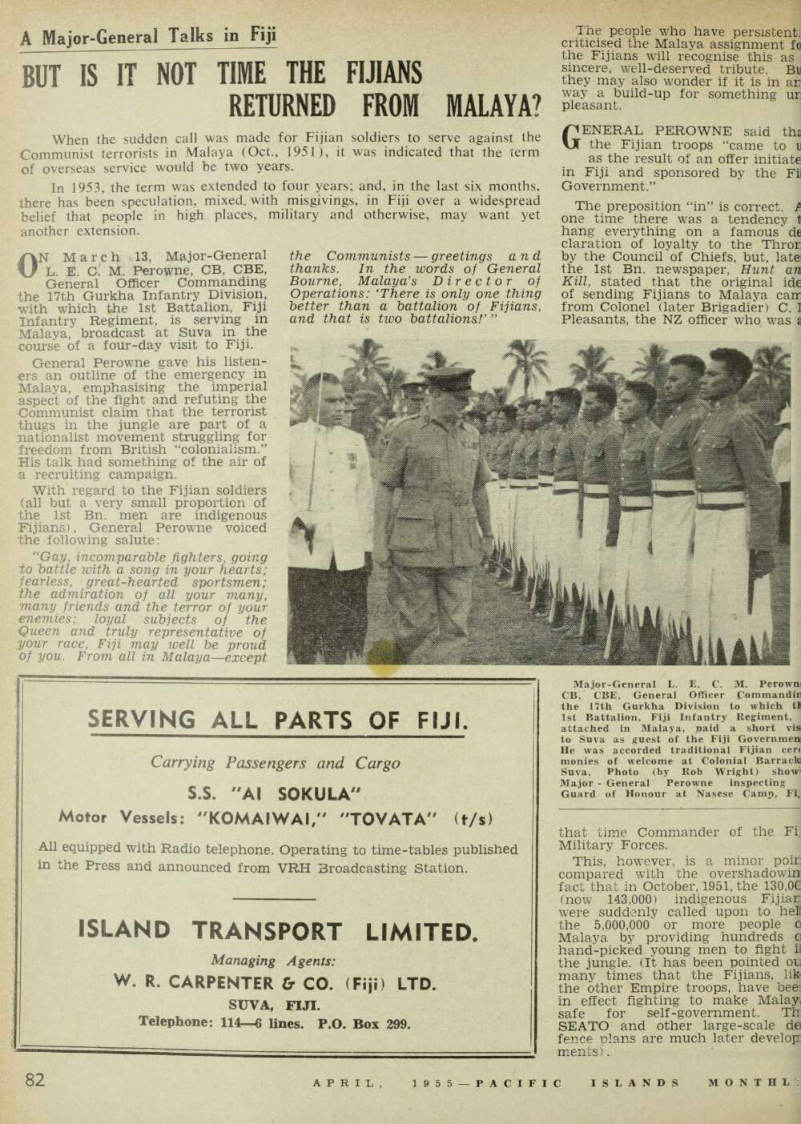
L. E. C. M. Perowne, CB, CBE, General Officer Commanding the 17th Gurkha Infantry Division, with which the Ist Battalion, Fiji Infantry Regiment, is serving in Malaya, broadcast at Suva in the course of a four-day visit to Fiji.
General Perowne gave his listen ers an outline of the emergency in Malaya, emphasising the imperial aspect of the fight and refuting the Communist claim that the terrorist thugs in the jungle are part of a nationalist movement struggling for freedom from British “colonialism.”
His talk had something of the air of a recruiting campaign.
With regard to the Fijian soldiers (all but a very small proportion of the Ist Bn. men are indigenous Fijians), General Perowne voiced the following salute: " Gay, incomparable fighters, going to battle with a song in your hearts; fearless, great-hearted sportsmen; the admiration of all your many, many friends and the terror of your enemies; loyal subjects of the Queen and truly representative of your race, Fiji may well be proud of you. From all in Malaya—except
the Communists greetings and thanks. In the words of General Bourne, Malaya’s Director of Operations: ‘There is only one thing better than a battalion of Fijians, and that is two battalions!’”
The people who have persistent, criticised the Malaya assignment fo the Fijians will recognise this as sincere, well-deserved tribute. Bu they may also wonder if it is in an way a build-up for something ur pleasant.
General perowne said th* the Fijian troops “came to u as the result of an offer initiate in Fiji and sponsored by the Fii Government.”
The preposition “in” is correct. P one time there was a tendency t hang everything on a famous de claration of loyalty to the Thror by the Council of Chiefs, but, late: the Ist Bn. newspaper, Hunt an Kill, stated that the original ide of sending Fijians to Malaya cam from Colonel (later Brigadier) C. I Pleasants, the NZ officer who was *
that time Commander of the Fij Military Forces.
This, however, is a minor poin compared with the overshadowin fact that in October, 1951, the 130,0 G (now 143,000) indigenous Fijian were suddenly called upon to hell the 5,000,000 or more people o Malaya by providing hundreds o hand-picked young men to fight ii the jungle. (It has been pointed ou many times that the Fijians, life the other Empire troops, have bee: in effect fighting to make Malay, safe for self-government. Th SEATO and other large-scale de fence plans are much later develop: ments).
Major-General L. E. C. M. Perowni CB, CBE, General Officer Commandin the 17th Gurkha Division to which t[?] Ist Battalion, Fiji Infantry Regiment, attached in Malaya, paid a short vis to Suva as guest of the Fiji Governmen He was accorded traditional Fijian cert monies of welcome at Colonial Barrack[?] Suva. Photo (by Rob Wright) show Major - General Perowne inspecting Guard of Honour at Nasese Camp, Fi[?]
5 In December, 1951, a Reuter re port contained the following com ment ; f “To a population of 130,000, out numbered by aliens in its home land and battling hard to adjust its whole economic system in the face of great obstacles, the with drawal of hundreds of the most promising young men for two years is considered likely to be much more than serious. This point is the spearhead of criticism by pro- Fijian Europeans, who add that only recently has the Fijian popula tion level began to recover the ground lost between 1880 and 1920” [N 1951, doubts about the fairness of calling on the Fijians to fight in Malaya were expressed in the PIM and in many other quarters, vhile strong protests were made by Methodist Church spokesmen in Fiji and Australia.
There was more criticism when ;he term of the Ist Bn’s service was ‘xtended until 1956, and last De :ember a statement by the British Uommissioner-General in South east Asia (Mr. Malcolm MacDonald) lad repercussions in Fiji’s Legis ative Council.
Mr. MacDonald was reported in *Z as saying that the Fijians would »e in Malaya for “quite a long time.” mmediately a new spate of specula ion and criticism went the rounds n Suva, and in the Council the lev. S. G. C. Cowled (Chairman of he Methodist Mission, which has /ell over 80 per cent, of the in ligenous Fijians as its adherents) isked (1) if the campaign in lalaya were getting anywhere; (2) I the military approach were the ight one; and (3) if the Fijians rere being asked to do too much ecause of their high reputation as ungle-fighters in the Pacific War nd in Malaya.
Reflecting the apprehension over possible further extension of the srm of service in Malaya, Mr.
V. G. Johnson stressed that there ras a feeling in Fiji that the ijians had done their bit and tiould return at the end of the pre mt term—at the beginning of 1956.
There was a good deal of selfish ess somewhere, said Mr. Johnson, nd perhaps the big Dominions nould shoulder more of the burden f fighting terrorism in Malaya.
Replying for the Government, the olonial Secretary (Mr. A. F. R. toddart) said that these pertinent uestions could be answered pro erly only by the UK Government nd the Malayan Government. The uestions exercising the minds of eople in Fiji had also exercised the find of the Government in the ast when making the decision that le services of a Fijian battalion lould be made available.
Referring to the NZ report of the rniark attributed to Mr. Mac donald, Mr. Stoddart said: “I think
members will be quite sure that that remark, if it was made, was m no way made with the authority of this Government. Though we have not got the precise text or context of what was said, we do not think it was any more than a general re mark which was particularised in
reporting.”
GOVERNMENT and Army spokes men at times have caused plain speaking in Fiji by claiming that overseas travel and experience rby way of the campaign in Malaya) “broadens the outlook” and other wise greatly benefits Fijian service men and their families.
General Perowne said something of the sort in his Suva broadcast, and last year Brigadier Pleasants stirred up a sharp press retort by suggesting (in NZ) that examples of the broadening process were to be found among Fijian ex-service men who had come back to drive taxis or work as hotel waiters!
The reply was that if this sort of thing had to be the summit of Fijian ambitions the Fijian soldiers should come home straight away, before any further “broadening” occurred at a time when the Fijian people were being constantly ex horted and badgered to make full use of their birthright (the land).
WHEN the Ist Bn. sailed from Tv Suva on January 8, 1952, a press commentator estimated that at least one, in 12 men aged between
20 and 30 had been withdrawn from Fijian life. This, of course, took no account of the many Fijians in the forces at home or training in NZ; or in the police force, or in mining and other in dustries, for which there is a steady demand for Fijian workers, largely from the villages.
Since the recruits taken into the
forces are all selected healthy me the proportionate loss is actua. higher than any figures indicate THE Fijians’ success in Mala was never a subject of dou General Perowne said that th have maintained the highest rate killing-per-contact of any u n engaged in the theatre. “The hi
andard of their junior leaders, eir natural ability in jungle-craft, eir energy and determination, and eir tremendous endurance all con fute to this result,” he said.
One officer and 12 other ranks we been killed or died of wounds id others have died as the result accidents or sickness.
A Singapore report on March 8 ited that the Fijians had counted for 176 terrorists, includ y three captures, and that their erage was 100 man-hours for each il.
Because of a Colonial Office ;tum, the total number of men, jian or otherwise, in the defence rces in Fiji and overseas is an icial secret. This curious security le applies to the whole Colonial apire. A conservative estimate uld put the number of indigenous (ians in the forces at possibly >re than 2,000.