There and Back In a Dreamship
pp. 62-64 · Read in the full issue
This continues the story of my dreamship Tovata—ex Purple Sea—ex SC67I from page 21 of March PIM. Rightly, I feel it should he entitled “In praise of an Avomine Pill.”
SUVA, March 25.
SOME days before we finally set sail for Naitauba, I asked Mr.
W. G. Johnson, who managmg directs Tovata as well as the other W. R. Carpenter enterprises in Fiji, just what sort of a ship she was.
Did one just sit on the deck, or was there a bunk? .
“Good God,” he said, “This is a real ship—of course, it has cabins, and bunks with new spring mattresses.” He left me to digest this for a moment and then added: “If you are not used to going to sea in small ships, of course, and there is any 'sort of weather, you will probably just want to curl up in your bunk.”
I thought it very probable.
There followed a couple of days of delay when a tropical depression hesitated somewhere to the north of Fiji, then departure time was set for 9.30 am on March 1. This also was the date of arrival in Suva of the Orsova and as a family friend was passing through from America I decided to go on board to break fast with him.
This was bad psychology—for the friend. After we had eaten in Orsova’s air-conditioned dining room he walked with me to the other end of Suva wharf where Tovata lay champing at the bit. His predic tions, after he had sighted her, were so dire I immediately got out my tin of Avomine tablets and ate one pill.
I inspected my cabin. Not very large, certainly, but the inner-spring mattresses were there as per speci fication. It lacked only one thing which I demand in any sea-going vessel —something in which to be
sick. Apparently these people had more faith in Avomine and the Tudor stomach than I had. Well, sans faire rien.
I hauled myself up on to the very top deck above the wheel-house and felt pretty good.
But the Captain, going into his wheel-house saw me there, looking pleased with myself, arid remarked: “I don’t know about the weather.
Maybe we get it pretty rough later on out there.”
This had the neces sary deflationary effect and my reaction was immediate. “In that event someone had better get me something to be sick in.” He
grinned and gave an order in Fijian and next time I went back to the cabin there was a new galvanised bucket under the bunk.
Then I ate another Avomine pill.
We sailed eastward inside the reef and a fierce squall came down out of the north blotting out Suva
By Judy Tudor
and the land. I was invited into the wheel house and stood behind the helmsman, and the captain got out his charts and showed me the course.
We entered the open water near the small island of Nukulau. The sea was heaving about in big lumps and Tovata began her peculiar cork screw motion into it But so far, so good. Avomine was living up to its reputation. , if it gets rougher, said the Cap tain, it will be beyond that point there—in about an hour. The Point came and went and if the sea got any worse I failed to perceive it — Tovata was already do ing most of the things I have hitherto objected to in ships any how, with no ill effects. I retired with a book and a deckchair to the top deck.
At frequent intervals someone came along and pushed a cup of tea and biscuits into my hand, and I disposed of them. At less frequent intervals an oriental-looking lad came along and hissed “Food!” and made enticing motions towards the dining-saloon I had inspected this —about as big as a large dining table and seats around it—and had
decided that it was not for me, i matter how scientific and effectii seasick pills are these days. It w, sandwiches on deck, or nothin And ginger-ale. I had been told th some ginger-ale had been put the ice for me.
“Sandwiches?” The steward guess he was a steward —looked though he had never heard of the; but after pondering for some tir he went away and a long time aft he came back.
“Ginger—no, no!” he sai “Sardine, salmon, pilchard—gingei no. What you like, eh!”
I gave up. “Tomato,” I yell!
“Tomato, tomato.” And forgetti what country I was in—“ You sav tomato?”
He evidently did. Some very go tomato sandwiches eventually turn up. Some time later he appeal again with a broad grin and a la:, tin of icy-cold pineapple juice, took the last of it into the cal. with me that night and during 1 darkness the can rolled off the slu Ever tried to put yourself togetl, in a 6 x 5 cabin, in the dawn, wM the cabin floor is awash with pii apple juice?
With the first light Tovata r just lolloping along on slow swe The Captain said the sea had g«; down at midnight. I climbed on deck and dangled my I through the wheel-house wind Naitauba stood out ahead silhouette against the new o Someone brought us hot coffee.
Perhaps the spirit of Ron Johnson, who drifted in Ton (then SC67I ) from Hawaii to in 1948, momentarily left his h sent stand at the Sydney GPO ;
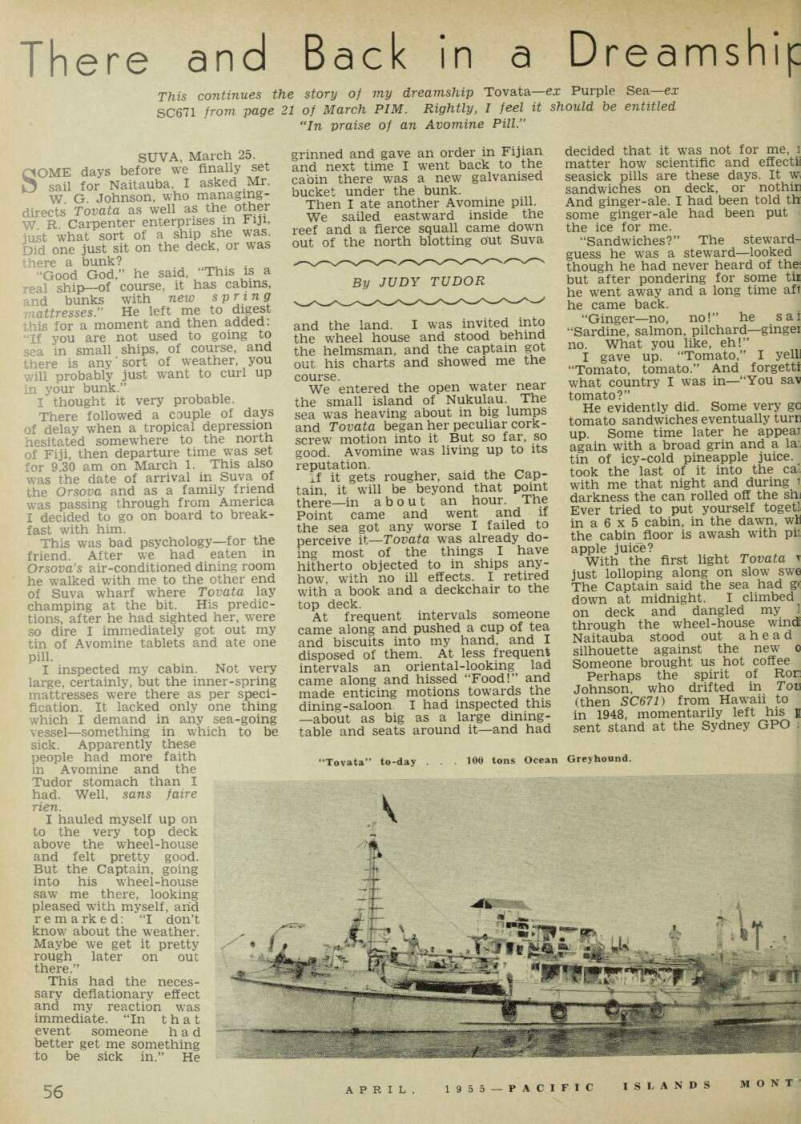
“Tovata” to-day . . . 100 tons Ocean Greyhound.
yas somewhere around at that noment. I guess he never got It so food! Journey’s end, a fair morning ind hot coffee. What more could me want'/ * * ♦ HOR those two weeks on Naitauba I —with the rest of the South Pacific —we suffered a succession f tropical depressions of high, xoderate and low intensity. Con jquently my only contact with ovata was as she threshed her way ast the island one night during le worst of the blows and some ow, between 9 pm and midnight, in Teaming wind, torrential rain and imbled sea, managed to decant veral bundles of reeds (for re aring the vatas —t hose raised ands on which a great proportion Fiji’s copra is cured) and half dozen people before she went on Suva.
Delays now began to pile up and lally it was decided to divert her len she had finished a voyage to itewa Bay ports (Vanua Levu) to :k me up at Naitauba. rhis was about 100 miles and a od half day out of her way and such consideration on the part any ship owners has never ne my way before, I was de mined to play my part. )ur rendezvous was for 7 am on ursday, March 24—more or less, r it is one thing to make mdezvous in these circums f ances; )ther to keep it. No sooner had date been made on the Tues r (by radio-telephone) than the mlins got busy. Up came another jpical depression”; up came the nd, screaming and howling DUgh the coconuts, blowing back Ir fronts like the manes of wild ses; down came the rain—inches t. So it continued Tuesday, and
inesday, and Wednesday night..
rovata will never come in this,” ■ the Hennings. Still, I was up daylight. Seven o’clock came, no Tovata. Miraculously, we tied to have hit a patch of calm the sea was comparatively flat there were patches of blue sky gave one cause to hope. But iy. 1 nine we were again being e g by squalls; at 9.30, Mac came , Tovata has gone around the t, he said, casually. Having i brought up to the stern ol which believes that ships wait said, casually. Having been ght up in the stern school h believes that ships wait 10 one, I was ready to decamp nee. But no.
x they said. ita had come on the last 11 and was ering anyway, ite my break but it could ly be said I relaxed,
prudently,
an Avomine
Ten-twenty. The Tovata had not come back, neither had it sent its launch, as was hoped. The planta tion launch was made ready. I col lected my luggage; put my three cameras in a zippered bag and hoped that they would not end in the drink; took off my shoes; rolled up my jeans; put on a hat that a female in a Sydney shop had sold me as waterproof; buttoned on my plastic raincoat; said my goodbyes and was ready. Mac came along; and Finau to captain the launch; and Sinbad to tend the engine; and two or three other large Fijians whose job was (1) to see that Tovata did not roll on the launch; and (2) to throw me onto Tovata if necessary, and heave my baggage on after me.
THE Tovata could now be seen coming from around the point She began to describe circles off the normal anchorage, carefully keeping a safe distance from the reef. (Anchorage is a misnomer here—it is too deep to anchor and ships just hang about outside; the passage through the reef is too shallow for craft larger than launches).
By now the sky in the north began to assume the colour of an over-ripe plum and as we got into the passage the storm hit us. Down came the rain in a solid wall and in a matter of seconds visibility was reduced to nil. Naitauba was blotted out; so was the reef. The last I saw of Tovata was her square stern disappearing at speed away from us. I felt that her captain was now beating it to Suva while his luck held.
“See, the rain is flattening the waves,” said Mac soothingly, but I wasn’t interested in waves, large small or flattened, except that now,’ they alone were left to show us that we were heading in the right direc tion. More clouds emptied them selves upon us. Once I was asked if I would like to shut myself in with the engine. I refused. On another occasion Mac wanted to know if I were wet. I said no—but that was a lie. When I examined myself on the ship I looked as though I had been dunked in the sea. The allegedly waterproof hat was a pulp; the rain had come through the plastic coat as though it were muslin; enough water streamed from my shirt and pants to float the Tovata and both items are, at this writing, still draped over
the rail on the back landing of the GPH still drying out.
In this fashion we played tag with the Tovata in and out of rain squalls beside the Naitauba reef for what seemed hours—but probably was less than one, the while the men kept up a high-pitched conversation accompanied by a wealth of gesticu lation which—so far as Fijians are concerned—always leaves me in doubt as to whether we are on the
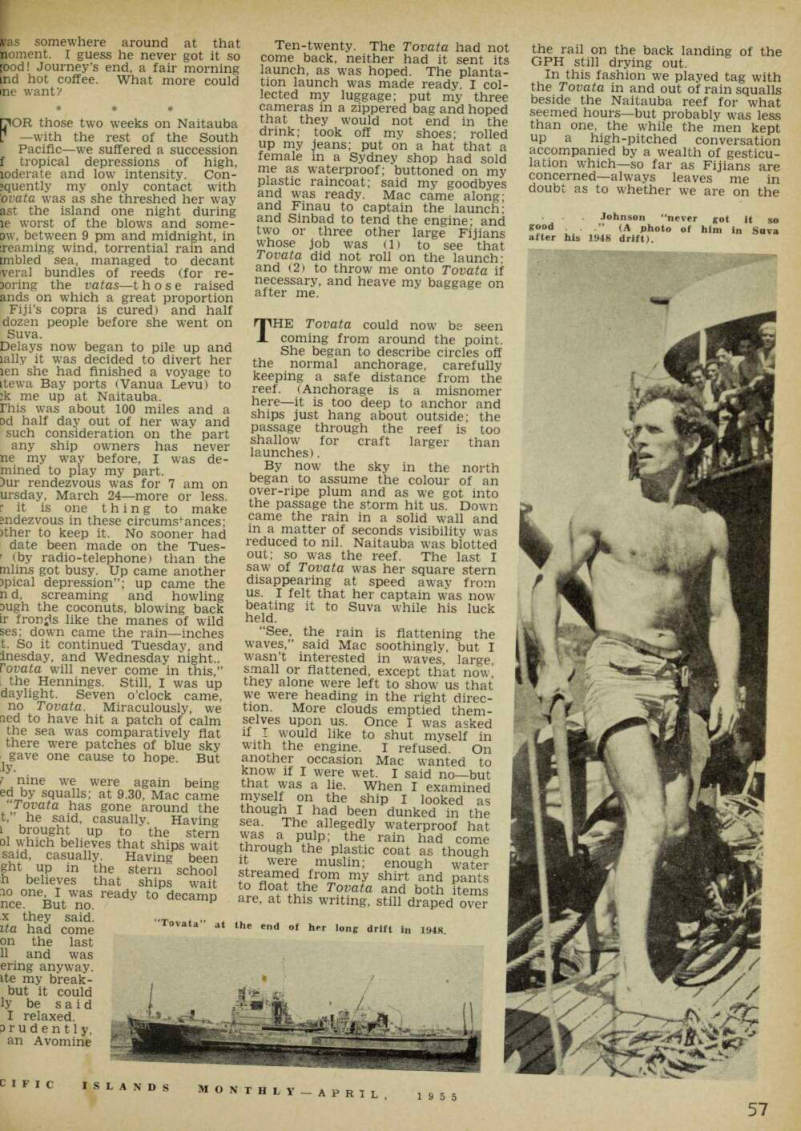
"Tovata" at the end of her long drift in 1948.
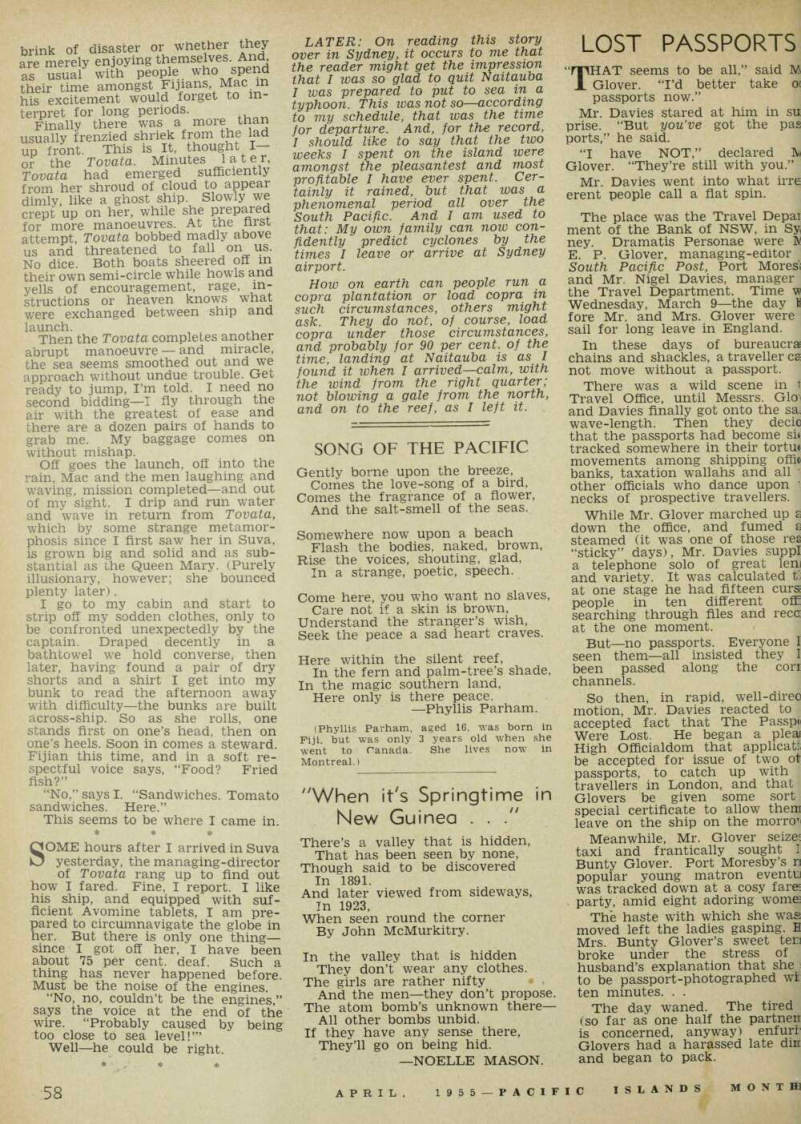
Johnson “never got It so good (A photo of him In Suva after his 1948 drift).
brink of disaster or whether they are merely enjoying themselves. And, as visual with people, who spend their time amongst Fijians, Mac in his excitement would forget to in terpret for long periods.
Finally there was a more than usually frenzied shriek from the lad up front. This is It, thought I or the Tovata. Minutes later, Tovata had emerged sufficiently from her shroud of cloud to appear dimly, like a ghost ship. Slowly we crept up on her, while she prepared for more manoeuvres. At the first attempt, Tovata bobbed madly above us and threatened to fall on us.
No dice. Both boats sheered off in their own semi-circle while howls and yells of encouragement, rage, in structions or heaven knows what were exchanged between ship and launch. , A ..
Then the Tovata completes another abrupt manoeuvre and miracle, the sea seems smoothed out and we approach without undue trouble. Get ready to jump, I’m told. I need no second bidding—l fly through the air with the greatest of ease and there are a dozen pairs of hands to grab me. My baggage comes on without mishap.
Off goes the launch, off into the rain, Mac and the men laughing and waving, mission completed—and out of my sight. I drip and run water and wave in return from Tovata, which by some strange metamor phosis since I first saw her in Suva, is grown big and solid and as sub stantial as the Queen Mary. (Purely illusionary, however; she bounced plenty later).
I go to my cabin and start to strip off my sodden clothes, only to be confronted unexpectedly by the captain. Draped decently in a bathtowel we hold converse, then later, having found a pair of dry shorts and a shirt I get into my bunk to read the afternoon away with difficulty—the bunks are built across-ship. So as she rolls, one stands first on one’s head, then on one’s heels. Soon in comes a steward.
Fijian this time, and in a soft re spectful voice says, “Food? Fried fish?”
“No,” says I. “Sandwiches. Tomato sandwiches. Here.”
This seems to be where I came in. * * * SOME hours after I arrived in Suva yesterday, the managing-director of Tovata rang up to find out how I fared. Fine, I report. I like his ship, and equipped with suf ficient Avomine tablets, I am pre pared to circumnavigate the globe in her. But there is only one thing— since I got off her, I have been about 75 per cent. deaf. Such a thing has never happened before.
Must be the noise of the engines.
“No, no, couldn’t be the engines,” says the voice at the end of the wire. “Probably caused by being too close to sea level!”’
Well —he could be right.
LATER: On reading this story over in Sydney, it occurs to me that the reader might get the impression that I was so glad to quit Naitauba I was prepared to put to sea in a typhoon. This was not so—according to my schedule, that was the time for departure. And, for the record, I should like to say that the two weeks I spent on the island were amongst the pleasantest and most profitable I have ever spent. Cer tainly it rained, but that was a phenomenal period all over the South Pacific. And I am used to that: My own family can now con fidently predict cyclones by the times I leave or arrive at Sydney airport.
How on earth can people run a copra plantation or load copra in such circumstances, others might ask. They do not, of course, load copra under those circumstances, and probably for 90 per cent, of the time, landing at Naitauba is as I found it when I arrived — calm, with the wind from the right quarter; not blowing a gale from the north, and on to the reef, as I left it.