Current News Items From Our Correspondents
pp. 51-53 · Read in the full issue
In Papua-New Guinea
Native Liquor Ordinance
Strongly Opposed
Public opinion in the Territory, if (ou can judge by the statements of rarious organisations, is over whelmingly against the Native Liquor )rdinance amendments which give he Administrator the authority to ssue permits to certain natives to iuy and consume intoxicating drink.
Most outspoken are public and irivate bodies in New Britain—the [ew Britain District Advisory Coun il, the Rabaul and Kokopo Town idvisory Councils, the Rabaul Sub tranch of the RSL, and all except ne of the religious bodies.
More than half the inmates in le Rabaul Gaol are natives serv ig sentences for drinking liquor, mple evidence that avenues of pur lase of liquor are not hard to find.
Police on District Services raids i sing-sings invariably mean Tests for drinking. One sing-sing i the Kokopo area early in March elded a bag of 17 offenders, all of nom were given six-months gaol rms.
Despite the stiff penalties, there is been no noticeable decrease in is phase of “crime.”
A member of the Kokopo Town Ivisory Council suggested that
foreign seamen who paid for native women with liquor instead of cash were a major source of supply.
A few Chinese have been con victed of selling liquor to natives and sentenced to short prison terms, but the local under-staffed and overworked police force seldom secures sufficient evidence to bring malefactors before a court.
Drunken Driver In Fatal
Accident
Recently a native named Totil was sentenced at Rabaul to 12 months imprisonment for man slaughter.
Totil was the driver of a jeep in volved in a collision with another jeep. Of the two native passengers in the other jeep, one man had his right leg amputated above the knee.
Totil, who admitted being drunk at the time of the accident, was un injured. He ran away from the scene of the accident but gave him self up to the police next day.
As a result of inquiries, four other natives who had been drink ing with Totil on the day of the accident were each sentenced to six months’ imprisonment. One of them was the president of the Reimber Native Village Council
Though incidents like this greatly strengthen the argument against native drinking, it must be allowed that they are not a common occur ence.
There is a section of the Euro pean community, many of them thinking people in responsible posi tions, who have been in the country long enough to understand the native, who believe the only solu tion to the problem is the issuing of liquor permits to approved natives.
It is undeniable that, short of prohibiting the import of liquor into the Territory, natives will always find someone willing to supply them with it. On this basis of fact the “pros” parry the attack of the non supporters.
What if the native privileged to drink gets drunk? Why shouldn’t he get drunk, say the “pros.” in a democratic country where the law deals alike with all persons, irrespec tive of colour, why should one section enjoy “advantages” not allowed to others? (Over)
What if the drunken native causes trouble? Punish him and revoke his licence to drink.
And, being unable to drink legally, what is to prevent his buying his drink outside the regular channels?
The supervision exercised by those who have not abused the privilege granted them will do it, claim the “pros.”
To the argument of the RSL that implementation of the Native Liquor Ordinance would seriously endanger the welfare of the families of ex servicemen, the supporters of the Ordinance reply that this is an as sumption which only fair trial could prove right or wrong.
Of all the queries, the one un answerable is: “What good will it do the native ”
Native Liquor Question At
Port Moresby
The Territories Minister (Mr. Paul Hasluck) during his March visit to Papua, attended a meeting of the Hanuabada Native Council in Port Moresby to give the councillors an opportunity to fire a few questions to him.
Among other things, the natives asked if they could have permission to drink. They said they felt there should be some system introduced enabling selected natives to have a drink occasionally without being gaoled for it. and suggested that this could be done by establishing
a club and allowing selected natives to drink on the premises.
Mr. Hasluck had no direct answer, but said that the liquor question was complex and was being looked into.
Anyway, it seems to be another phase in native progress when councillors pluck up courage enough to ask the Minister himself.
The council was also concerned with the cost of living at Hanua bada, and asked that wages be in creased in line with the higher liv ing costs. They said Hanuabada
natives had a tougher time becau they had to buy from the stores, i stead of growing food.
The Minister was given an e ample of how Administration wag for natives were lower than tho paid by many private firms.
Fatal Shark Attack
A native was fatally mauled a shark at Loani, opposite Samar in March. The boy was wading waist-deep water when he was t tacked about the thigh, and d: before anything could be done ; him.
£2O Fine For Canings
A £2O fine (£lO on each of two harges) was imposed at the Rabaul 'ourt on March 17 on Father Stephen White, a Roman Catholic tiissionary of Vunadadir Mission, tear Rabaul. The prosecution barged Father White with assault, tating that he had caned two lative schoolgirls, aged 17 and 18, rom Vunapope mission school. In vidence, Father White said he had ily tapped the girls on the buttocks s a reminder of his instruction ) behave themselves in future.
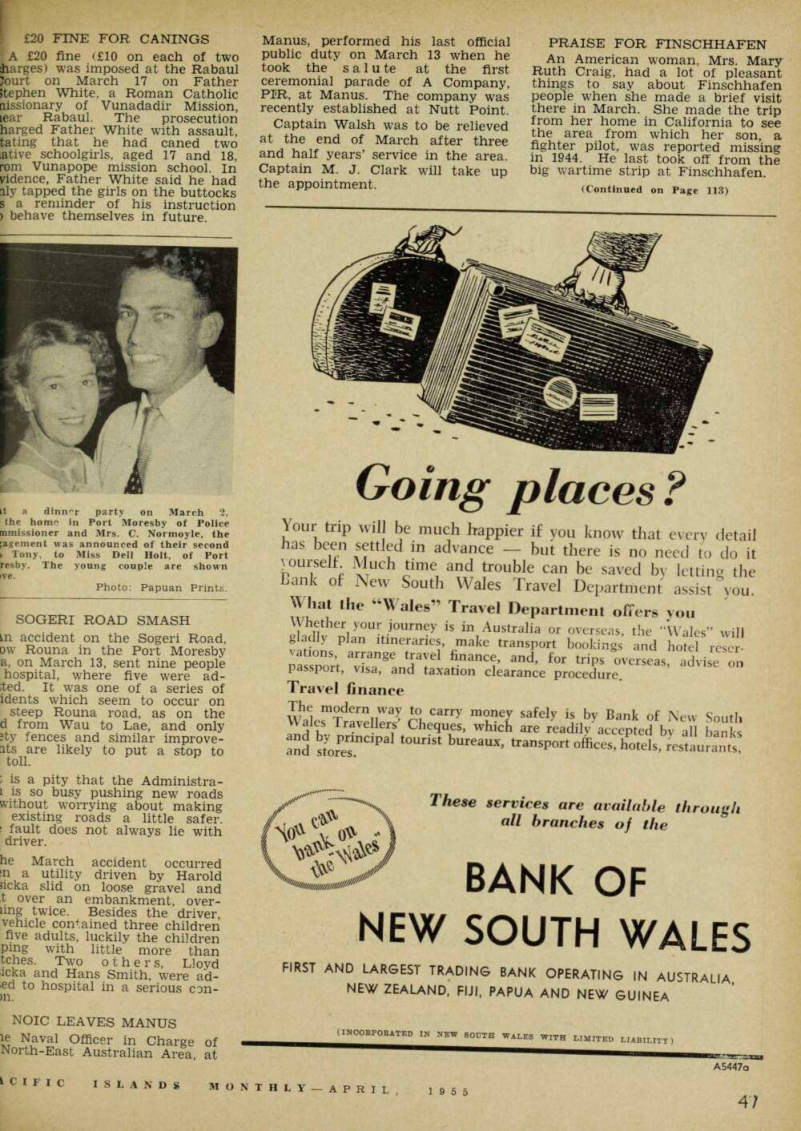
It a dinner party on March 2, the home in Port Moresby of Police mmissioner and Mrs. C. Normoyle, the engagement was announced of their second [?] Tony, to Miss Dell Holt, of Port [?]resby. The young couple are shown [?]ve.
Photo: Papuan Prints.