While Hell’S Broth Simmers
pp. 15-16 · Read in the full issue
Editorial . . .
Asians And Africans ‘Confer’,
READERS of this journal over the last ten years will not be surprised by the new orienta ion of South Pacific defence.
Lustralian and New Zealand forces re going to Malaya—where a 'ijian Battalion has been stationed or three years.
Ever since the erratic Australian ocialist leader, Evatt, connived at le betrayal of the Dutch in the etherlands Indies, and threw his ifluence as a high official of nited Nations in favour of the irmation of the “Republic of idonesia”, and drove the Ameri ms out of the great Manus base ■nearly 10 years ago—this journal insistently has pointed out that lere is danger to our safety in le increasing Red penetration of jutheast Asia.
For years, our warnings were eated by Bureaucratic Brass and -called Statesmen in the same ly as were our warnings, in the 30-40 period, against the ever owing menace of Japan. Our lers were a little late in cognising the Japanese danger; id they are similarly late in iking preparations to meet the ing that is taking shape in utheast Asia.
Ihere can be no argument out the meaning of the develop ;nts and events which have lowed Moscow’s decision, taken the end of World War 11, to janise and use Mongolian Asia ainst the British Commonwealth I the United States. In Moscow’s iw, the English-speaking world ist be crushed, because it is ;stern civilisation’s main bulwark linst Muscovite Communism.
Uter 1945, a Red Government s placed in absolute control :r China’s 500 million people; laya was honeycombed by Reds; ;nch control over Indo-China was fermined, and the richest area arthern Viet-Nam) transferred Communism: the futility of the >bling United Nations was nonstrated in Korea (still ler an uneasy truce); Thibet 5 over-run and occupied by the is; Siam and Burma have been •t in a state of panic; Afghanis is so deeply penetrated by Red uence that it now is coming >e to outright war with nstan; and the gang of political enturers which the Japanese called as a “government” in onesia before they departed in ly 1946, now are kept in power the Communists, and have a
close and growing tie-up with Red China.
For years, both politicians and press in the South Pacific seemed to regard all those events as fortuitous and accidental and un connected. But now even the most reluctant politicians have to admit that they conform with Moscow’s world strategy—all are part of the pattern.
Now, Australia is falling over her own feet in her haste to “re-align Australian defence policy which, until now, has been based on con ditions in the Middle East.” She is doing now what she should have done six or seven years ago, when she conceived the Colombo Plan, and tried, by handing over many, many millions of pounds as a free gift to induce the Southeastern Asiatics to stay at home and be good boys.
IT is difficult to see what actual good now can be achieved mereiy by sending Australian and NZ forces to Malaya. It is not military action —like policing the Malayan jungles against the Chinese terrorists—that is needed;
but strong and ruthless political action, backed by military force, either to establish selected govern ments in all those Southeastern countries to stamp out and keep out all Communist activity; or to ensure that the nationalist govern ments already there shall maintain, without mercy, all measures necessary to prevent Communist penetration.
The post-war breed of politicians, however, will not attempt anything like that. The Anzac battalions probably will camp somewhere near Singapore, merely as a token force, to show that we are aligned with the Americans against the Musco vites. It is not even yet clear that the Anzacs will assume jungle guardianship, so that the over worked Fiji battalion—which has: been kept in Malaya long beyond: its allotted time —may return home.
THE Reds may be expected to continue their white-anting process: the further penetration of Indo-China and Indonesia will be followed by increasing Com munist power in the so-called Parliaments of Siam and Burma; and when the seemingly inevitable explosion occurs, the Reds will be nicely placed in Southeast Asia to do the bidding of Moscow in relation to the South Pacific.
There are only two factors which perhaps may give us comfort at the moment. One is that efforts still are going on to get a Cold War Peace Conference at Prime Ministerial level—the idea being
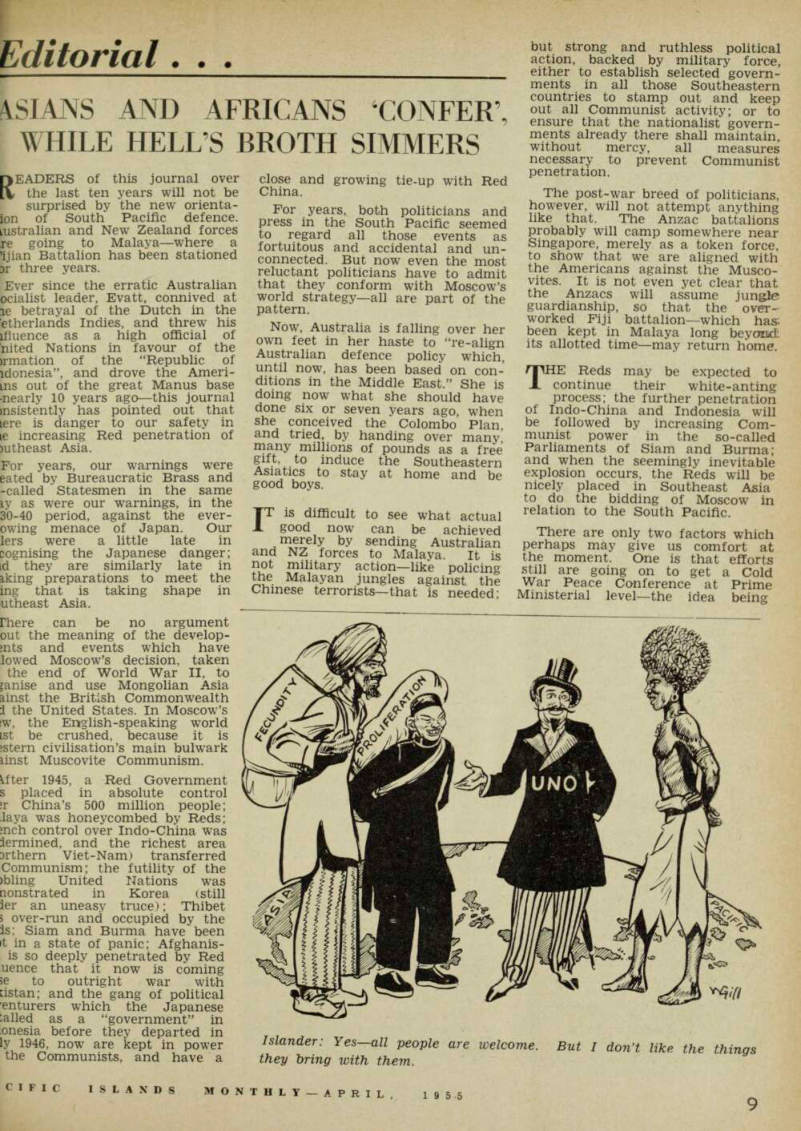
Islander: Yes—all people are welcome. But I don’t like the things they bring with them.
that, if such a conference were successful. Communism's outward thrust might be halted, in South east Asia as elsewhere.
The other is the absence, frpm the Asian scene, of any mighty in dustrial machine such as that which equipped and maintained Japan s advance into the South Pacific.
If war comes, Russia’s industrial potential will not have much to spare for Asia; and China’s heavy industries, while growing quickly, still are negligible in comparison with what would be needed to maintain a war effort in the Pacific.
BUT if the worst were to happen, the South Pacific would be far more likely to attract attack early in World War 111 than was the case early in World War 11.
Then, our lives were not greatly affected—until Japan came in late in 1941, we had only a few raiding ships in the Pacific to remind us that the Powers were engaged in armed conflict.
This time, if and when it comes, atomic bombs from long-range planes and submarines may reach the South Pacific countries before the actual declaration of war.
Therefore, it is to our advantage that the armaments which the Asiatic Communists are building up for our undoing should be kept as far away as possible. The occupa tion of Malaya by our forces will assist in keeping the Red line at least in the latitude of Indo-China.
We should have some little warning if we are to be attacked by aircraft from Saigon.
BUT —and this is a really ugly but —we of the South Pacific could be gravely embarrassed and endangered if the Reds succeed in building up secret bases in Indonesia, which lies well south wards of Malaya, and is actually within sight of the northwestern coasts of Australia and New Guinea.
While the situation steadily is deteriorating in Indo-China, it is fairly well under control in Malaya.
But in Indonesia—between Malaya and the South Pacific countries —it is bad, and getting worse. The
weak, babbling, . inexperienced
politicians of Indonesia are the natural prey of Communist agents; and the increasing build-up of underground Red organisation there does make us increasingly liable to a treacherous attack.
Our security can be guaranteed only if Western control were re-established over Indonesia, and maintained until the Indonesians were trained in the fundamentals of competent government. But, in a world over-run by sentimental theorists and dreamers, we cannot expect to see this situation dealt with in a practical way—not, that is, before and until the world reverts to war conditions.
And the irony of it all is that the Asia-Africa Conference —an anti-European manifestation due to commence at Bandoeng, Java, on April 18 —proposes to discuss, under the heading of “Colonialism”, the Indonesians’ wholly indefensible claim to Western New Guinea.
In its final analysis, the Asia- Africa Conference has only one meaning. If European communities —especially those in the South Pacific—are to survive in the world that they have created, they must maintain superiority in arms, go always fully armed and realise that the .way to racial survival does not lie through appeasement, t The MV Beaverbank, aboard which Mr. G. R. Powles, High Com missioner of Western Samoa, and Mrs. Powles travelled on vacation to Europe, also lifted nearly 2,500 tons of copra and several hundred tons of cocoa beans for the United King dom late in March.