Exploring Mboli Caves
pp. 82-83 · Read in the full issue
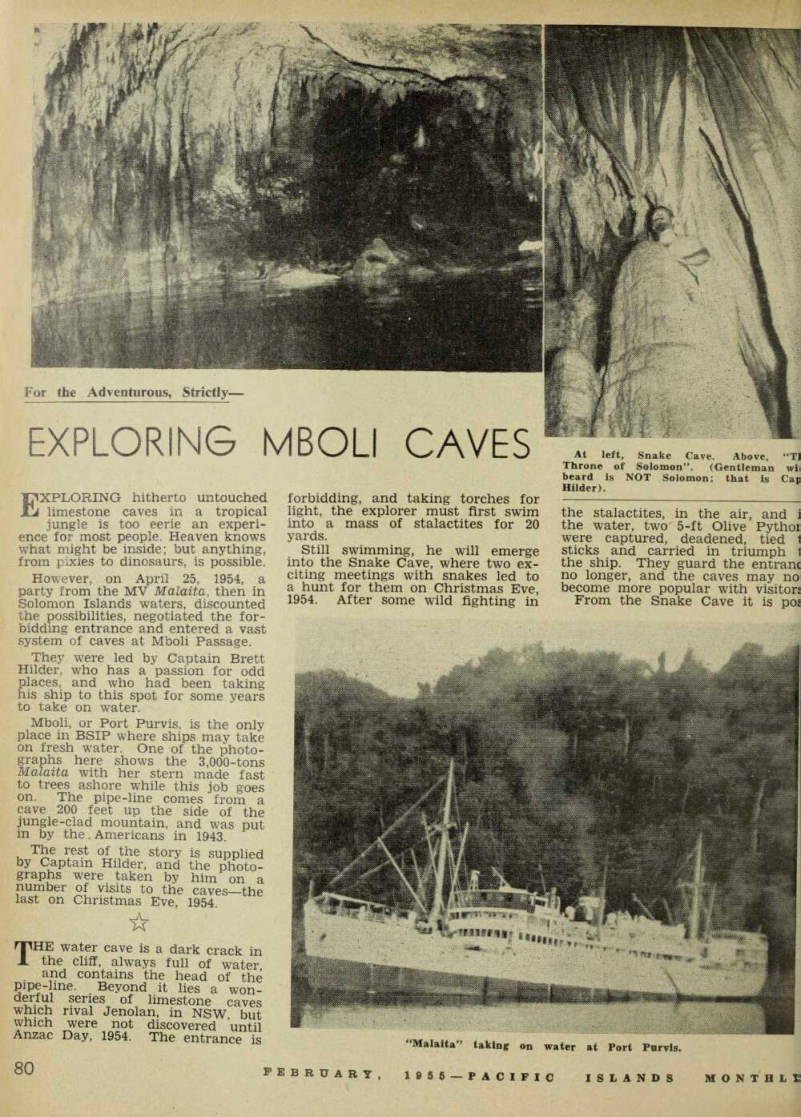
For the Adventurous, Strictly—
EXPLORING hitherto untouched limestone caves in a tropical jungle is too eerie an experi ence for most people. Heaven knows what might be inside; but anything, from pixies to dinosaurs, is possible.
However, on April 25, 1954, a party from the MV Malaita, then in Solomon Islands waters, discounted the possibilities, negotiated the for bidding entrance and entered a vast system of caves at Mboli Passage.
They were led by Captain Brett Hilder, who has a passion for odd places, and who had been taking his ship to this spot for some years to take on water.
Mboli, or Port Purvis, is the only place in BSIP where ships may take on fresh water. One of the photo graphs here shows the 3,000-tons Malaita with her stern made fast to trees ashore while this job goes on. The pipe-line comes from a cave 200 feet up the side of the jungle-clad mountain, and was put in by the. Americans in 1943.
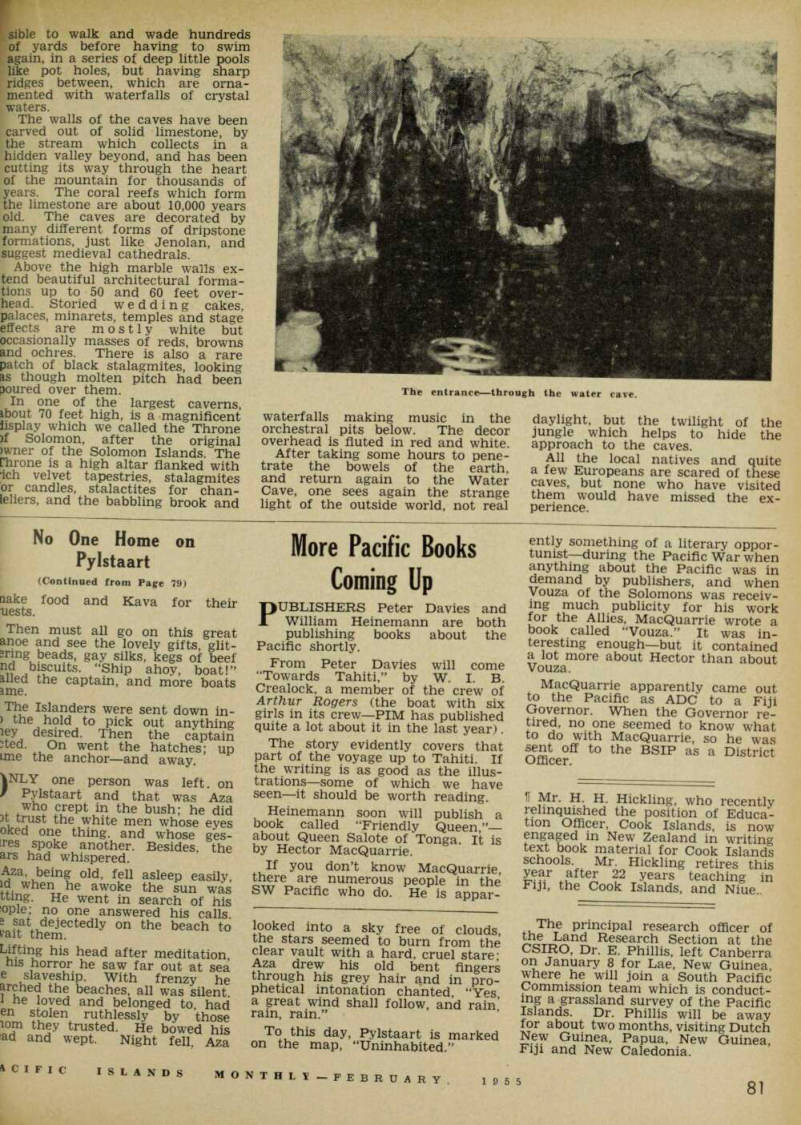
The rest of the story is supplied by Captain Hilder, and the photo graphs were taken by him on a number of visits to the caves—the last on Christmas Eve, 1954. ☆ THE water cave is a dark crack in the cliff, always full of water and contains the head of the pipe-line. Beyond it lies a won derful series of limestone caves which rival Jenolan, in NSW but which were not discovered until Anzac Day, 1954. The entrance is
forbidding, and taking torches for light, the explorer must first swim into a mass of stalactites for 20 yards.
Still swimming, he will emerge into the Snake Cave, where two ex citing meetings with snakes led to a hunt for them on Christmas Eve, 1954. After some wild fighting in
the stalactites, in the air, and I the water, two 5-ft Olive Pythor were captured, deadened, tied t sticks and carried in triumph t the ship. They guard the entranc no longer, and the caves may no' become more popular with visitors From the Snake Cave it is pos
At left. Snake Cave. Above, “TI[?] Throne of Solomon”. (Gentleman wi[?] beard is NOT Solomon; that is Cap[?] Hilder).
"Malaita” taking on water at Port Parvis.
sible to walk and wade hundreds of yards before having to swim again, in a series of deep little pools like pot holes, but having sharp ridges between, which are orna mented with waterfalls of crystal waters.
The walls of the caves have been carved out of solid limestone, by the stream which collects in a hidden valley beyond, and has been cutting its way through the heart of the mountain for thousands of years. The coral reefs which form the limestone are about 10,000 years old. The caves are decorated by many different forms of dripstone formations, just like Jenolan, and suggest medieval cathedrals.
Above the high marble walls ex tend beautiful architectural forma tions up to 50 and 60 feet over head. Storied wedding cakes, palaces, minarets, temples and stage effects are mostly white but occasionally masses of reds, browns and ochres. There is also a rare patch of black stalagmites, looking as though molten pitch had been poured over them.
In one of the largest caverns, ibout 70 feet high, is a magnificent Jisplay which we called the Throne )f Solomon, after the original )wner of the Solomon Islands. The Uirone is a high altar flanked with ;ich velvet tapestries, stalagmites or candles, stalactites for chan leliers, and the babbling brook and
waterfalls making music in the orchestral pits below. The decor overhead is fluted in red and white.
After taking some hours to pene trate the bowels of the earth, and return again to the Water Cave, one sees again the strange light of the outside world, not real
daylight, but the twilight of the jungle which helps to hide the approach to the caves.
All the local natives and quite a few Europeans are scared of these caves, but none who have visited them would have missed the ex perience.
The entrance—through the water cave.