Tropicalities
pp. 79-80 · Read in the full issue
Magazine Section
Christy Minstrels Of 60
Years Ago
Mr. J. D. Whitcombe Of Auck
land, former long-time resident of Tonga, sends along an old document, an extract from which should stir the memories of other Tonga old-timers. It is the pro gramme of a concert given on De cember 11, 1894, by the Nukualofa Amateur Dramatic Club, in the Nukualofa Pale Kai—as it then was. (The Fale Kai was a build ing set aside as an eating place for the Tongan Nobles during sessions Df Parliament.) The first part of the programme lists a series of items by the ‘Christy Minstrells” —no names mentioned—but the second part lists the following:— Pianoforte duet, Misses Treskow and Watkins. >ong: “The Flag that Braved”, Mr. Leefe. 3ong: “Three Old Maids of Lee”, Miss Woodfield.
Recitation: “The Spanish Cham pion”, Mr. D. Bohitele Kaho. song: “Vashti”, Miss Treskow and Company.
Song: “Mona”, Mr. Egan Moulton.
Duet; (Tableau) “Hear Me Nor ma”, Miss Woodfield, Mr. E.
Moulton, and Company.
Song: “An Awful Little Scrub”, Mr.
Plesner.
Duet: “Life’s Dream is O’er”, Miss Treskow and Mr, E, Moulton. ?ableau: “Faith, Hope, and Charity,” Company.
Song: “After the Ball”, Mr. D. B.
Kaho.
How Fijian Is “Mocambo”?
ra recent issue of a British travel magazine we read of a coffee-shop in London called the Jocambo (decor is “part South Sea sland, part Italian”—whatever hat may mean). It was stated here that Mocambo is Fijian for meeting place.”
The December Fiji Visitors’ bureau bulletin also had something o say about the Mocambo —this ime meaning the hotel at Nadi firport, at least the lounge of which s known to every airline passenger ravelling into or through Fiji.
That Macambo came into exis ence during the war, as an Ameri an officers’ club, and according to he Bureau the name Mocambo was •estowed on it by nostalgic resi ients of Los Angeles who were lomesick for a nightclub of the ame name in that city.
It sounds a more reasonable ex planation.
Nadi’s Mocambo has had varying fortunes since it was an officers’ club —but is now run as a success ful private enterprise by Mr. Barry Philp,
Ballet Among Shy
Head-Hunters
AS part of their research into native tribal dances, ballet dancer and choreographer Beth Dean will shortly visit some of the remoter parts of New Guinea with her husband Victor Carell.
They plan to start at Aitape and then work north to Vanimo. Miss Dean hopes that in this region they will come in contact with civilisa tion-shy headhunters, whom she feels will be quite different from the “dignified, courteous and gentle natives of Australia.”
Miss Dean and her husband re cently spent five months living with aborigines in Central Australia, filming their tribal dances. Their book, Dust For Dancers, which was written after their return from Cen tral Australia, will pobably be pub
lished while they are in the Terri tory, (Editorial advice for Miss Dean: Try the Sepik River—more head hunters there, although they are not shy.)
London Polish For Bsip
Police
REPORTERS who boarded the liner Otranto in Melbourne recently found two brown skinned Islanders armed with a sound knowledge of judo and the latest crime prevention and detec tion methods.
They were Police Sergeants Oduana Silverio and Kipling Gordon-Beti of the British Solo mon Islands.
Having just completed a six month course at Hendon, the Police Training College in London, the two sleuths were returning home to strike terror in the hearts of BSl’s underworld.
One of them, Sergeant Gordon- Beti, was wasting no time on the ship: reporters found him enthusi astically absorbed in a book called “Crime and the Police.”
Both men are stationed at Honiara and have charge of 50 native constables.
Help Wanted—On Hair
Hydrometers
WE have many strange requests from time to time, but this one wins the biscuit this month: Tavi Kauffman, the Danish “nature-man” in Tonga, wants to make a hydrometer from a human
hair. He has no books on the sub ject and would welcome informa tion, which should be addressed to him c/o Nukualofa post office, Tonga.
We have never heard of anyone making hydrometers, or anything else, except hair-shirts, out of hairs.
This is evidently what comes of voluntarily casting oneself away to be a hermit on one of the outer Tongan isles. . . . But hair hydro meters! Frankly, we’re amazed, Kauffman, we understand, be lieves that the world would benefit if everyone returned to the Stone Age; with this in view he planned to heave all his books into the sea once he was established on his Tongan island.
We are in two minds about nature-men generally, but one thing we are sure of is that no Stone-age man ever made a hy drometer —much less out of a hair. (According to the dictionary, hydrometer means “an instrument for ascertaining the specific gravity of liquids.” The most common ex ample is the syringe affair used for determining S.G. of the fluid in a car battery—and thus the amount of charge. . . It has been suggested to us that someone along the way had hit a wrong key, and what Kauffman really wants to make is a “hygrometer”—an instrument for measuring humidity. Apparently a hair is sometimes used for that— as a sort of coiled spring, A hygrometer, we are informed, is a highly delicate and expensive in strument.)
Apia Will Toot, Too
LAST year Oscar Nordman, of Papeete, had some legal troubles as the result of a siren erected on his office, with which, as self appointed city crier, he released friendly farewell blasts to departing tourist ships. Members of a near by club objected to the noise and the siren was declared a public nuisance—until other citizens pro tested the ban, and the interdict was withdrawn.
We now hear that Mr. Eugene Paul, prominent Apia business man, back from a recent Papeete visit, is considering the installation of a similar farewelling hooter atop an Apia picture theatre.
Cl Stand By For Hurricanes
THANKS to meteorological officer
Gordon F. Russell (well known , in Fiji) the Cook Islands popu lation must be the most weather conscious south of the Line. When ever these Islands are hit by a day or two of excessive rain, heat, or ■ explanation duly appears m the daily news sheet in terms of outbursts of Antarctic air,” “in tense anticyclones over the Kerma decs, or “intrusions of the Tropical Convergence” from the north f h e Cooks have been remarkably free from damaging hurricanes since the war, but the danger is alwavs present from November to April and
meteorologist Russell is not allowing the locals to forget it. In mid- November, Rarotonga had a full scale hurricane alert to test the de fences and make certain that the population knows its drill if a blow strikes at short notice, The warning is given by a pair of trucks, sirens wailing, encircling the 21-mile road around the island but starting from opposite direc tions. Local police, village officials, and school-masters then go into action, The test was held in mid-week “thus enabling all people to discuss it over the week-end,” said the Press Sheet.
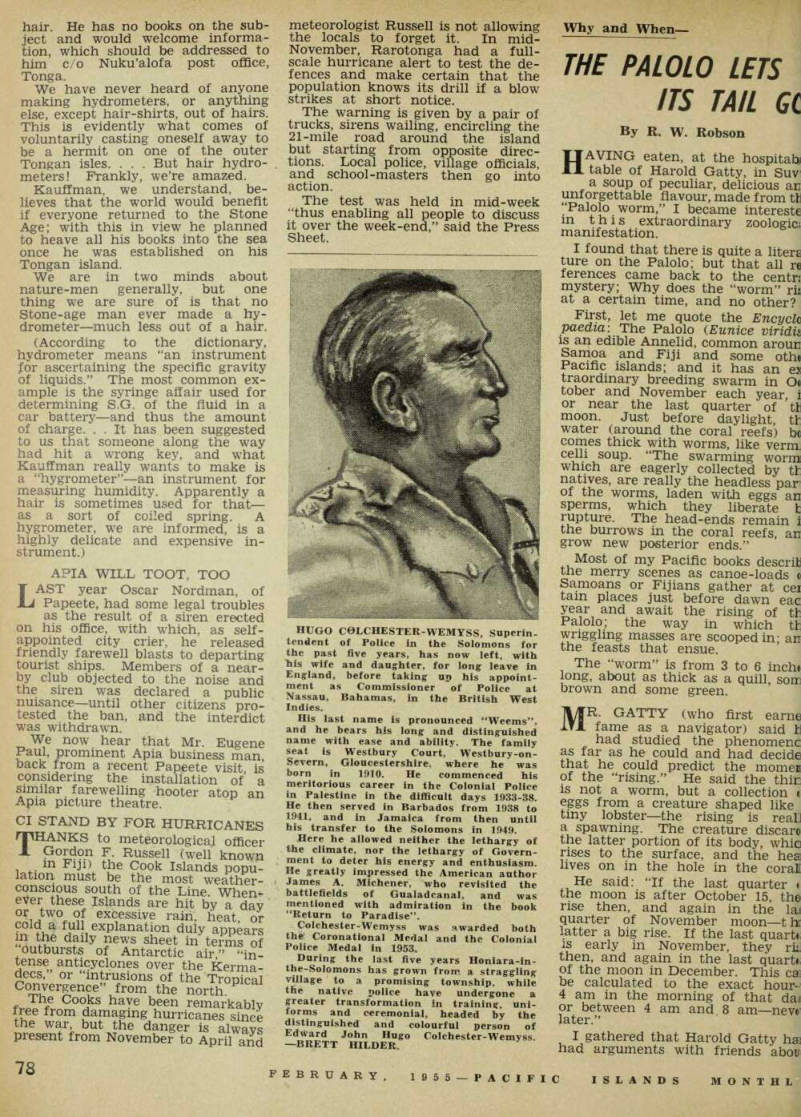
Hugo Colchester-Wemyss, Superin
tendent of Police in the Solomons for the past five years, has now left, with his wife and daughter, for long leave in England, before taking up his appoint ment as Commissioner of Police at Nassau, Bahamas, in the British West Indies.
His last name is pronounced “Weems”, and he bears his long and distinguished name with ease and ability. The family seat is Westbury Court, Westbury-on- Severn, Gloucestershire, where he was born in 1910. He commenced his meritorious career in the Colonial Police in Palestine in the difficult days 1933-38.
He then served in Barbados from 1938 to 1941, and in Jamaica from then until his transfer to the Solomons in 1949.
Here he allowed neither the lethargy of the climate, nor the lethargy of Govern ment to deter his energy and enthusiasm.
He greatly impressed the American author James A. Michener, who revisited the battlefields of Gualadcanal, and was mentioned with admiration in the book “Return to Paradise”.
Colchester-Wemyss was awarded both the Coronational Medal and the Colonial Police Medal in 1953.
During the last five years Honiara-in the-Solomons has grown from a straggling village to a promising township, while the native police have undergone a greater transformation in training, uni forms and ceremonial, headed by the distinguished and colourful person of Edward John Hugo Colchester-Wemyss.