Current News Items From Our Correspondents
pp. 37-49 · Read in the full issue

In Papua-New Guinea
I Dearer And Scarcer
Electricity
Despite Territory-wide complaints, icreased electricity charges began grating in the main centres of apua-New Guinea on January 17.
The new charges give a better ;al to large-scale consumers, but le small householder will have to ly more. Under the new sliding ale, the first units are the dearest, lich means the more the house >lder attempts to cut down on s power, the harder he will be t.
He will, therefore, probably try to e all the power he wants, in the pe that the general average cost 11 work out to his advantage, and is is not good for Territory towns’ idequate electricity generating int.
Port Moresby Council recently nplained that nothing was being ne to avoid future blackouts, and it rationing could be expected fore the Rouna hydro-scheme be i operating. The Lae Town Ad-
visory Council complained in Janu ary that one of the three power units ordered from Britain for Lae’s new power house had been diverted to Rabaul, thus giving Rabaul four plants and Lae two.
The Council asked for the return of its third plant.
Meanwhile Rabaul has been com plaining for years about its lack of power, as it is forced to make use of old Japanese power plants. Re strictions in Rabaul are undoubtedly
severe, with no electric stoves being installed because the power house cannot take the load.
The Rouna hydro-scheme which is to supply Moresby, is striking trouble, too.
In January, two engineers arrived at Port Moresby from Melbourne to inspect the power-house, which is being threatened by a possible land slip from the hill above it. Cracks appeared in the hill some time ago, and have got worse.
In late January it was decided that the site of the power house for the Rouna hydro-electric scheme would have to be moved. Tests are now going on to find a more suitable site than the one already prepared. (Over)
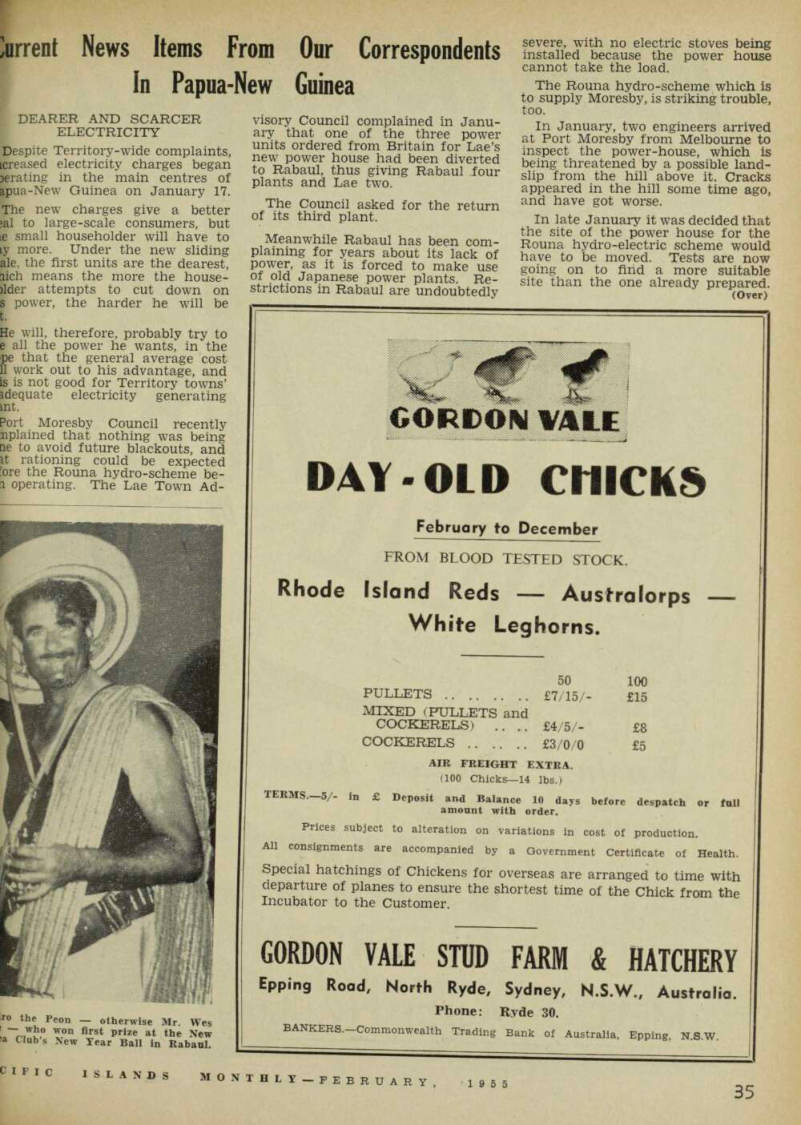
ro the Peon otherwise Mr. Wes first prize at the New ea Club s New Year Ball in Rabaul.
:l searchers back from
Sepik
[embers of Enterprise of New nea Gold and Petroleum No bility oil survey team returned
from a survey of the company’s per mit area in the Sepik at the be ginning of January.
They had been away three months, in an area up towards the Dutch border. The wet season
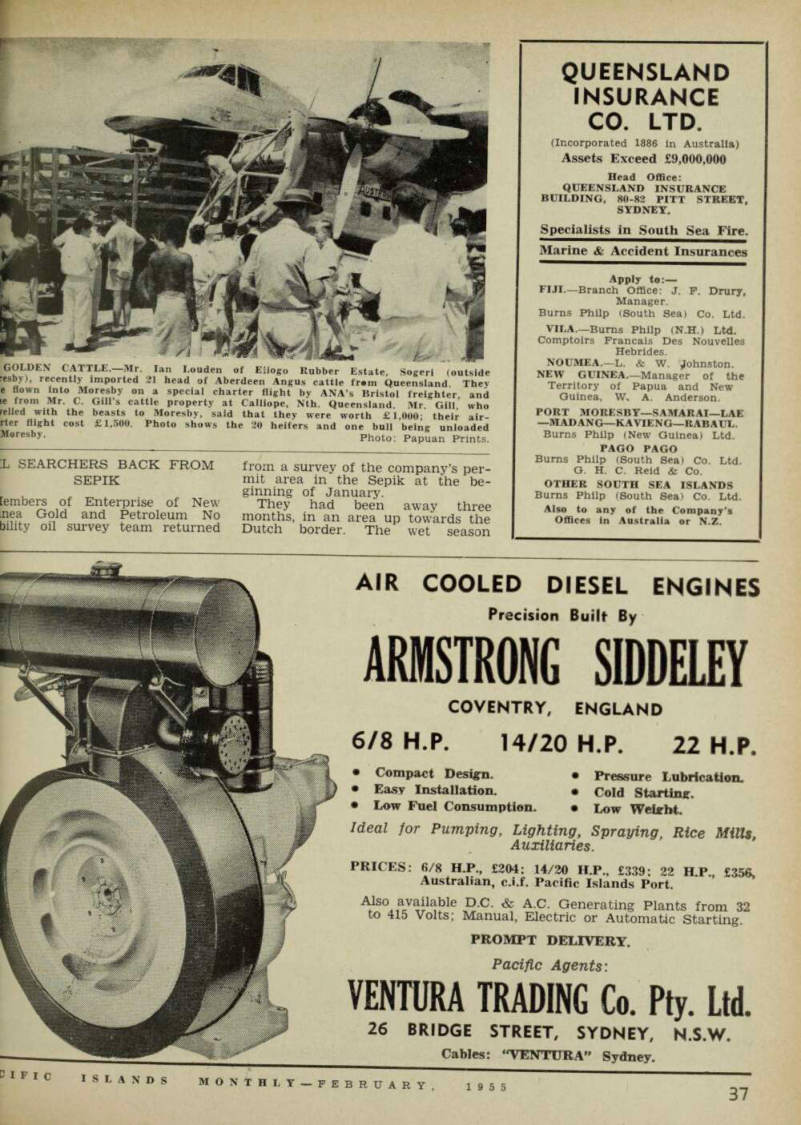
GOLDEN CATTLE.—Mr. lan Louden of Eilogo Rubber Estate, Sogeri (outside resby), recently imported 21 head of Aberdeen Angus cattle from Queensland They [?]e flown into Moresby on a special charter flight by ANA’s Bristol freighter and [?]elled with the beasts to MOresby, said th Nth. Queensland. Mr. Gill, who [?]relied with the beasts to Moresby, said that they were worth £1,000; their air [?]rter flight cost £1,500. Photo shows the 20 heifers and one bull being unloaded Moresby - Photo: Papuan Prints.
arrived, winding up operations tem porarily. The party expects to re turn to the Sepik about April.
Paratroops Who Did Not
Jump
Army authorities in Port Moresby in January were arranging for a surprise “parachute” raid on the town during the week-end of Feb ruary 5-6.
The paratroops, members of the PNGVR, will “blow-up” several key points and then attempt to escape.
First news of their presence in the town will come through reports to the police that the key points have been blown up, and this will be the signal for troops of the Pacific Islands Regiment and the police to set about rounding the raiders up.
The public will be asked to help by reporting the presence of Euro pean troops wherever they see them.
Colonel R. K. Wilson, a Port Moresby surgeon and former war time commando, will lead the PNGVR parachutists, who will actu ally arrive by jeep, although they may be allowed to escape in a real helicopter, through the courtesy of Bahamas Helicopters, based with APC at Port Moresby.
Moresby Flying-Squad
Six two-way radios were installed in police vehicles in Port Moresby
during January. This will make the police force more mobile.
The sets are frequency-modulated, similar to types being used in two Australian States. The sets will operate through a base transmitter, remotely controlled, and set on the top of Burns Peak, overlooking Port Moresby.
French Movie Makers
Two French photographers a ciated with the French Museur Paris and with UNESCO, arr in Port Moresby in January c two months’ visit.
They will make films of prim native life in the Highlands,
films may be released through United Nations.
'he photographers are M. Pierre isseau and M. Toni Saulnier. M. sseau, who is a scientist as well photographer, has already been ioci a t e d with documentary ntific films in the Amazon, nch Congo and Guinea and has several successes in the inter lonal film field.
A-U’S New Year Present
r au’s usual Christmas present is closing of the Wau-Labu road luse of washaways. i 1954, supplies had to be air ?hted for several weeks; now in early January, the road washed away in three places r Gorakor Gorge. Works De cent officers predicted the road lei be closed at least two weeks. s f n , eant another airlift, with no taking part in it this year. 3 supphes were quite adequate; BUI9IO began storing all its ply a shipments at the mill until the
These gates are to be erected at the trance to Queen Elizabeth Park in [?]baul. New Guinea, and will be a [?]emorial to the New Guinea men who [?]t their lives during the Japanese war. [?]st of the gates and their erection is [?]ing met by the women ex-residents of [?]w Guinea who now live in Australia— [?]any of them the widows of men who [?]d in the Territory between 1942-45. [?]unds were collected by the New Guinea [?]men’s Club of Sydney on behalf of [?]men living in NSW; and by the New [?]inea Women’s Assn, of Melbourne on lalf of women in all other Australian [?]ites. Early in December the Melbourne lociation had approximately £260 and [?]ney, £l7O. More money has come in [?]ce.
At first it was intended to erect only centre pair of gates; but response has [?]n so good that the women will now able to erect the two smaller side es as well. Each leaf of the carriage es will be 6 ft, x 6 ft. he Royal cypher will be attached to filagree in the centre of each gate; I on one of the pillars there will be inscription. In association with these es, a Memorial Book will be compiled be kept in Rabaul library) and in it be inscribed the names of all the [?]ians who were lost during the war in [?] Guinea.
ig trucks could tart using the oad again.
The Markham liver bridge, the ew and import nt link at the ae end of the >ad, was officially jened by the Ad linistrator, Brig.
L M. Cleland, at ie end of Jan ary.
Brownings
Twenty-two atives were re nted missing in ® canoes follow g severe New ear storms in the jrt Moresby and ulf districts, but ter being miss -11 a week, all but ie turned up.
Nineteen of the ttives were on a noe trip from ;rema to Manu anu village near
sui, when they were struck by the irm. They had a load of sago ich they had received during the ditional ceremony of Heri, which one of native exchange. Heri has icntly been revived in the area.
Cwo canoes went out from the [age, both specially equipped and ‘pared with magic. When only
one returned, and Civil Aviation and Qantas aircraft had searched in vain for days, the people of Manu Manu blamed the loss of their menfolk on the neglect of some of the magical preparations.
But after a week, eighteen of the nineteen turned up again after the canoe had been swamped and they
had struggled ashore far up the coast. One native had been drowned.
At the same time, below Port Moresby, in the Rigo district, two native men and a girl turned up on different beaches after they had been in the water for more than a day. Their canoe had been missing at the same time and had been blown for days down the coast.
Govt. Secretary Returns
The Government Secretary of Papua and New Guinea, Mr. S.
Lonergan, returned to Port Moresby on January 3 after seven months’ leave.
With his wife he travelled across the Pacific to America, from coast to coast by road, then on to Eng
Our photo shows members of the Junior Red Cross of Port Moresby distributing gift parcels at the Native Hospital, Ela Beach, Port Moresby, on December 30. The gifts were sent by The American Junior Red Cross.
Photo: Papuan Prints.
land aboard the Queen Mary.
Administrator
More than three thousand en thusiastic natives took part in festivities during the visit of the Administrator, Brigadier Cleland, at Losuia, in the Trobriands in January.
They gave him and Mrs. Cleland a spectacular reception, one of the highlights being the gathering of hundreds of natives with flaming torches, who followed the party down to the pier at Losuia after lining the road for a memorable farewell. z The previous day, when the Ad ministrator’s vessel, the Leander, left Kitava for Kiriwina, the party had an indication of the big recep tion in store for them as native canoes of all sizes sailed past the Leander towards the main island.
The canoes continued to go by for two hours.
In the Trobriands the Admin istrator visited many villages and met residents.
Deparmental
Reorganisation
The change-over of work of some Administration departments in Papua New Guinea will not take place until the new financial year.
The changes were announced last
November, and affect the Govern ment Secretary’s Department (which will be known as the Department of Civil Affairs); the Treasury (which will shed some of its functions, such as the operation of stores and transport); and the De partment of District Services (which will change its name to Department of Natives Affairs, without losing any of its functions).
The Assistant Administrator, Mr.
Rupert Wilson, said, after a visit!
Canberra in January, that changeover of the departure; would not be sudden, but a “gradl merging.”
Just Lift The Receiver:
Port Moresby took another step the direction of its automatic te phone system in January with changeover of telephones in Boroko area.
’he old system or ringing a handle ten fruitlessly) has been replaced h a system of dial telephones ich contact the exchange merely having the receiver lifted. The Is will not begin to operate until automatic service is installed lie end of 1955, some time behind edule. [onedobu exchange changed over the new system last year.
Native Education At
Goroka
he first native central school in Central Highlands opened at 'oka at the end of January, he school was opened by the
Director of Education, Mr. W.
Groves, who said it would be further developed as a focal point of native education in the Highlands, providing secondary courses and teachertraining.
Later, too, there are plans for a similar girls’ school, and land has been reserved nearby.
Well known Sydney artist, Miss
Mary Edwards, arrived at Lae in January to begin a painting tour of New Guinea. She later went on to Minj in the Western Highlands, Miss Edwards has previously painted numerous portraits of Fijians.
Bishop Returns
The Roman Catholic Bishop of Papua, Bishop Sorin, returned to Port Moresby by air on January 21, after 12 months abroad. (Over)
it left: Mr. Roy Greenham, of the [?]glo Iranian Oil Company, left Port [?]resby on transfer to East Africa on January 5. He has been fields resident logist of the Australasian Petroleum [?]pany at Port Moresby. Right, Mrs.
Washington who was farewelled by My friends before leaving on January 7, make a home South after 33 years [?]dence in the Territory. Mr. Washing recently retired from the Department Lands after 32 years service. Mr. and [?]s. Washington were two of the oldest dents of Port Moresby. Mrs. Washing [?]’s father, Mr. Simon, served as a [?]gistrate under Sir William MacGregor.
Photo: Papuan Prints.
e[?]se two young people announced their [?]Element in Port Moresby on New [?]’s Eve. They are Miss Barbara Poile, the Public Service Commissioner’s [?]rtment. and Mr. Denis McLaughlin, [?]osts and Telegraph Department.
Photo: Papuan Prints.
He went to ranee in Janu ry, 1954, to under ) an operation »r a spinal con ition. The opera on was successful id the Bishop
is able to start moving around me months before one would (Finally expect.
However, he spent the whole of 5 time in Europe recuperating.
Ps Institute
Ihe principal of the Public Ser * Institute of Papua New Guinea, r. D. I. Glastonbury, visited Aus
tralia in January to complete arrangements for Administration officers to take University and tech nical courses through the Institute.
These courses will be done through the co-operation of various Australian educational bodies, and the scheme has a l ready drawn many inquiries about specialised courses.
Names—But No Signs
Hundreds of printed maps show ing the town area of Port Moresby have been distributed to Port Moresby people, to help them to get to know the town’s street names.
It is the first plan of its type dis tributed, and it’s an asset.
But an even greater asset would be the installation of street signs in Port Moresby. They are notice ably absent.
Meanwhile, Madang is having its street-name troubles. Names were submitted but were not accepted by the District Commissioner; they will be discussed again. (Over)
Miss Cynthia Smith of the Methodist Mission Nakanai, New Britain, was married in Rabaul. on January 17, to Mr Alex Floyd, Assistant Forest [?]otanist and Eco [?]oglst of Lae. In the [?]icture, left to right, [?]re: Mr. Owen Smith; Miss Hazel Smith, he bride’s sister; [?]e groom and bride; Mr. V. Ready; and Miss Marjorie Floyd. he groom’s sister, Mr. B. M. Richard on. who gave the [?]ride away, is not [?] the picture.
Photo: C. H. Meen.
More School-Age
Youngsters
European and Asian Primary in the Territory this year expect to , cater for a total enrol ment of 1,040 pupils, with enrol ments increasing m nearly every district.
In Port Moresby there is a new system of zoning, with new students attending the school nearest to then homes, although students already enrolled are not affected.
Here are the main enrolments in Papua New Guinea, showing the growth of many schools; Port Moresby schools, 252; Rabaul Euro pean, 95; Rabaul Asiatic, 160; Lae European, 102; Lae Asiatic, 41; Madang, 40; Wewak, 24; Kavieng, 60: Kerevat, 19; Lombrom, 48; Lorengau, 21; Bulolo, 91; Wau 45; Samar ai 24; Popondetta 8; Sogeri 12.
In addition, there are 201 students obtaining their education by corre spondence.
New Bread
A new bread company began operating in Port Moresby in January.
It is a branch of the well-known firm, Sunshine, and it turns out a pre-cut and wrapped loaf, as well as some fancy breads. Port Moresby people receive it well.
Burns Philp NG Ltd. are the agents in Port Moresby.
Service Homes
The Assistant Director of the War Service Homes Division, Mr. E. J.
Slater, said in Port Moresby in January that there was unlikely to be any delay with finance for Terri tory home builders when the Division began operating in the Territory.
He was on a three weeks’ v: during which he planned to vestigate arrangements for setl up the service, which should opei later this year.
Maximum amount available any class of assistance will £2,750.
Para-Typhoid In Moresby
A number of cases of para phoid “A” fever were notified in art Moresby in January. The news tused a run on the clinics for in ctions of TAB. and for a week or jo most people were going about implaining of sore arms and hang ers.
In the middle of January there >re four confined cases and about renty suspected cases, many of em children. Because of the unber of children, the Health De triment began to look into the issibilities of the disease being me by special foods such as cakes ice cream.
During investigations it was found at there were some unsatisfactory pects about the manufacture of me local ice cream, but there was i suggestion that this or any other 1 cream was the cause of the idemic.