Territories Talk-Talk
pp. 28-31 · Read in the full issue
By Tolala
A Happy Meeting
It was at a cocktail party at Ingleburn (NSW) and my hostess said: “Meet Mr. Pope. He’s from the Islands, too.” I shook hands with H B. Pope, one-time Commissioner of the British Phosphate Commis sion on Nauru, a pioneer and one who has made history.
And, as we sipped our sherries, we travelled back to the time when he started out on a recruiting trip in TNG in 1921, with official approval to obtain labourers for the Phos phate Commission. He left Madang in the old Exproboard’s schooner, Wunatali, with Skipper MacPherson, bound for Morobe and, as a passenger, ex-Policemaster Jack Nettleton, setting out on the first leg of his trip to the then little known goldfields wl\ere Jack was to strike it rich.
Many were the names of the old time personalities he mentioned: The German official Warnecke, who was on Nauru for a while and later, after his return to Rabaul, met a tragic death; there was Steve
Whiteman (“the best-dressed man in the Pacific”) and his charming wife, Eileen—both noted for their wonderful hospitality; Wilder Nelligan, the genial DO at Talasea; Linehan, the Morobe DO, and Capt.
Wright, the dapper Government Secretary; Willy Dupain and wife Muriel, who treated him so royally when he visited Rabaul in 1921; and W. H. Lucas, whose office was near his own in the Prime Min ister’s Department when they were both Technical Advisers to Billy Hughes on Nauru and New Guinea respectively.
HB has made several trips back to NG since War II and is due for another round trip in a few months —a pleasant break from the rural atmosphere of Ingleburn.
Old-Timers’
Stakes Readers may remember some time ago I made reference to the B4’s with longest residence in NG.
I omitted mention of Jack Allen,
of Gilalum plantation (in tj Kokopo area) who first saw NG 1917 with an AN & MEF, i whom I well remember as C Wireless at Kieta, in 1921.
Jack has been a constant resid throughout the years and, dui War 11, was attached to the A Incidentally, he was one of the o timers I met up with immedia after my release from the Japs 1945. He is still very much a wc ing unit on Gilalum. He took c as O/C AWA, at Rabaul, w; Jimmy Twycross left.
I saw him the other day in S ney and, like most Islanders, he retained his youthful appearanc; have often wondered how it is t Europeans, who have lived mi years in the tropics, appear so well preserved—des the vicissitudes of tropic life.
PS Staff Shortage in PNG Some naive person, with a se of humour and an appreciation the fitness of things, could comp a good parody on the “House T Jack Built,” using the Territo housing shortage as a basis. Read various statements by Govermr
iflQcials it would seem that: • Allocation of land to settlers is lelayed owing to staff shortages. • Staff shortages are due to carcity of housing accommodation: nd • Housing shortage is due to the hortage of tradesmen.
Now, where do we go from there?
few Guinea —A Spring
loard
And speaking of houses and the eed for them recalls the death ist month of W. G. Pooley, who as a State-wide identity in NSW i connection with house-building, »ing Secretary of the Building acieties Assn, for many years. WG as in Rabaul during the early *ars of Civil Administration. I ave an idea he was a Police or ative Affairs Dept, official; any ay, both he and his attractive wife ere very popular. A pity he did not ave some of his house-building eas behind him in NG.
Come to think of it, NG has been ie spring-board for a few folk who allied there awhile before going i to make their mark in various ;lds of world activities. Without ling into a brown study, the names tiich occur to me are those of Iwin McCarthy, OC of the Knights the Green Ink (auditors, to you) Rabaul in the early ’2o’s, who came an expert on international mmerce and is now Deputy High mimissioner for Australia in Lon m (now on leave in Australia); n Grabowski, No. 1 with Guinea rways at one time, an expert on avy aerial freighting and the Lginator of the Air-Beef in Aus ilia; Raphael Cilento, knighted in 35, one-time Director of Public salth in T-NG and afterwards rector of Refugees and DP’s for TO; Ted Knox, ex-Director of iblic Works, TNG, and now rector of Works in NSW; J. T. oner, Finance Member of the Ex oboard in Rabaul, 1922-25, who came Commonwealth Public Ser :e Commissioner and retired a iiple of years ago. [ should say NG is a good class -3m in the School of Experience, know of no better place to test e’s initiative or learn the value the Golden Rule.
Every Eleven Years Once again we have a double number year in 1955 and the pos sibility of recurring numbers in dates. ... I was signing a chit in the New Guinea Club, Rabaul, and when I had scribbled the date, 22/2/22, I turned to Bob Croft, an accountant with the Exproboard at the time, and remarked: “I wonder where we’ll be on 3/3/33.” “God knows,” he replied. And we de cided to try and remember the date and get in touch with each other.
Believe it or not, on that date I was walking up Martin Place, on leave in Sydney, when I met Bob Croft, then in business in Sydney.
He recalled the incident of eleven years before. I had forgotten it.
Such a coincidence naturally called for a celebration, which is per missible every eleven years.
On 4/4/44 there was no signing of chits nor celebrations for me.
I was in a hill-side air-raid shelter near the Quarry, in Rabaul, off the Malaguna Road, surrounded by sword-happy Japs, and Allied bomb ers dropping eggs all over the place.
It was about this time that Albert Evensen, Bill Korn and others dis appeared.
And on 5/5/55, Quien Sabe? All I know is it will commemorate my landing in Rabaul 44 years before.
Nippon’s War Dead
The mu c h-discussed Japanese War Graves Mission arrived in P-NG this month in the Taisei Maru; Taisei appropriately mean ing the Occident in the Flowery Language. There will, no doubt, be much ceremonial display, for the Jap pays great respect to his own dead—as I witnessed in Rabaul, up to a time in 1944, after which the little, white wooden boxes, con taining the ashes of dead warriors, were no longer sent back to Japan, for very obvious reasons.
For days prior to the sailing of a vessel carrying these ashes, the little boxes were placed in a special shrine, and one such was erected near the old House Paper of Colyer.
Watson, in Mango Avenue, before which a long line of Nipponese passed, stopping to make their obeisances and then went their way.
When the boxes were being trans ferred to the ship, the bearer of
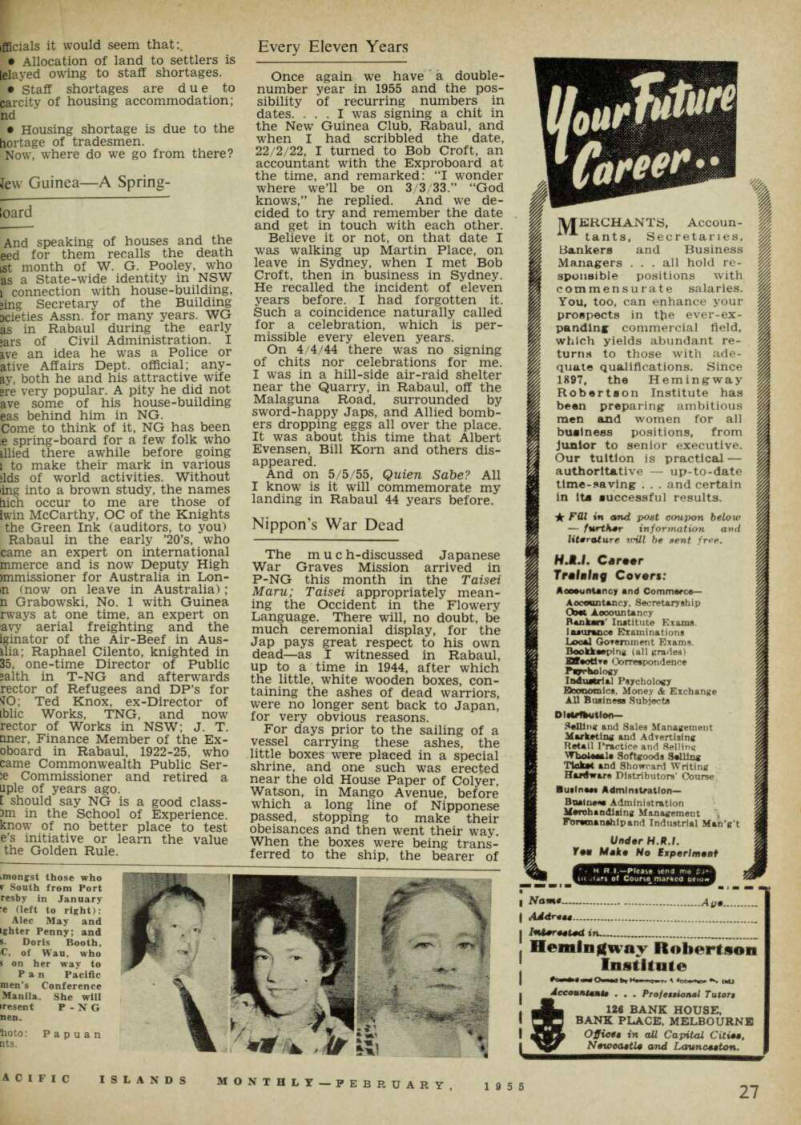
[?]mongst those who [?]v South from Port [?]resby In January [?]re (left to right): Alec May and [?]ghter Penny; and [?]s. Doris Booth, C, of Wau, who [?]s on her way to Pan Pacific men’s Conference Manila. She will [?]resent P-NG men.
Photo: Papuan
nts.
iach wore white gloves, with a rtiite cloth sling suspended from is shoulders passing round the box.
After sea communication ceased 4th the Flowery Kingdom, many ere buried in and around Rabaul; nd there was one occasion, I remem er when some hundreds were sup- Dsed to have been trapped in a hill de shelter somewhere up in Diddy lans, when it received a direct hit the entrance. And there they ityed. The Japs fobbed it off isually—said the victims were only hpseri (Korean) workmen!
I can’t see any harm coming from ie present Mission’s visit, and I e no useful human purpose served r chanting hymns of hate.
Very often those who have sufleast from the ravages of ir are the most vocal in an en avour to prolong national hatreds.
DO Ewing is long enough in the oth to see that there are no cret conferences between the ission and old Jap native sympa isers. And as for charts and drographic information, it’s unds to a peanut that the Japs’ lowledge of P-NG waters is equal our own—and probably better. [t is not impossible that certain lividuals of our own skin colour » a greater security risk to P-NG an the Graves Mission and/or achers combined.
ugging for
g Business You know UNO?” queried Big 1 (who is a bit of a cynic and certain reasons must remain
onymous). t
nodded. Yes, I knew of UNO.
Bill continued: “It’s nothing but ramp for big business interests, eeding up civilisation amongst mitive people who don’t support ; big commercial enterprises. The •re civilised folk are, the more ;y buy things they don’t really nt; because when they become ilised, they are kidded into think - : they do want ’em. And that’s re business for the commercial erests.” didn’t argue with Bill. It’s never 7 good; but when I returned ne I turned up some statistics of sorts into T-NG, before and after r 11, of commodities in general d by the natives. This is what I nd (1939 imports are shown t, followed by those of 1953) : ’rade tobacco, 263,516 lbs; 444,012 ’extiles (lava-lavas, etc), £68,980; 7,165. ighting kerosene, 135,961 ,836 gals.
'rade goods, £2,536; £35,725.
Ud Bill might have something re, after all.
e Race for
-Heathenisation
nd while I was thumbing through
some of those official statistics, I was struck with the aptness of Bill Gill’s cartoon in November PIM (p. 11). No wonder the poor lad appears all tied up in a knot; for in T-NG alone there were 23 “re ligious missions” listed at June 30, 1953.
Not all different denominations, however. For instance, there are four types of Lutherans; five types of RC’s. The former sect claims 146,400 adherents, while the latter shows 215,750.
Total adherents of all denomina tions are shown as 438,750. In 1939, adherents numbered 319,022 and there were only 11 “religious missions.”
Reminds me of the remark made by a popular RC missionary, work ing up in the Sepik area, some years ago. “But how many real converts have you, Father?” he was asked, when the matter of mission ad herents came up for discussion.
“Well,” he paused a moment. “I’ve been here sixteen years now. I have hopes.”
Up to the present the process of de-heathenising the indigent has been carried out by Christian missions—not, without occasional evidence of sectarian bitterness. One wonders what would happen if followers of the Prophet Mahomet entered the arena, via West New Guinea. The Trusteeship Agreement gives freedom of worhsip and freedom of religious teaching.