Sixty Years in
pp. 26-139 · Read in the full issue
Fine Record Of Nelson
And Robertson
Over 130 friends and clients —including some who have been on the company’s books for nearly 40 years—will attend a dinner given by Nelson and Robertson Pty. Ltd. at the Pickwick Club, Sydney, on February 18, 1955. The function will mark the end of the first 60 years in the life of this substantial and highly respected Islands trading company.
BEGUN in 1895 as a ship chartering firm, it branched quickly into all avenues of shipping and island trading. The friendliness and high personal integrity of its founder, Mr. Ivan Nelson, won for the com pany the goodwill and high esteem of all those with whom he dealt.
To-day, the busy offices of Nelson and Robertson are still the first “port of call” for many Pacific Island residents making their periodic trips to Sydney.
Mr. Ivan Nelson was born in Sweden and arrived in Australia at the age of 17. He held several positions in Sydney including that of teller at the Bank of Sydney.
Later, he joined the ship broking firm of Gibson and Co., where he gained his first experience in ship ping.
At the age of 24, Nelson decided to start on his own. He formed a partnership with Mr. G. J. Robert son, whose knowledge of shipping was extensive and, with a total capital of £5O, they began to charter ships.
Their sailing vessels carried coal from Newcastle to Fiji and New Zealand; sugar to Vancouver; and NZ timber to Australian ports. They
started Islands trading about 1905.
Records show that the company’s first clients in the South Pacific Territories were Mr. J. O. Mouton and Captain J. M. Rondahl, both of New Guinea. Nelson had earlier met Captain Rondahl in Samoa and had induced him to begin a copra plantation in New Guinea, then a German territory.
An inveterate traveller, Nelson ranged all over the Pacific, from Tonga, Samoa and Fiji in the east, to New Guinea and Papua in the west, extending the firm’s business in every direction —buying, selling and shipping Islands produce. By 1910, Nelson and Robertson either owned or had interests in over 30 sailing vessels.
The highly profitable cocoa in dustry in present-day Western Samoa owes its beginning to the early 19th Century pioneering efforts of Ivan Nelson. He also helped establish the pineapple trade there. The first shipment of Samoan pineapples arrived in London on one of the company’s ships about the end of the World War I—long before the Hawaiian industry came to the world’s attention.
It was during his early Samoan ventures that Nelson became asso-
dated with A. Nelson and Son, 1; to become O. F. Nelson and Ltd., of Apia—an association wt has lasted for nearly 50 ye Nelson and Robertson also gaii and has retained, Australian rej sentation for Steamships Trao Co. of Papua. A well-known L don firm, Eggar, Forrester Verner Ltd., has been the compa: London agent since Nelson Robertson joined forces in 1895.
Nelson’s policy of travelling wii and constantly—a policy still ployed by the firm—established him innumerable connections the copra trade. During World T I the company made its own si monts to Denmark. In 1918, Ne; was appointed agent in Sydney the influential HSAG and other German firms until their expra ated properties were sold. Du:, this time he handled all buying; shipments totalling sometimes • £30,000.
The company acquired, in I from W. Lowrie, the so-ca Rabaul Hotel —a two-roomed sh with negligible amenities. Ur the company’s management fl 1916 till 1942, it prospered and g to an establishment with accomi dation for 65 guests. With the u anese invasion and subseqi allied bombing, the hotel was oT< erated and, in 1945, the comp did not build again. They reces compensation for war damage in 1953 built their own office om hotel site. An office was establis in Brisbane in 1952.
(Continued on Page 137)
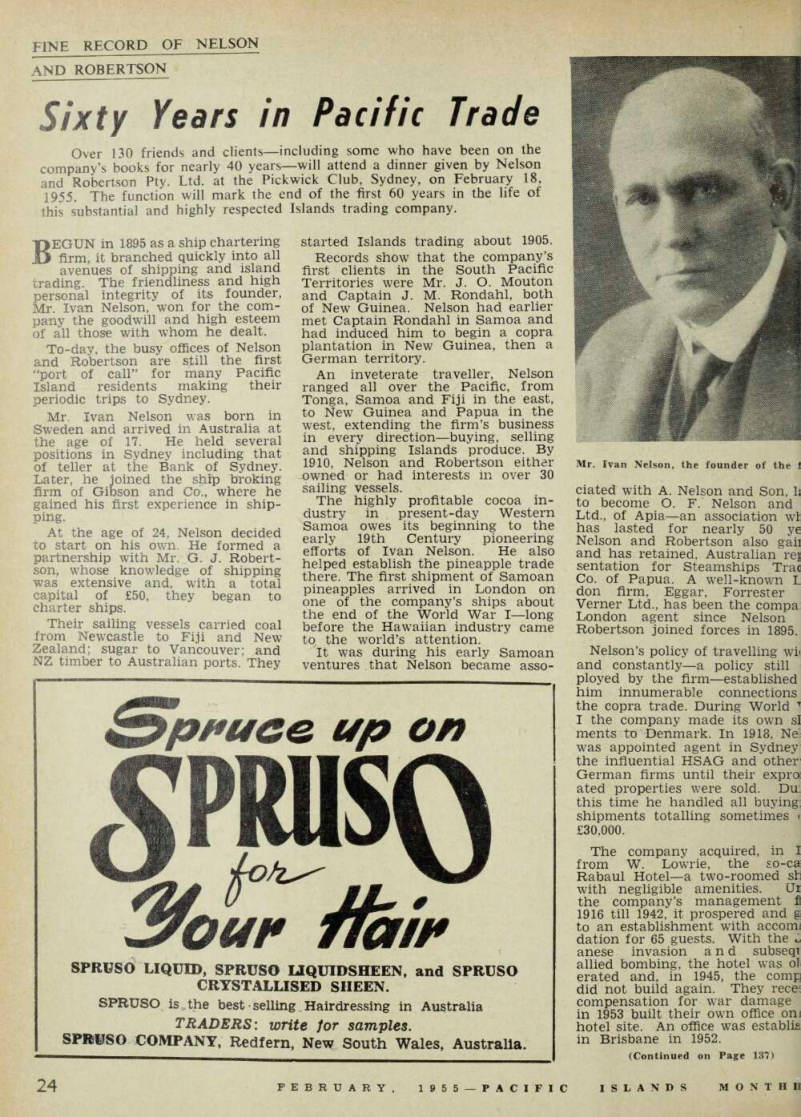
Mr. Ivan Nelson, the founder of the [?]
Ipart from his Islands connec ns. Nelson was always interested world-wide shipping for timber, eat and coal chartering. He sent wcastle coal to the USA during ) great British strike. His were l vessels which carried much of stralia’s early wheat harvests to srseas countries. South America lefited from his activities and the jentine eventually made him ie-Consul in Sydney.
J. J. Robertson left the firm in 0 and Nelson carried on until 4 when the firm became a Limited npany. In 1935, Nelson and bertson became a Proprietary npany. The present chairman of ectors and son of the founder, , Norman C. Nelson, joined the n in 1920 and succeeded his tier as head of it when Mr. Ivan son died in 1941. Mr. Norman son’s son, Ivan Jnr., joined the ipany in 1954, at 22. »ne of the company’s present jctors, Mr. W. E. Ryall, has been h the firm for nearly 50 years. fellow directors, Messrs. N. C. son, H. -R. Cooper, R. Law, A. H.
Iker and J. Flitcroft account for otal of 119 years’ service. Most them have been with the firm ;e they first started work. One the staff members, Mr. W, H.
Farlane, has worked for the firm 30 years. elson and Robertson have grown idily throughout their 60 years operation. But Mr. Norman
Nelson is justifiably proud of the rapid expansion which has taken place in post-war years.
In 1945 they had a staff of 11.
To-day the company employs 52 in two Sydney offices, five at Brisbane and four at their new Rabaul office.
Mr. Nelson attributes this rapid in crease to the initiative and energy of his staff and directors; the prosperity of post-war Island terri tories; and a large increase in coastal shipping.
Still a comparatively young man, he looks forward to many more years of friendly association with the thousands of Pacific Islands residents whom Nelson and Robertson have served for well over half a century.
For the first time in many years a banana-buyers licence has been issued for Ovalau and Moturiki, in Fiji. The licence has been granted to Mr. Seth Douglas, of Waidau, Ovalau. Mr. Douglas planned to begin operations in early January.
The Banana Board has agreed that the price to be paid to the growers is to be 7 6 per case.
Mr. Norman Nelson