Good Prices for Island
pp. 23-25 · Read in the full issue
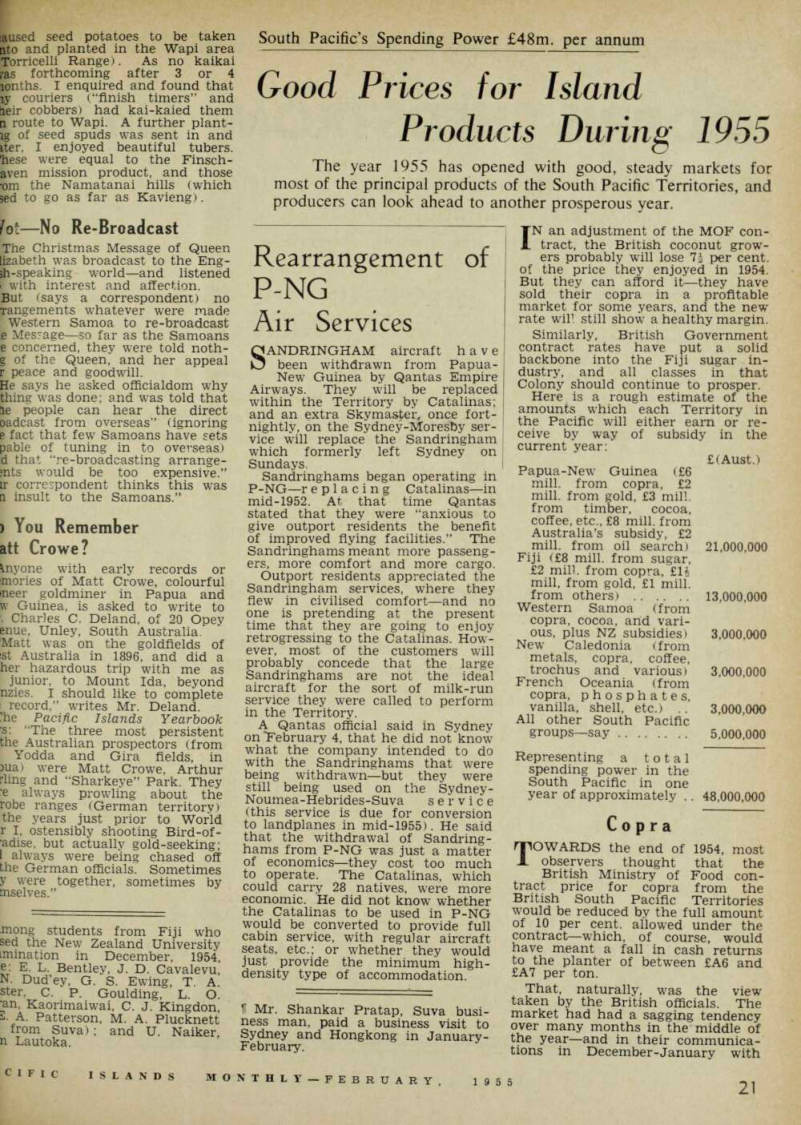
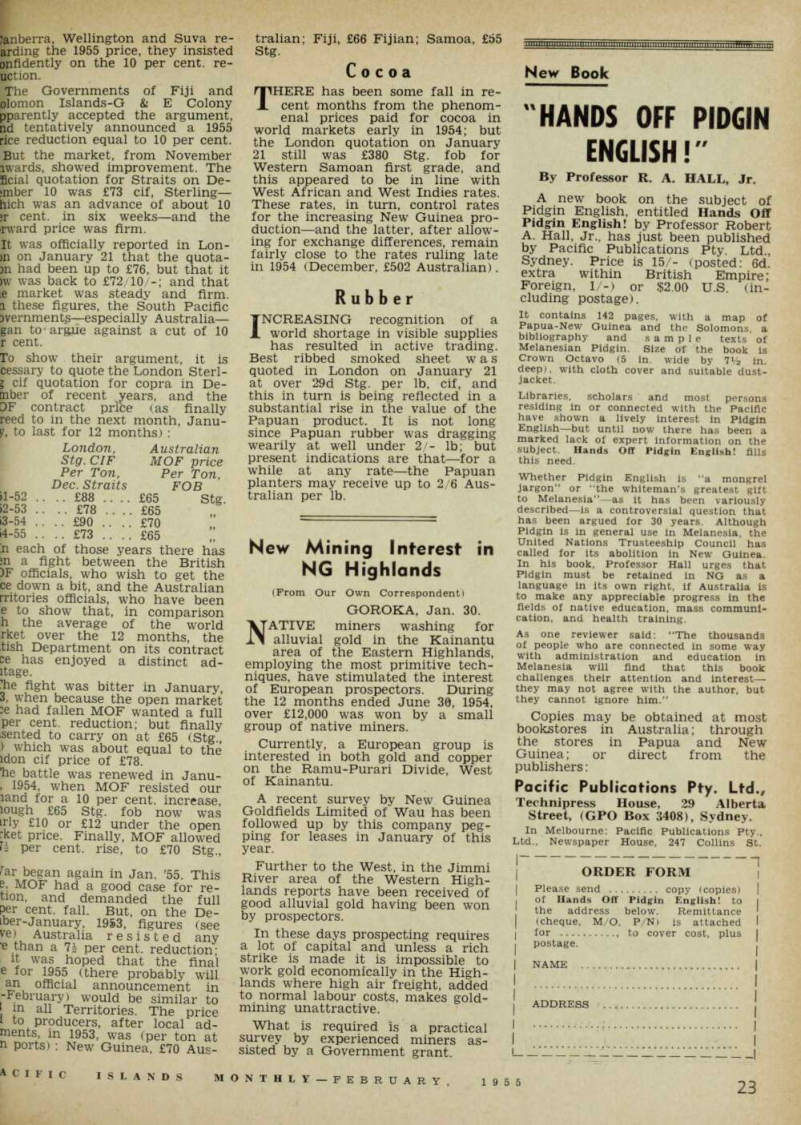
South Pacific’s Spending Power £48m. per annum
Good Prices for Island Products During 1955
The year 1955 has opened with good, steady markets for most of the principal products of the South Pacific Territories, and producers can look ahead to another prosperous year.
IN an adjustment of the MOF con tract, the British coconut grow ers probably will lose 11 per cent, of the price they enjoyed in 1954.
But they can afford it—they have sold their copra in a profitable market for some years, and the new rate will still show a healthy margin.
Similarly, British Government contract rates have put a solid backbone into the Fiji sugar in dustry, and all classes in that Colony should continue to prosper.
Here is a rough estimate of the amounts which each Territory in the Pacific will either earn or re ceive by way of subsidy in the current year: £(Aust.) Papua-New Guinea (£6 mill, from copra, £2 mill, from gold, £3 mill. from timber, cocoa, coffee, etc., £8 mill, from Australia’s subsidy, £2 mill, from oil search) 21,000,000 Fiji (£8 mill, from sugar, £2 mill, from copra, £U mill, from gold, £1 mill. from others) 13,000,000 Western Samoa (from copra, cocoa, and vari ous, plus NZ subsidies) 3,000,000 New Caledonia (from metals, copra, coffee, trochus and various) 3,000,000 French Oceania (from copra, phosphates, vanilla, shell, etc.) .. 3,000,000 All other South Pacific groups—say 5,000,000 Representing a total spending power in the South Pacific in one year of approximately .. 48,000,000
Copra
TOWARDS the end of 1954, most observers thought that the British Ministry of Food con tract price for copra from the British South Pacific Territories would be reduced by the full amount of 10 per cent, allowed under the contract—which, of course, would have meant a fall in cash returns to the planter of between £A6 and £A7 per ton.
That, naturally, was the view taken by the British officials. The market had had a sagging tendency over many months in the middle of the year—and in their communica tions in December-January with
Janberra, Wellington and Suva re arding the 1955 price, they insisted onfidently on the 10 per cent, re liction.
The Governments of Fiji and olomon Islands-G & E Colony pparently accepted the argument, nd tentatively announced a 1955 rice reduction equal to 10 per cent.
But the market, from November iwards, showed improvement. The ficial quotation for Straits on De ;mber 10 was £73 cif, Sterling— hich was an advance of about 10 »r cent, in six weeks—and the rward price was firm.
It was officially reported in Lon >n on January 21 that the quota )n had been up to £76, but that it >w was back to £72/10/-; and that ;e market was steady and firm, a these figures, the South Pacific jvernments—especially Australia— gan to -argue against a cut of 10 r cent.
To show their argument, it is cessary to quote the London Sterl et cif quotation for copra in De tnber of recent years, and the DF contract price (as finally reed to in the next month, Janu 7, to last for 12 months) ;
ii each of those years there has ;n a fight between the British )F officials, who wish to get the ce down a bit, and the Australian rritories officials, who have been e to show that, in comparison h the average of the world rket over the 12 months, the tish Department on its contract ce has enjoyed a distinct ad itage. ’he fight was bitter in January, 3, when because the open market ce had fallen MOF wanted a full per cent, reduction; but finally sented to carry on at £65 (Stg., ) which was about equal to the idon cif price of £7B.
Tie battle was renewed in Janu , 1954, when MOF resisted our land for a 10 per cent, increase, lough £65 Stg. fob now was irly £lO or £l2 under the open ■ket price. Finally, MOF allowed h per cent, rise, to £7O Stg., far began again in Jan. ’55. This e, MOF had a good case for re turn, and demanded the full per cent. fall. But, on the De iber-January, 1953, figures (see ve) Australia resisted any ■e than a H per cent, reduction; it was hoped that the final e for 1955 (there probably will an official announcement in -February) would be similar to m all Territories. The price I to producers, after local ad ments in 1953, was (per ton at n ports): New Guinea, £7O Aus
tralian; Fiji, £66 Fijian; Samoa, £55 Stg.
Cocoa
THERE has been some fall in re cent months from the phenom enal prices paid for cocoa in world markets early in 1954; but the London quotation on January 21 still was £3BO Stg. fob for Western Samoan first grade, and this appeared to be in line with West African and West Indies rates.
These rates, in turn, control rates for the increasing New Guinea pro duction —and the latter, after allow ing for exchange differences, remain fairly close to the rates ruling late in 1954 (December, £502 Australian).
Rubber
INCREASING recognition of a world shortage in visible supplies has resulted in active trading.
Best ribbed smoked sheet was quoted in London on January 21 at over 29d Stg. per lb, cif, and this in turn is being reflected in a substantial rise in the value of the Papuan product. It is not long since Papuan rubber was dragging wearily at well under 2/- lb; but present indications are that —for a while at any rate—the Papuan planters may receive up to 2/6 Aus tralian per lb.
London, Australian Stg. GIF MOF price Per Ton, Per Ton, Dec. Straits
Fob
>1-52 . . .. £88 .. .. £65 Stg. >2-53 . . .. £78 .. .. £65 >3-54 . . .. £90 .. .. £70 >4-55 . . .. £73 .. .. £65