Editorial ...
pp. 15-16 · Read in the full issue
Japan Is Again A Major
Pacific Problem
lA.RLY in February the people of i Rabaul, in grim silence, watched the Japanese official party from e Taisei Maru groping around in e war cemeteries and 1942-45 ttlegrounds, collecting the remains Japanese dead, burning the bones, id carrying the ashes in little jelled caskets aboard the ship, for eservation in Japan.
Here and there, throughout the [omons and New Guinea, wherever »y found and retrieved their war ad, the Japanese erected small imorials, in Japanese and in Eng 1, to tell future generations that panese servicemen had died there. 7e ry touching, no doubt. And we pe there is no significance in the it that future residents have been is addressed in Japanese! Eng i should suffice. [he war is over, ten years ago. e United States and the British mmonwealth, facing a new peril the Muscovite-Mongolian Com nist alliance, are trying very •d to line up the post-war Japan part of the Western defence imst the Reds. We are urged to libit a Christian spirit and for e our enemies. The spectacle the sad little men from Tokio hering up their poor bones and louring their dead in the South it Islands should move us to derness. •ut it doesn’t. Some memories still too fresh and raw, and too ply implanted in our minds, to overshadowed by any Oriental ;monial in New Guinea. We note t among the Jap war dead tiered up by the Taisei Maru e some four-score men of the ;er class, executed by Australia, ;r the fairest possible trial, for 7 brutal war-time crimes. Are expected so soon to forget that?
JRING the early part of the Pacific war, when the Japanese were sweeping southwards over the archipelagoes, certain of ory and vast aggrandisement, r made their own rules; and the nory of the way in which they ted Europeans and native nders who fell into their hands, makes us sick with horror. was all of the same pattern— massacre of those helpless Aus lans at Tol Plantation; the cruel .deliberate murder of the two sion sisters at Buna, and of old tain Isaac Handley and the Rev.
L- Sadd and 22 New Zealand icemen at Tarawa; the wanton mg of Australian men and len ln the Moluccas; the in
describable cruelties (massacre, really) inflicted upon the surrend ered Australian and Indian soldiers in Burma and in Borneo—the list is almost endless.
They believed they were going to over-run all the countries in and around the Western Pacific, and so they made their own rules. Their war-crimes were not spontaneous incidents —they were part of Japan’s deliberate policy, expressed in most countries which she over-ran be tween 1931 and 1943, to extermin ate or enslave all classes of people which might in any way obstruct the occupation and settlement by Japanese of any Western lands which they conquered and found de sirable.
These are the facts of history. Set them against the flood of soft and sentimental stories which we have had since 1945 about the kindness and hospitality of the Japanese householder, and the delectableness of his olive-tinted daughter. Which is the true Japanese—the gentle man who bows and smiles and makes himself extremely agreeable
to the dominant European; or the soldier who seems to take much joy in carrying out his officer’s instruc tion to torture and murder the wretched people whom they have got into their power?
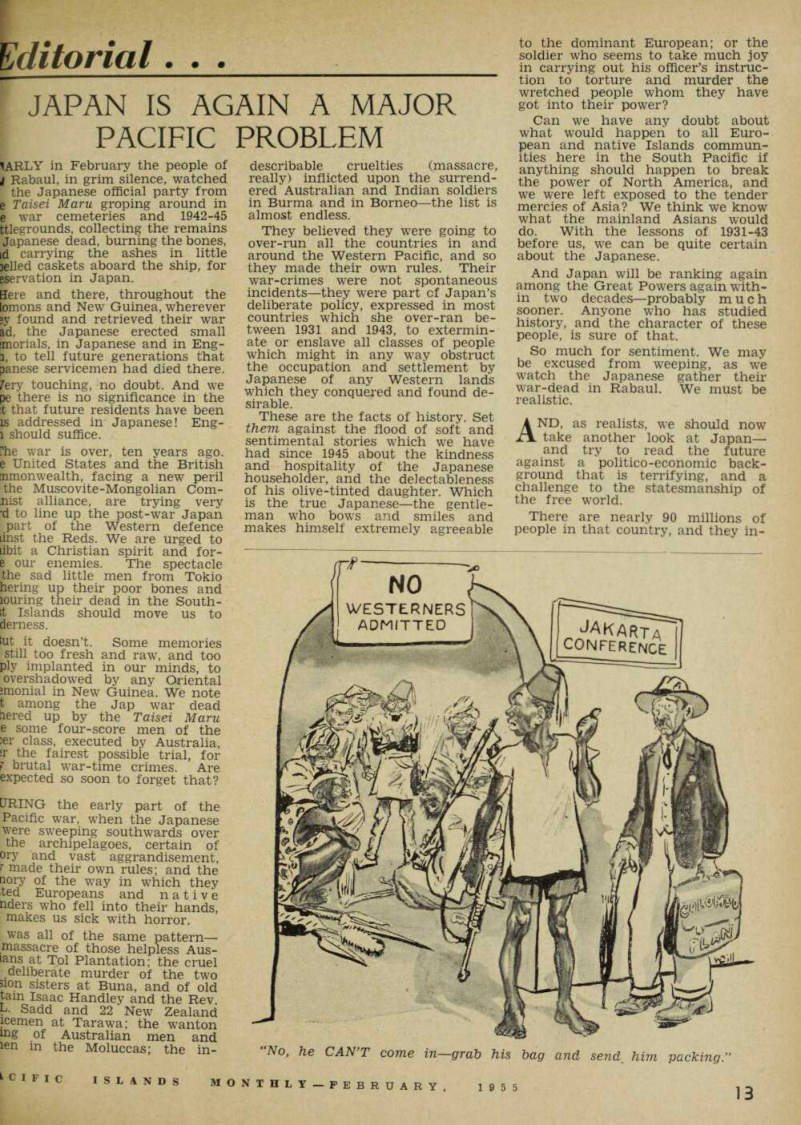
Can we have any doubt about what would happen to all Euro pean and native Islands commun ities here in the South Pacific if anything should happen to break the power of North America, and we were left exposed to the tender mercies of Asia? We think we know what the mainland Asians would do. With the lessons of 1931-43 before us, we can be quite certain about the Japanese.
And Japan will be ranking again among the Great Powers again with in two decades—probably much sooner. Anyone who has studied history, and the character of these people, is sure of that.
So much for sentiment. We may be excused from weeping, as we watch the Japanese gather their war-dead in Rabaul. We must be realistic.
AND, as realists, we should now take another look at Japan— and try to read the future against a politico-economic back ground that is terrifying, and a challenge to the statesmanship of the free world.
There are nearly 90 millions of people in that country, and they in
crease by at least one million each year. Every square yard of pro ductive soil is in use —and still there is not nearly enough food for the population. These are educated people, demanding an ever-rising standard of life —but unable to achieve it because of the bitter struggle for a bare existence on their little islands.
By war and conquest, in the first 40 years of this century, they occupied vast adjoining lands—Man churia, Korea, Formosa, Micronesia.
By war, they lost the lot —being too greedy and ambitious. But war did not destroy that vast and virile population; they are back on their little islands, their capacity to re produce themselves unimpaired, and no power on earth can hold them back.
There is the challenge to Western statesmanship. It is a fundamental law of nature—the law of self preservation—as inevitable as the coming of the night after the day —that if they are not provided with lands into which they may expand, they will again hurl themselves upon their neighbours, in an attempt to conquer other peoples, and provide themselves with new living-space.
All the Western nations recognise the problem. Never was there greater need for an international authority to deal with such matters.
But, in 1945-46, just at the moment when we seemed on the point of establishing world orderliness through the United Nations Organ isation, the Moscow conspiracy to force Communism upon us as the dominant international force be came manifest: international dis order increased; and UNO has been practically hamstrung.
Failure to deal with the problem of Japan’s future is just another of the international and human tragedies which must be laid at the door of Muscovite Communism. It is astonishing to find how almost every complication in world affairs to-day may be traced back, upon analysis, to the promoters of the Cold War.
We dare not trust the Japanese— but we must live with them. If it were possible to co-operate with them, in shaping their future, all Pacific countries could benefit, very much. But, for the present, in the face of the political situation that has been created in Asia by Red conspirators and Western muddlers, any such attempt seems to be im possible.
A chiming clock is to be made by a Derby, UK, firm of clockmakers for Queen Salote, of Tonga. The clock is intended for the Queen’s palace chapel. It will have three dials, each four feet in diameter, and will also have four chiming bells.