Suggested
pp. 155-156 · Read in the full issue

Northbound to NG GETTING MORE BANANAS
Out Of Fiji
Study of NSW Methods Suggested
UNDER the stimulus given by NZ Fruit Distributors Ltd. it seems likely that production of bananas in Fiji will be greatly in creased.
The Co. has promised to take up to 750,000 cases of bananas from Fiji for the next five years. In 1953, shipments totalled 382,000 cases; the total for 1954 probably will be 365,000; and it is hoped to step this up to 750,000 by 1957.
The Co. has donated £4,000 to a Banana Development Fund, and the Fiji Government is liberally as sisting the same project—it plans to increase the banana acreage, fairly soon, by 3,000 acres.
Mr. David P. Ragg, a former re sident of Fiji, quoting the fore going facts, comments: I believe the Fiji industry could learn a lot from the methods used by the Australian banana grower.
I have seen how the growers at Goff's Harbour secure spectacular results by their methods of inten sive cultivation and irrigation: and these could be employed in Fiji with almost equal success, particu larly in the drier areas round Siga toka.
Good results might be gained by interchange of technical officers be tween the Departments of Agricul ture of Fiji and NSW, who have had experience in banana culture, har vesting and marketing in their res pective spheres. The Fijian official could learn Australian methods, and this could be put into good effect on his return, preferably v/ith the as sistance of an Australian banana
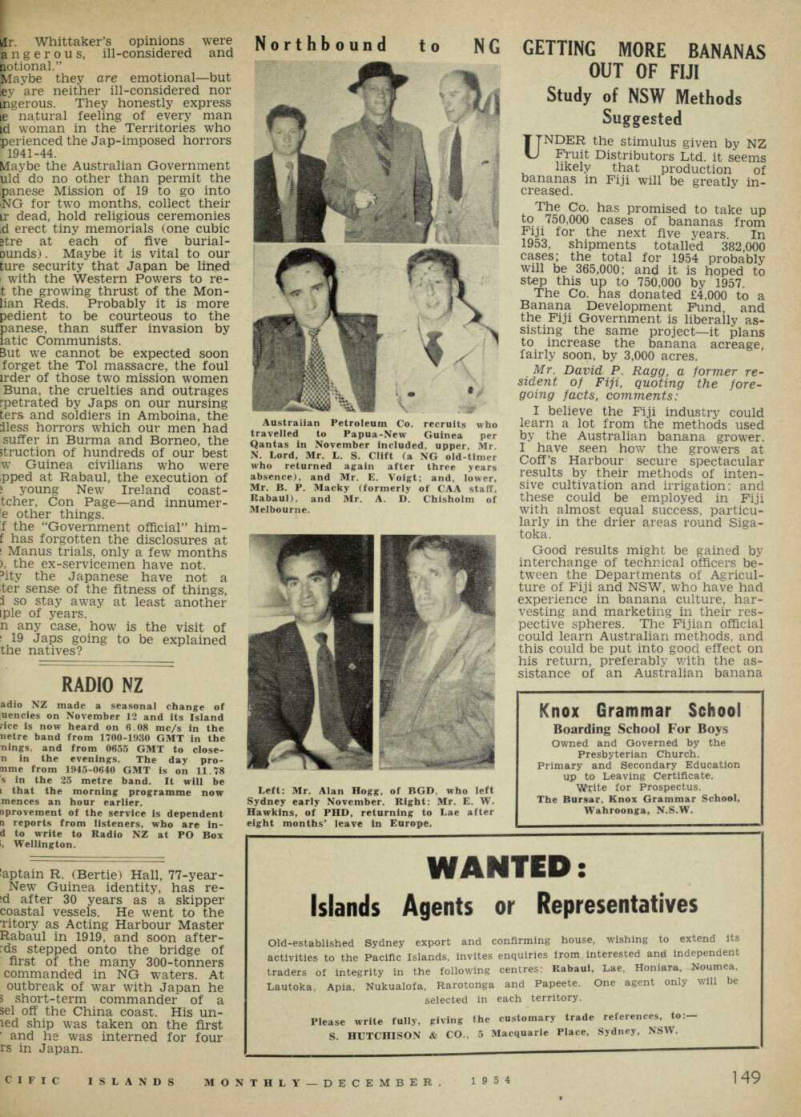
Australian Petroleum Co. recruits who travelled to Papua-New Guinea per Qantas in November included, upper, Mr.
N. Lord, Mr. L. S. Clift (a NG old-timer who returned again after three years absence), and Mr. E. Voigt; and, lower, Mr. B. P. Macky (formerly of CAA staff, Rabaul), and Mr. A. D. Chisholm of Melbourne.
Left; Mr. Alan Hogg, of BGD, who left Sydney early November. Right: Mr. E. W.
Hawkins, of PHD, returning to Lae after eight months’ leave In Europe.
expert who could be loaned for reasonable term to see that t' methods are being tried o correctly. Fijian growers mig send one or two of their best mi to Goff’s Harbour, to see for ther selves how to use up-to-da methods.
Fiji Falls Short On Nz
Shipments
Meanwhile, Fiji is not filling h banana quotas and a committee h been appointed in Fiji to look in the reasons for this and to sugge remedies.
Mr. W. J. Lahore, Suva Manage of the ANZ Bank, is chairma Other members are Mr. N.
Lamont, senior agricultural office Mr. R. Spowart, buyer’s represen ative, Watisoni Seru and Savenai Tavusavusa, growers’ representative and Buli Verata, Tevita Leilom representing Fijian Affairs Board The inquiry is being instituted i the result of concern on the pa of the New Zealand importers.
Fijian growers have repeated failed to fill the shipping space n served, while bananas from and Samoa have been refused spai in excess of their allocation (Sm is last loading port). The Ne Zealand importers must pay for tl reserved shipping space, wheth used or not.
No Fiji Bananas For
Australia
A Suva correspondent says thi Australian interests have offen Fl3B - per case for Fijian banana but that Fiji growers have spurnt the offer —they are satisfied wil the 19 - per case they get from tl New Zealand market.
Department of Commerce and Di partment of Agriculture in Sydn< ridiculed the idea that Fiji cou build up a trade in Australia i those prices. They said they kne of no move in Australia to impo Fiji bananas. After the cyclone i February, 1954, had severely dan aged NSW North Coast plantation some growers were getting £7 pi case for their bananas. But thi was just a flash in the pa Normally, Australia was adequate supplied with bananas from loc sources. (Bananas were bringir from 16 - to 40/- per case in tl Sydney market on December 7).
In any event, as the Fiji growe; cannot satisfy the NZ market, it unlikely that they can do very muc about sending bananas to Austral: —although a lot of people a] agreed that it would be a good thir for Fiji and for the Australia banana consumer if they could.