Traveller’s Impressions of
pp. 55-57 · Read in the full issue
Not A Nice
Country!
Traveller’s Impressions of Indonesia
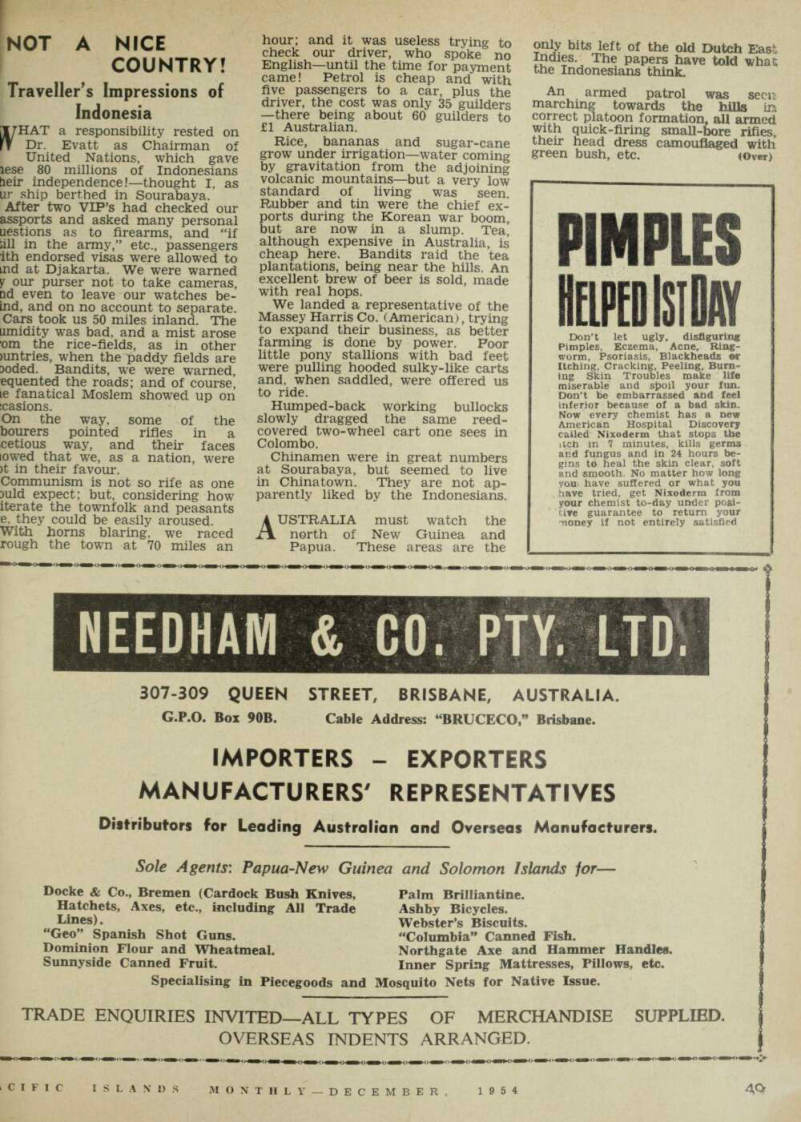
[I7HAT a responsibility rested on IT Dr. Evatt as Chairman of United Nations, which gave lese 80 millions of Indonesians
heir independence!—thought I, as
ur ship berthed in Sourabaya.
After two VlP’s had checked our assports and asked many personal uestions as to firearms, and “if ;ill in the army,” etc., passengers Ith endorsed visas were allowed to md at Djakarta. We were warned y our purser not to take cameras, ad even to leave our watches be- Lnd, and on no account to separate.
Cars took us 50 miles inland. The umidity was bad, and a mist arose om the rice -fields, as in other >untries, when the paddy fields are Doded. Bandits, we were warned, equented the roads; and of course, le fanatical Moslem showed up on icaslons.
On the way, some of the bourers pointed rifles in a cetious way, and their faces towed that we, as a nation, were )t in their favour.
Communism is not so rife as one )uld expect; but, considering how iterate the townfolk and peasants e. they could be easily aroused.
With horns blaring, we raced rough the town at 70 miles an
hour; and it was useless trying to check our driver, who spoke no English—until the time for payment came! Petrol is cheap and with five passengers to a car, plus the driver, the cost was only 35 guilders —there being about 60 guilders to £1 Australian.
Rice, bananas and sugar-cane grow under irrigation—water coming by gravitation from the adjoining volcanic mountains—but a very low standard of living was seen.
Rubber and tin were the chief ex ports during the Korean war boom, but are now in a slump. Tea, although expensive in Australia, is cheap here. Bandits raid the tea plantations, being near the hills. An excellent brew of beer is sold, made with real hops.
We landed a representative of the Massey Harris Co. (American), trying to expand their business, as better farming is done by power. Poor little pony stallions with bad feet were pulling hooded sulky-like carts and, when saddled, were offered us to ride.
Humped-back working bullocks slowly dragged the same reed covered two-wheel cart one sees in Colombo.
Chinamen were in great numbers at Sourabaya, but seemed to live in Chinatown. They are not ap parently liked by the Indonesians.
Australia must watch the north of New Guinea and Papua. These areas are the
only bits left of the old Dutch East Indies The papers have told what the Indonesians think.
An armed patrol was seen marching towards the bilk* in correct platoon formation, all armed with quick-firing small-bore rifles, their head dress camouflaged with green bush, etc. (Over)
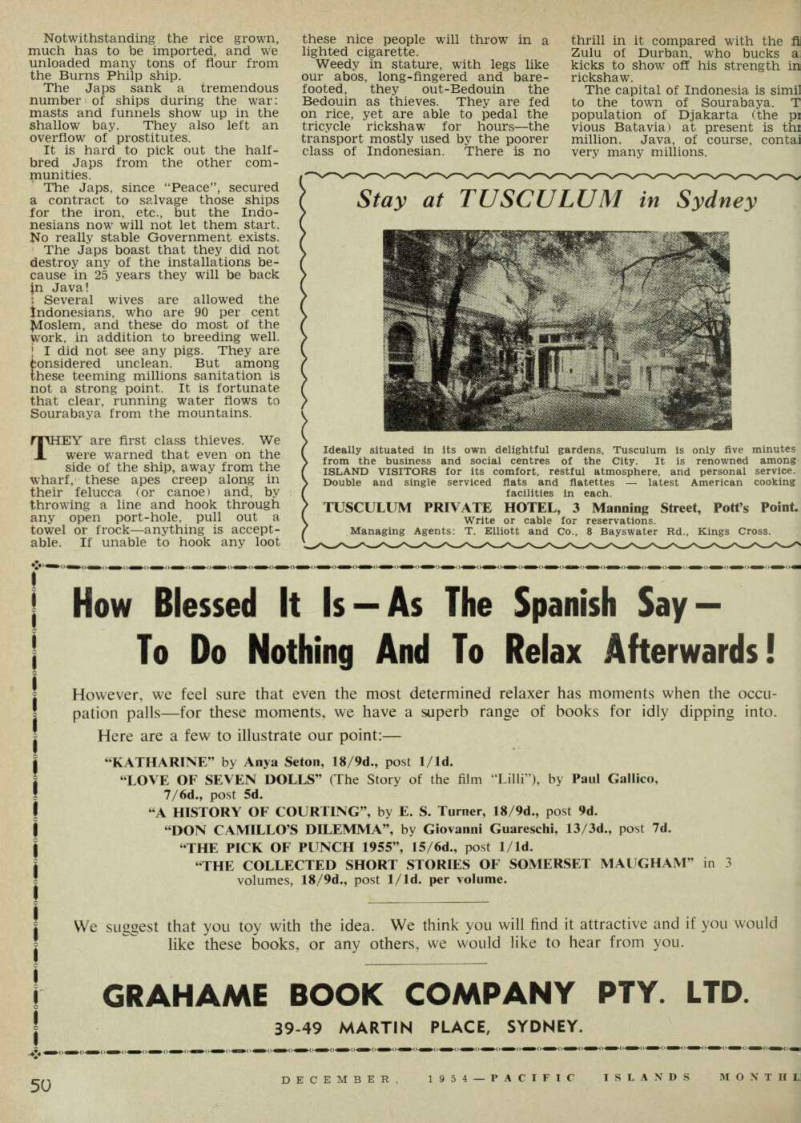
Notwithstanding the rice grown, much has to be imported, and we unloaded many tons of flour from the Burns Philp ship.
The Japs sank a tremendous number of ships during the war: masts and funnels show up in the shallow bay. They also left an overflow of prostitutes.
It is hard to pick out the half bred Japs from the other com munities.
The Japs, since “Peace”, secured a contract to salvage those ships for the iron, etc., but the Indo nesians now will not let them start.
No really stable Government exists.
The Japs boast that they did not destroy any of the installations be cause in 25 years they will be back
in Java!
; Several wives are allowed the Indonesians, who are 90 per cent Moslem, and these do most of the work, in addition to breeding well. ; I did not see any pigs. They are fconsidered unclean. But among these teeming millions sanitation is not a strong point. It is fortunate that clear, running water flows to Sourabaya from the mountains. rpHEY are first class thieves. We X were warned that even on the side of the ship, away from the wharf, these apes creep along in their felucca (or canoe) and, by throwing a line and hook through any open port-hole, pull out a towel or frock —anything is accept able. If unable to hook any loot
these nice people will throw in a lighted cigarette.
Weedy in stature, with legs like our abos, long-fingered and bare footed, they out-Bedouin the Bedouin as thieves. They are fed on rice, yet are able to pedal the tricycle rickshaw for hours —the transport mostly used by the poorer class of Indonesian. There is no
thrill in it compared with the fii Zulu of Durban, who bucks a kicks to show off his strength in rickshaw.
The capital of Indonesia is simil to the town of Sourabaya. T population of Djakarta (the pi vious Batavia) at present is thi million. Java, of course, contai very many millions.
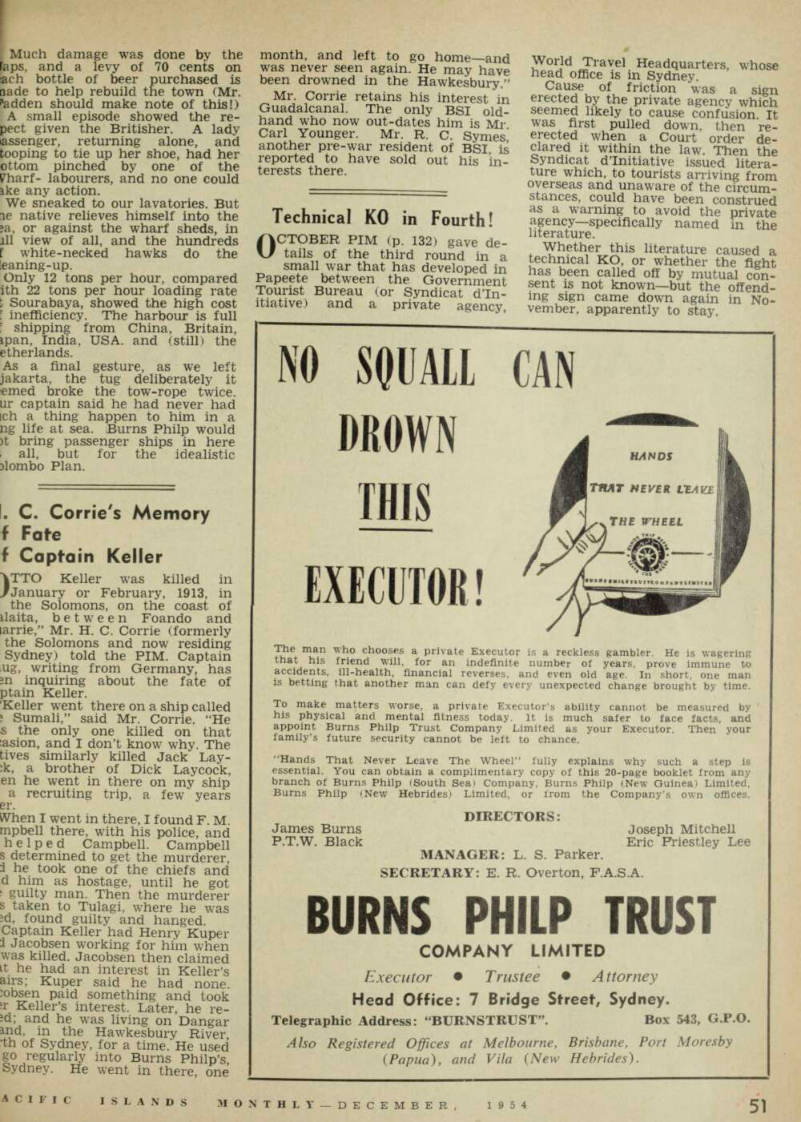
Much damage was done by the faps, and a levy of 70 cents on ach bottle of beer purchased is nade to help rebuild the town (Mr. should make note of this!) A small episode showed the re pect given the Britisher. A lady assenger, returning alone, and tooping to tie up her shoe, had her ottom pinched by one of the Kharf- labourers, and no one could ike any action.
We sneaked to our lavatories. But le native relieves himself into the »a, or against the wharf sheds, in all view of all, and the hundreds [ white-necked hawks do the leaning-up.
Only 12 tons per hour, compared ith 22 tons per hour loading rate t Sourabaya, showed the high cost f inefficiency. The harbour is full : shipping from China, Britain, ipan, India, USA. and (still) the etherlands.
As a final gesture, as we left Jakarta, the tug deliberately it emed broke the tow-rope twice, ur captain said he had never had ich a thing happen to him in a ng life at sea. Burns Philp would )t bring passenger ships in here - all, but for the idealistic alombo Plan.