Future Of The Solomons
pp. 32-34 · Read in the full issue

Sir Robert Stanley Goes to London With Plans and Estimates But—
Still Doubtful
WHEN Sir Robert Stanley, CMG, British High Commissioner for the Western Pacific, and the man with the toughest administrative job in the South Seas, passed through Sydney late November, on a quick trip to London, he firmly declined to tell radio or press reporters anything about his mission.
BUT it is not difficult to draw certain conclusions: London is being asked to take some deci sions which will affect directly the future of the Sorrowful Solomons.
Sir Robert is an administrator of rare conscientiousness. His 3-years’ appointment expires in mid-1955, when he is due for retirement from the Colonial Service, after a career notable for sound, self-sacrificing work in all parts of the Empire, es pecially Africa. It would be consis tent with his record and tempera ment if he tried, as his last big job, to introduce some plan which could at least provide the Solomons with an impulse towards development and self-supporting economy. rE Solomon Islands (14,600 square miles) comprise the second largest territory in the South Pacific —twice the size of Fiji or New Caledonia —and, being the geographical continuation of the Bismarck archipelago and Bougain ville, they are capable of maintain a very large population. At present, only 100,000 sulky Melanesians live there (mostly on Malaita).
Prior to World War 11, the Aus tralian planters’ success in growing coconuts in Solomons was com parable with the New Guinea achievement —despite the fact that the Australians in New Guinea got the advantage of all the German pioneer work prior to World War I, and the 1920-30 gold discoveries.
But, after 1940, BSI suffered a series of calamities. The Japanese invaded and, before they were thrown out, devastating battles had been fought over most of the settled parts.
New Guinea also was devastated; but, while the NG planters got com pensation on a very generous scale, BSI got nothing at all.
BSI. like New Guinea, came under the blighting influence of aggressive Socialist administration between 1945 and 1950; but, while little per manent harm was done in NG, the effect of anti-private-enterprise laws in BSI wiped out the big trad ing firms—and they still are out— and drove away the only big mining company which had shown any readiness to exploit BSl’s mineral resources.
Australia has subsidised ng to the extent of several million pounds per annum, and has withheld any form of income taxa tion. Britain has given BSI only a Development Fund of some £500,000 (to be extended to a million, maybe) and a grant out of Japanese repara tions of some £500,000; but, on the other hand, has imposed upon the few private planters remaining there a punishing rate of income taxation.
The oil companies in combination are spending millions in P-NG on oil search: timber concerns are en gaged in developmental work; new industries like cocoa and coffee pro duction are bounding ahead; and the Australian Dual Territory is bursting with money and bubbling with enterprise—were it not for Ministerial preoccupation with native rights and idealistic plan ning, new European settlement in P-NG would be phenomenal.
But in the Solomons, from 1945 to 1952, there was stagnation. Be cause of lack of official encourage ment, lack of transport facilities, high income taxation, new private enterprise has stayed away. The handful of planters who returned to a heartbreaking task of rehabi litation have made little progress and, in some cases, have abandoned the archipelago. The only corpora tion which showed any enterprise or faith in the future was Levers Pacific Plantations Ltd., which did a fine job of rehabilitating its large plantation organisation, and has done considerable new planting.
IN 1952, the care of the Solomons, Gilbert and Ellice group and the British side of the New Hebrides was separated from the Governorship of Fiji, and made a separate Governorship; and this was the job to which Robert Stanley was promoted, after half a life time in secondary posts in Africa, Cyprus, Gilbraltar, and West Indies.
He went to Honiara in October, 1952, and was not seen outside the tropics again until he reached Syd ney on November 25, 1954.
Governors do not talk; but one needs no second sight to feel sure that the representations which Sir Robert is going to make to the British Colonial Office are based on incontrovertible facts established
by him since he arrived, and whic may thus be shown; • BSI cannot be developed an made self-supporting by Goverr ment enterprise alone, no mattt how generous the latter may be i providing transport and commun: cations, and technical aid for prc ducers. • BSI cannot be very generous i providing transport and commun: cation facilities, because BSI solely dependent upon the Unite Kingdom for all finance outside i own very limited revenues. To prc vide bigger and better Department! services, BSI must have considei ably bigger staffs. Additional pei sonnel cannot be sent into BSI ur less adequate housing and simile amenities are provided; the lath require money. e if BSI is to grow and becorr self-supporting, private enterprij must be tempted into the grea empty islands. Private enterprise not going in unless it has assu; ances of suitable land on a reasoi able tenure, and a Governmei policy of encouragement (which, < course, means at least the sarr freedom from taxation as is er joyed by New Guinea, on one sid and New Hebrides, on the other At present, BSI Government notorious for the way in which has imposed income taxation upc its dwindling handful of priva planters and traders. ® BSI has announced no polic of making suitable lands easi available for development by Eur< pean enterprise. So far as is know BSI still is preoccupied with tl post-war planners’ ideas of keepir all the available lands for the futu; welfare of unborn generations natives. (There are 100,000 nativ in the Solomons— mostly on Malar —and the Solomons, on Indonesia
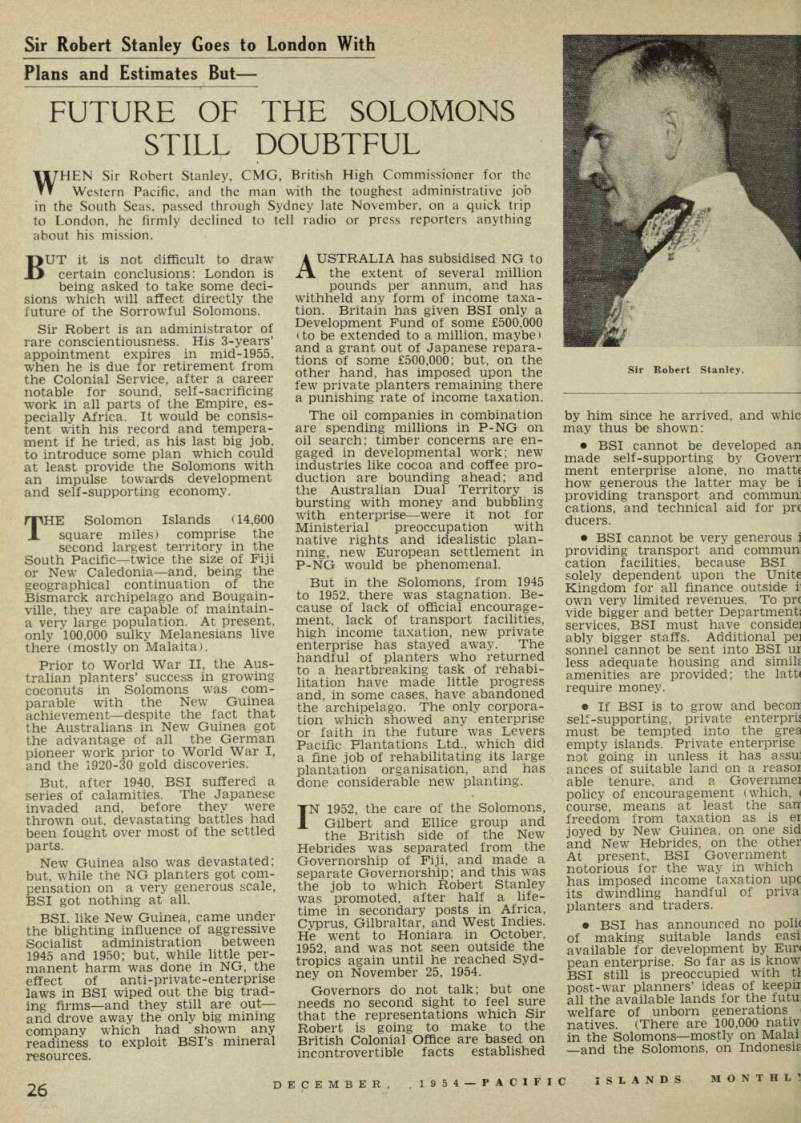
Sir Robert Stanley.
Dr Philippines standards, could barry 10 or 20 millions.) • Any plan of big development in the Solomons must create a labour problem. The present native popu lation could not provide a large labour force. The only suggestion (ret made in relation to BSI labour is that encouragement might be jiven to the surpluses of two ilready crowded South Pacific com nunities —the Indians, in Fiji, and ;he Gilbertese, in the Gilbert and Sllice Colony—to go to the Solo nons.
JIINCE 1952, Sir Robert Stanley J has not spared himself.
Travelling on comfortless small hips in all kinds of tropical ireather, he has been around his hree archipelagoes—Solomons, Gil lert and Ellice and New Hebrides — ,gain and again; and he has got heir respective problems into focus.
There is no great headache in the I and E Colony: the 40,000 intelli ent natives there, crowded together n their 200 square miles of atolls, übsisting on a strictly coconut conomy, plus earnings from Ocean sland phosphate, can be left pretty rell to their own administration, upervised by a sprinkling of lolonial Office officials.
The New Hebrides Condominium ; an insoluble problem for the [CWP. Britain hangs on there, ithout adequate reason; and prac cally all of any development that i taking place is due to French nterprise. Britain never has done nything worth noting to encourage uropeans to settle in New Hebrides -whatever British economy func ons there is Australian, the imbined result of the Burns Philp lipping and trading interests, and le Presbyterian Mission.
Sir Robert Stanley has made no .atement about the New Hebrides; nt it is easy to see that he can do othing to strengthen British in rests there without a directive id a new policy from the Colonial ffice; and there is no sign of that. i YEAR ago, the PIM gave pub- V. licity to a persistent report that the British side of the 3w Hebrides might be handed over France. That coincided with ie conclusion of Sir Robert ;anley’s first year of office.
It was safe to assume that a man his experience and discernment ust by then have asked himself ie question at which every intern et observer in the South Pacific oner or later arrives: Why on rth does the United Kingdom mg on to the undeveloped and onomically useless Solomon lands and New Hebrides, when ie dominant and growing power in ie Southwest Pacific is Australia?
If Australia, for defence and other asons, wants to hold New Guinea id the Bismarck archipelago, Aus alia for the same reasons should
hold Solomons and share responsi bility in the New Hebrides (where the Australian Government already owns the large areas of valuable land bequeathed to the Common wealth by the late Sir James Burns 50 years ago).
Britain has neither money nor trained personnel for these archi pelagoes. Australia, as now demon strated in P-NG, has both.
Britain is quite willing to hand over Solomons and New Hebrides to Australia. France, in respect of New Hebrides, has no objection. The British economy in Solomons and New Hebrides is 90 per cent. Aus tralian, already. But, whenever it is mooted —and the idea has twice been put up to the Colonial Office since 1945—Australia turns it down, flat.
So, if Australia does not want Britain’s share, perhaps France will tsikc it?
One cannot blame Canberra, over much. Why should Australia take over another Islands sink-hole for public money, so long as the Colonial Office is prepared—no matter how wearily—to keep the Union Jack flying in Honiara and Port Vila?
The fact that Solomons and New Hebrides together present to the co vetous eyes of one thousand million underfed Asiatics a total of over 20,000 square miles of very desirable tropical land, supporting altogether only 150,000 Melanesians, means
nothing to the Canberra bureaucrats who customarily deal with such matters by pigeonholing them away out of reach.
IT may be assumed that Sir Robert Stanley, once he saw that there was little prospect of Australian co-operation, left,G and E Colony and New Hebrides aside for the moment, and concentrated on the problem of what to do with BSI.
In his addresses to the BSI Ad visory Council in February and August, 1954, there are plain indica tions of how his mind is working. He realises that, if the Solomons ever are to be anything other than a millstone for the collective neck of the British taxpayer, they must be developed and he knows what that means.
Incidentally, a perusal of those Advisory Council reports shows also what the experienced, non-official members think of the outlook. They have said, in plainest possible terms, that there is no future for private enterprise there unless much better port and shipping facilities are pro vided, settlement facilities made available, and the iniquitous income tax abolished.
Already, Sir Robert has made public some detailed plans for more housing for an increased adminis trative personnel; for better port facilities for Honiara; for training natives in agriculture: for providing more native teachers; for a new
organisation to help new settlers both financially and technically: for producing better copra, and nevi staple crops like cocoa; for the pur chase of suitable vessels for inter island services; for a closer exa mination of the islands’ minera resources.
All are approved, as far as thej go, by the small non-official Euro pean population of BSI; taut the planning is not going nearly fa: enough if BSI ever is to become anything more than the Cinderelh Territory of the Southwest Pacific A real developmental programme needs either huge subsidies or huge luck, like gold or oil.
One can guess the scope of the plans which Sir Robert carried ii his brief-case to London, and the nature of the representations whicl he will make to Ministers alread; very weary of the clamour of i wide-flung and restless Colonia Empire. We may be sure that i man of his industry and singlenes of purpose will put up a good casi for the Solomons. But we are no optimistic about the result.
The future of the Solomons lies like the future of New Guinea am the Bismarck Archipelago, wit] Australia: and the sooner that i recognised by London and Canberrs the better for the few score non official Europeans who have com mitted their future to the Sorrowfi] Archipelago—and the better for th security of the South Pacific.