Territories Talk-Talk
pp. 26-29 · Read in the full issue
By Tolala
Pacific Affairs
Expert Passes
Sir Frederic Egglestone passed to his well-earned rest at the age of 79 on November 12.
He was for many years a keen student of Pacific Affairs and was one of Billy Hughes’ right-hand men at the Versailles Treaty in 1919, when we managed to get the Man date for New Guinea. Sir Frederic was chairman of a Royal Commis sion which sat in TNG back in the Thirties. I think it was one deal ing with the merging of the two territories: the idea was not approved then.
First time Frederic Egglestone caught my eye was one Sunday morning at AIF headquarters at Tidworth, in England, towards the end of 1918, when, as a WOI, he was calling the roll of the Courts Martial Section for Church Parade. What he lacked in military bearing he more than made up for in grey matter. He served Australia well as its representative in China (1941-44) and in the USA (1944-46).
Thinking of AIF Headquarters at Tidworth reminds me that there were a few past and future Terri torians on the staff in War I years, after evacuation from France: Staniforth-Smith, once Papua’s Ad
ministrator, with a red-tabbed GSO II; Pat Savage, pre-war TNG’s Superintendent of Stores was also a staff officer in “Q” branch; Steve Lonergan (now Government Secre tary, P-NG) was in CR section; and Jimmy Tate, Exproboard Secretary for a time, was also on the staff, and a couple of other Exproboard officials were attached to “A” branch.
Lastly, there was Harry Darby, who was on the HQ Guard as a substantive private (and later as a Captain with the White Army in Russia). Harry, it will be re membered by old-timers, was in charge of native labour at Rabaul, and later made a pile on the gold fields and met a tragic death after wards in India while returning from a world tour. “Masta Darby” was a household word amongst natives in Rabaul at one time.
The Territory’s
First Gentleman Mr. E. A. James, MLC, did the right thing when he started a move for the stepping-up of P-NG’s Ad ministrator in the Order of Preced ence.
For some time now PIM has agitated for just such an advance ment, but, true to the Aussie char-
acter, no one seems to regard ra and dignity as important.
German New Guinea had its G ernor; Papua had its Lieutena Governor; and now, the F Gentleman in the combined te] tories is relegated to the status an Administrator, and where t comes in the Order of Precede: is enough to give any ADC a hei ache.
Political jealousies seem to cl< the issue, but for international p poses the Territory’s Chief Execul should be a Governor, although, far as Canberra is concerned, h( little more than a link in the 1 partmental network. Modern cc munications may have something do with it, for it makes More little more than an outer sub of the national capital, and div< the administrative head of the n for initiative as was the case in days of Murray in Papua and H in German New Guinea.
Said Tom Griffiths, TNG’s I Administrator: “I will not tolei office-boy control.” And he left
The Living Wage
Old-time Public Servants of fc Papua and New Guinea, now li\ in retirement —and mostly on smell of an oily rag—must be a quiet smile to themselves ( present-day PSA claims of £23, a week for a man and wife, ] “cost of living adjustments.”
Sydney papers gave publicity one witness before the Concilia Commissioner, who complained visiting officials not offering him payment for their keep. Invarii the man on an outstation is < too glad to welcome and enter a visitor, who brings chit-chal the outside world, even if he I senior officer on an inspection, he waves away any suggestior payment.
During a period of the Ex; board regime in TNG, when plai tion inspectors visited a statioi was made compulsory for the to furnish a claim for the vi; and this claim was checked ' the travelling inspector’s diary, one inspector told me once: “ can’t live on a man for a we sometimes longer—eat his food drink his beer and then get 1 to Rabaul and write a report W. would get him the sack!”
Another system the Exprob had was to grant an extra li allowance to men living on pla: tions where it was difficult to ob fresh food or grow vegetables.
Ed. Note: With all respect to To! ideas of Territorial! hospitality, whii still magnificent, we think his com does not take sufficiently into consii tion the travel-bug that has b officialdom since the war.
This is partly explained by the dev ment of better air communications, fact that Australia is NG-conscious the Government has a passion for su by “experts” of various kinds.
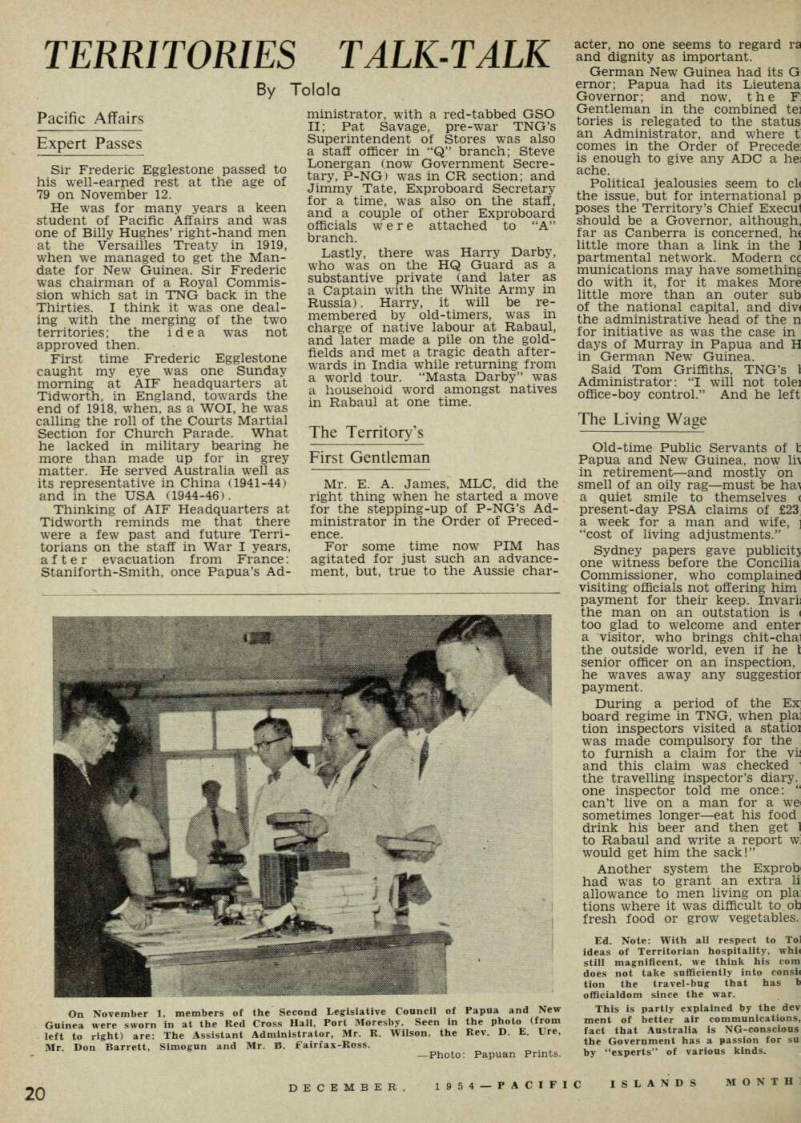
On November 1, members of the Second Legislative Council of Papua and New Guinea were sworn in at the Red Cross Hall, Port Moresby. Seen in the photo (from left to right) are: The Assistant Administrator, Mr. R. Wilson, the Rev. D. E. Ure, Mr Don Barrett, Simogun and Mr. B. Fairfax-Ross.
Photo: Papuan Prints.
I The position is getting better as most of the centres now have hotels, but in the immediate post-war years the lives of some officials were made a hell by these “visiting firemen”. One official has told PIM how, over a period of some months, he and his wife had only two meals without guests. No family should be asked to put up with this sort of thing —even if the guests are invariably charm ing. If this man’s wife had not had the character of an angel she would have run away and left him.
3raves on Maty Island
I see where ex-Coastwatcher H. McColl is enquiring about two graves on Maty Island (November ‘Editors’ Mail Bag”). Had he written £ Fred Archer, of Buka or Rabaul ibut at the moment in hospital in Brisbane) that gentlemen would 3robably have been able to give him :he desired information as to the
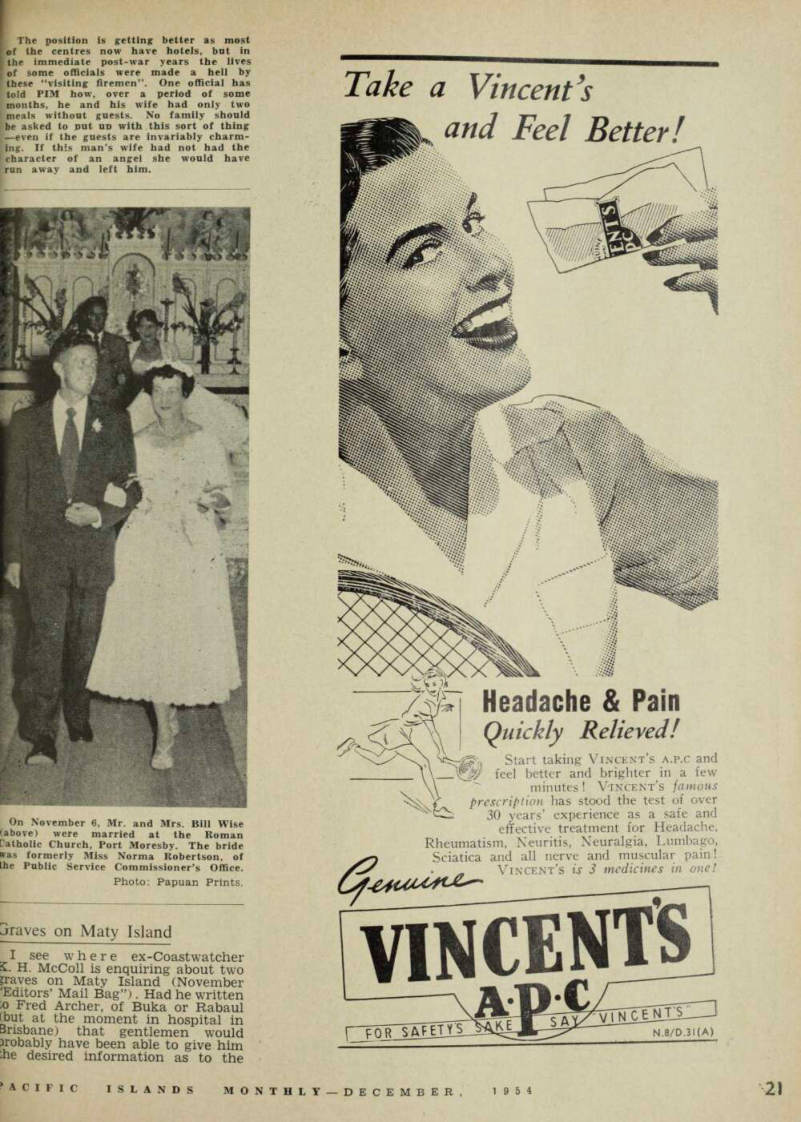
On November 6, Mr. and Mrs. Bill Wise (above) were married at the Roman Catholic Church, Port Moresby. The bride was formerly Miss Norma Robertson, of the Public Service Commissioner’s Office.
Photo: Papuan Prints.
identity of the occupants. I have an idea that one of the graves marks the resting place of a brother of H. R. Wahlen, but I am not sure.
Fred Archer was manager on Maty for some time and, besides being an observant gentleman, has a re tentive memory.
Calling H. R. W.
A Sydney journalist rang me the other day asking about H. R.
Wahlen and spoke, with bated breath, of the old German castle erected by Wahlen at Maron in the Hermit Group where, he had been informed, Wahlen kept a South Sea seraglio, and could I enlighten him?
Time, Distance and the Unknown invariably give birth to legendary characters and it would seem HRW has developed into one, though I am quite sure that that very logical and practical gentleman would be the last to desire such a role.
Certainly the “Wahlenberg” home at Maron was the most ornate and finest building in the German colony, and probably in the South Seas. (PIM published photos of it a couple of years ago). It was an imposing two-storey structure, ideally situated in its elevated, park-like grounds, where deer grazed, overlooking the isles of the Hermit Group and the boundless Pacific.
But it was never claimed to be a “German castle.” As for the harem —well, that was another myth; although the lasses of Maty and Aua were recognised as being the belles of the Bismarck Archipelago.
I don’t think HRW spent very much time at Maron. When I met him first in 1912 he was No. 1 of the newly-formed HSAG, the firm that took over Queen Emma’s in terests in the Colony. Isolated as Maron is, it was a port of call for the old NDL steamers plying be
tween Sydney and Hongkong, and during the middle Twenties the BP liners called there, as well as at Maty and Aua, extend ing them on to Seleo Island, near Aitape, ana then on down the Madang coast. Sea transport was better in those days.
A Plea for
Sectional Unity
One seldom reads impas sioned utterances from Administra tion officials in the Territory’s Legislative Coun cil. But Mr. S.
Elliott-Smith, DC of Wewak, can take a bow for pointing out to
fellow Councillors recently the need for unity amongst the non-in digenous population of the Terri tory. Said he: The deliberate nullification of the efforts of one section of the community by another, is stupidity in its worst form. It is dangerous.
It can only bring about distrust, hatred and eventually chaos.
The existing animosity between Administration, Missions and Com mercial activities in P-NG is well known, and those three sections of the community have been back-bit ing for the last 40 years, to my knowledge, each endeavouring to consolidate his own position with the native at the expense of the
other. And, added to this, the: have been the inter-section jealousies: Departmental: denon inational and the indiv i d u i jealousies amongst the plantei traders, miners and business house What a different picture cou have been painted had there bee co-ordinated action amongst all tl Europeans and Asians in their ei deavour (as Elliott-Smith says) achieve a better way of life.”
Jealousy of the other chap’s u fluence with the native people hi been one of the fundamental reasoi for this lack of unity. And now, wil progress in native education, th state of affairs is becoming appare] to the native himself as he enabled to read the written wor This should be realised by publicist who so often exercise little cautic when they spill that drop of ir which makes the thousands thinl If one native cannot read himsel there are now many who can ar who take a delight in passing c information of a contentious natur
The Jap Poachers
The several occasions on whic Jap poachers have been picked i in TNG recently, naturally tak pre-War residents back to tl times when Jap sampans were ing out the same tactics on terr torial reefs and denuding them ( the “chicken shell.” If I rememb< rightly, there was a fine of £5 fc each under-sized shell found in person’s possession, and that reguh tion probably still stands.
If it doesn’t, then it should.
The general excuse put forwar by local Japs for the B 4 poache] was that they were “pirates” an outlaws in their country—not re cognised by law-abiding Nipponese
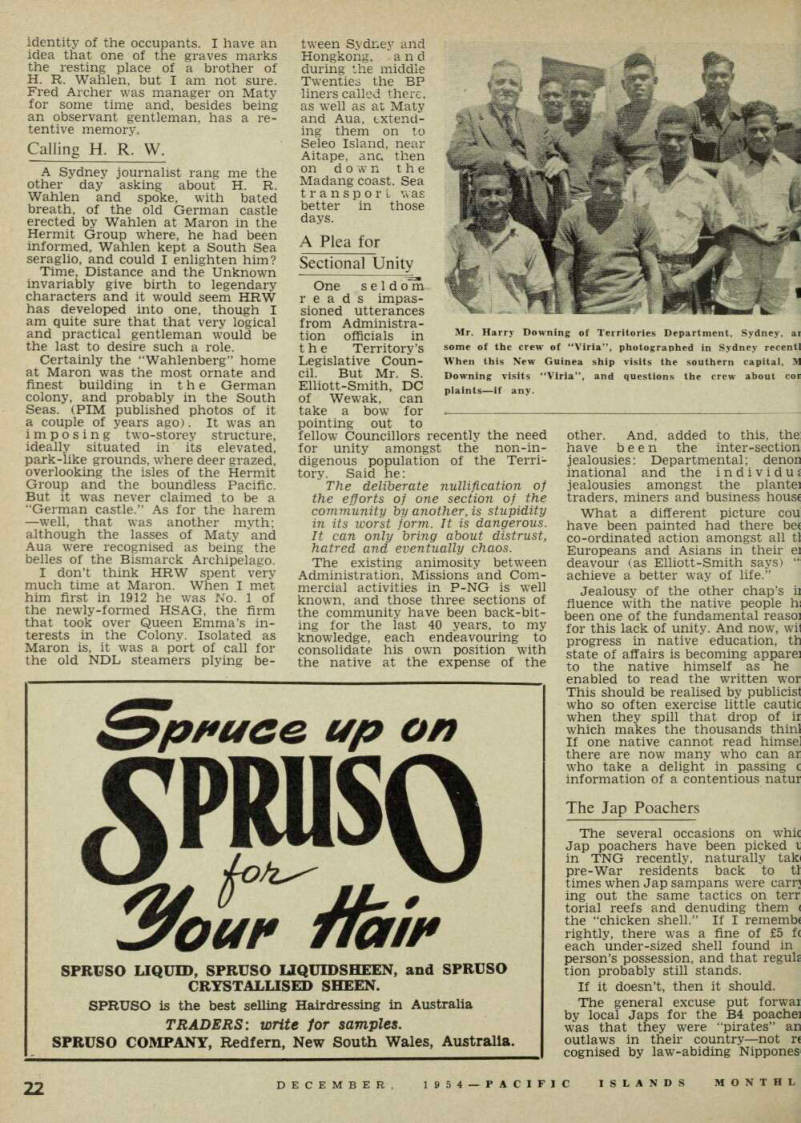
Mr. Harry Downing of Territories Department, Sydney, a[?] some of the crew of “Viria”, photographed in Sydney recent[?] When this New Guinea ship visits the southern capital, M Downing visits “Viria”, and questions the crew about co[?] plaints—if any.
Of Old Friends . . . i Back in Sydney from the US, (where he has been for the past 10 years, is Major W. T. Watson, DSO, MC and bar, DCM, better known to old TNG friends as Bill Watson, who skippered the AIF Rugby Union XV over in England in 1919. f Bill was with the Exproboard in the early days and was one of the Red Cycle crowd on the New Ire land East Coast. Later he and Herk Braddon ran a gymnasium in Sydney.
i . . And New
Recent re-organisation (beautiful bureaucratic word) of Administra tion departments indicates that the Assistant Administrator (or “Slide Rule” Wilson, as I have heard him sailed) is getting into his stride and moulding things nearer to his tieart’s desire. To read his remarks made at the November meeting of Leg. Council he would appear to be ;he answer to Canberra’s dream.