Tourists And Tuna
p. 23 · Read in the full issue
[?] Samoa Hopeful of
|NE of the greatest problems
F facing the Government in
jnerican Samoa at the present me is one common to many rritories in the Pacific—a short >e of productive land and a
ipidly increasing population.
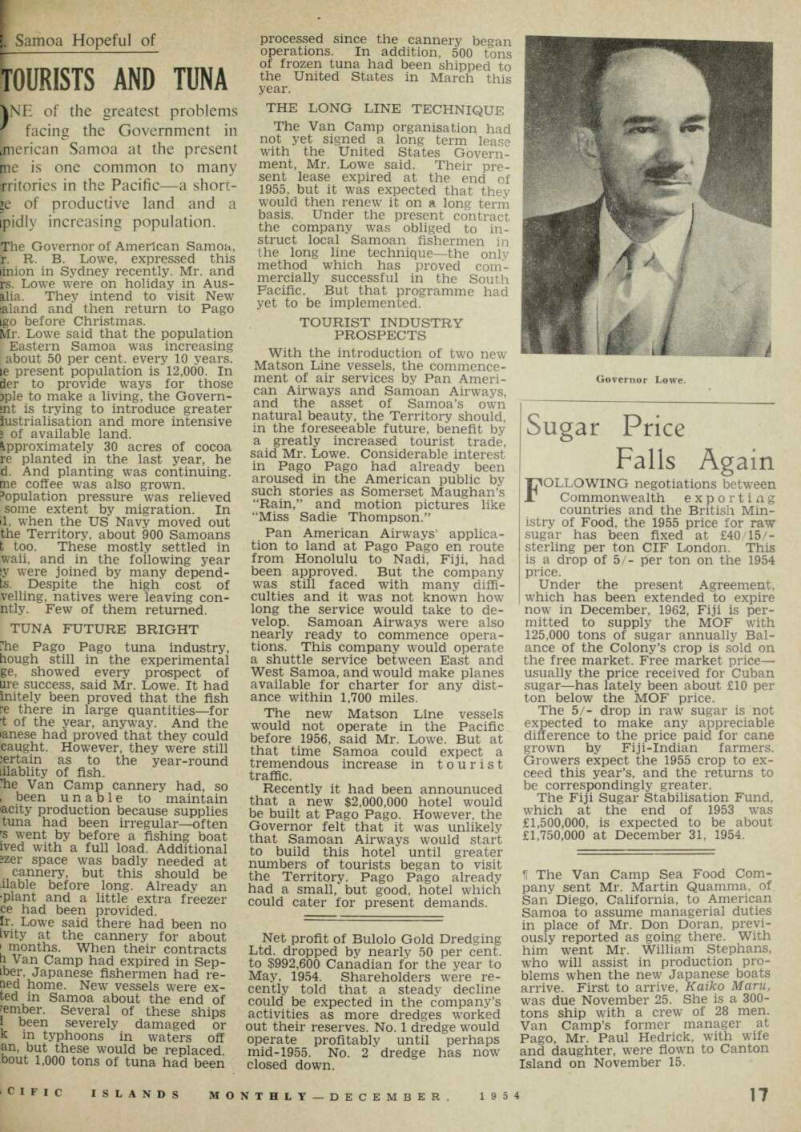
The Governor of American Samoa, r, R. B. Lowe, expressed this linion in Sydney recently. Mr. and rs. Lowe were on holiday in Aus alia. They intend to visit New laland and then return to Pago igo before Christmas.
Mr. Lowe said that the population Eastern Samoa was increasing about 50 per cent, every 10 years, le present population is 12,000. In der to provide ways for those jple to make a living, the Govern snt is trying to introduce greater iustrialisation and more intensive j of available land.
Approximately 30 acres of cocoa re planted in the last year, he d. And planting was continuing, me coffee was also grown. 3 opulation pressure was relieved some extent by migration. In •1, when the US Navy moved out the Territory, about 900 Samoans t too. These mostly settled in waii, and in the following year iy were joined by many depend ts. Despite the high cost of veiling, natives were leaving con ntly. Few of them returned.
Tuna Future Bright
?he Pago Pago tuna industry, hough still in the experimental ge, showed every prospect of lire success, said Mr. Lowe. It had initely been proved that the fish re there in large quantities—for •t of the year, anyway. And the •anese had proved that they could caught. However, they were still certain as to the year-round dlablity of fish. ’he Van Camp cannery had, so , been unable to maintain acity production because supplies tuna had been irregular—often r s went by before a fishing boat ived with a full load. Additional Jzer space was badly needed at cannery, but this should be liable before long. Already an •plant and a little extra freezer ce had been provided.
Ir. Lowe said there had been no ivity at the cannery for about i months. When their contracts a Van Camp had expired in Sep iber, Japanese fishermen had re aed home. New vessels were ex ted in Samoa about the end of member. Several of these ships been severely damaged or k in typhoons in waters off an, but these would be replaced, bout 1,000 tons of tuna had been
processed since the cannery began operations. In addition, 500 tons of frozen tuna had been shipped to the United States in March this year.
The Long Line Technique
The Van Camp organisation had not yet signed a long term lease with the United States Govern ment, Mr. Lowe said. Their pre sent lease expired at the end of 1955, but it was expected that they would then renew it on a long term basis. Under the present contract the company was obliged to in struct local Samoan fishermen in the long line technique—the only method which has proved com mercially successful in the South Pacific. But that programme had yet to be implemented.
Tourist Industry
Prospects
With the introduction of two new Matson Line vessels, the commence ment of air services by Pan Ameri can Airways and Samoan Airways, and the asset of Samoa’s own natural beauty, the Territory should, in the foreseeable future, benefit by a greatly increased tourist trade, said Mr. Lowe. Considerable interest in Pago Pago had already been aroused in the American public by such stories as Somerset Maughan’s “Rain,” and motion pictures like “Miss Sadie Thompson.”
Pan American Airways’ applica tion to land at Pago Pago en route from Honolulu to Nadi, Fiji, had been approved. But the company was still faced with many diffi culties and it was not known how long the service would take to de velop. Samoan Airways were also nearly ready to commence opera tions. This company would operate a shuttle service between East and West Samoa, and would make planes available for charter for any dist ance within 1,700 miles.
The new Matson Line vessels would not operate in the Pacific before 1956, said Mr. Lowe. But at that time Samoa could expect a tremendous increase in tourist traffic.
Recently it had been announuced that a new $2,000,000 hotel would be built at Pago Pago. However, the Governor felt that it was unlikely that Samoan Airways would start to build this hotel until greater numbers of tourists began to visit the Territory. Pago Pago already had a small, but good, hotel which could cater for present demands.
Net profit of Bulolo Gold Dredging Ltd. dropped by nearly 50 per cent, to $992,600 Canadian for the year to May, 1954. Shareholders were re cently told that a steady decline could be expected in the company’s activities as more dredges worked out their reserves. No. 1 dredge would operate profitably until perhaps mid-1955. No. 2 dredge has now closed down.
Governor Lowe.