Unfavourably to the Japanese
pp. 18-153 · Read in the full issue
Shell Poachers, grave-diggers or baseballers: —
New Guinea Reacts Unfavourably to the Japanese
Territory folk did not care whether they ever saw a Jap again—dead or alive, said Mr- George Whittaker, president of the Papua-New Guinea Branch of the RSSAILA recently.
HOWEVER, as part of the Anglo- American plans for protecting Western civilisation against Russo-Mongolian Communism, the South Pacific countries are being asked to resume friendly relations with Japan. Our former enemies— Germany, in the West, and Japan, in the East—are being lined up with us to resist the Red bloc.
Australia, reluctantly, has accepted a new trade treaty, under which the Japanese buy Australian wool and Australia buys a lot of Japan’s manufactured goods. But Aus tralians have not forgotten ' Jap atrocities in New Guinea and Am boina and Burma and Borneo and, when it comes to social intercourse, the diplomats’ plans have run off the rails.
A team of smiling Jap baseballers arrived to play baseball in Aus tralian cities. Some Australians snarled: most turned their backs; no one went to the baseball games; and the tour was cancelled and the team hurriedly shipped back to Japan.
Then, at end of November, it was officially announced that Australia had granted Japan permission to send to Papua-New Guinea, for two months, via Solomon Islands, a “Mission” of 19 persons, to collect the remains of war dead, hold re ligious ceremonies and erect small memorial stones, no bigger than one cubic metre, at five burial places.
Mr. G. K. Whittaker, MLC, of Lae, President of the RSL, expressed the views of P-NG ex-servicemen and others and said that they knew of only a few isolated Jap burial grounds—not enough to justify such a visit or a war-time cemetery.
And they certainly did not want a Jap war memorial there, to further remind them of the Jap invasion and the atrocities which attended it. “The right place for a Jap war memorial is in Japan,” said Mr.
Whittaker —and most of us will agree with him. (See Comment further on.) Meanwhile, there has been liveli ness on the Japanese fishing front.
The Japanese pay lip service to the Australian-New Guinea sea frontiers, beyond which they may not come; but with increasing frequency they are being caught taking shell or loading up with fish in New Guinea waters.
Advance With itchy Fingers’
WRITING after a South Pacific tour a few weeks ago, the American journalist, Robert C.
Ruark, described the way in which the Japanese have “resumed their itchy-fingered advance upon New Guinea and the other empty islands of the South Seas.”
Recent events in New Guinea sug gest that, if there is not soon a clarification of the international position, and if some order and dis cipline are not imposed upon these Japanese sea-scavengers, there may be serious trouble in relation to New Guinea.
The Japanese appear to be try ing to resume their reef-scraping activities where they ceased in 1940- 41. It will be remembered that the presence of shell-poachers in New Guinea and Solomons waters was constantly being reported in the ’Thirties —especially by the PIM — but that nothing much was done.
Australia then had little voice: whereas Japan was a World Power, and could get away with anything.
The position is different to-day.
An interesting feature of to-day’s developments is the part being taken by New Guinea civilians in captur ing or chasing away the robbers.
The Japanese may not enter New Guinea territorial waters, or land on non-Japanese islands, without entering through a recognised port, in a proper way; and, if they do not observe the law, European civilians, as well as officials, may place them under arrest.
Arrested by Civilians
ON November 4, seven Japanese, operating from a dory or sam pan off the Fead Islands were detained by Mr. G. L. Cleveland, manager of the Fead Islands Estate, and subsequently taken to Rabaul.
There they were convicted, on No vember 19 and fined £lOO each, or eight months’ imprisonment, with confiscation of their vessel and the troc h u s shell found in their possession. All were charged under the Commonwealth Act with poach ing in Territorial waters.
About this incident our Rabaul correspondent writes: Only a fortnight before young Ray Lacey (he is only 37) captured his Japs, Geoff Cleveland, manager of a plantation on Nuguria Island (in the Fead Group,
just inside the Territorial boundara made prisoners of seven Japanese trocb fishermen. They were one group several, in dinghies and sampans, whi disembarked from a mother ship gather shell on a reef in full view of t plantation.
At Geoff’s approach, in a pinnace, t ship (later identified as the “Eh Maru”) hurriedly gathered in her boi —all except one sampan containing 1 hapless seven—and made for the op sea.
The seven, with all the speed th inboard motor could muster, attempl to get away from the pinnace. They w< easily overtaken, taken in tow, and pla<
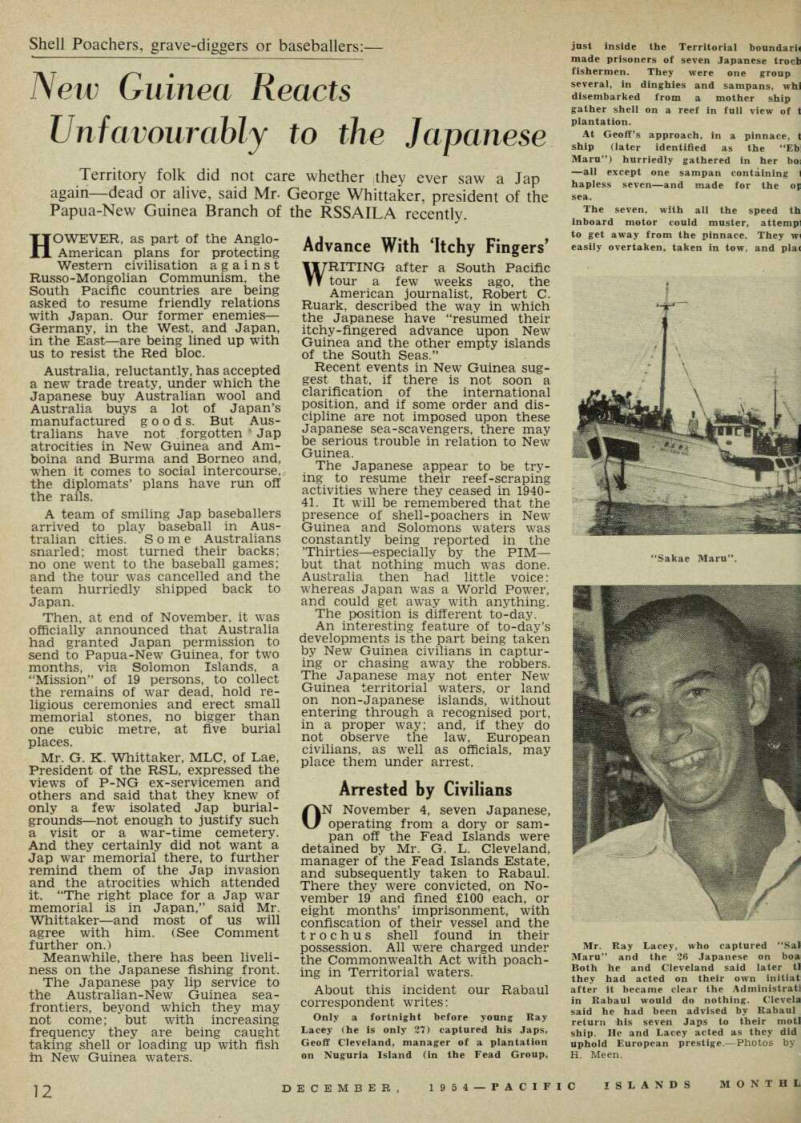
“Sakae Maru”.
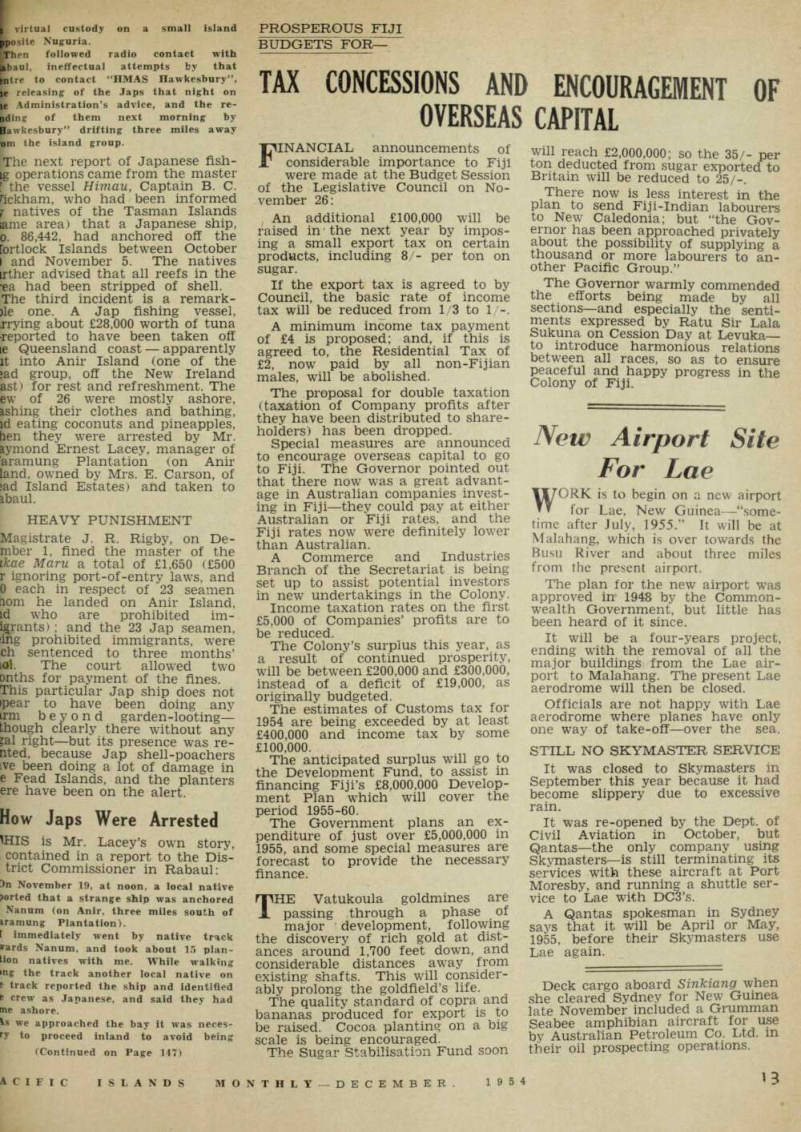
Mr. Ray Lacey, who captured “Sat Maru" and the 36 Japanese on boa Both he and Cleveland said later th[?] they had acted on their own initiat after it became clear the Administrati in Rabaul would do nothing. Clevela said he had been advised by Rabaul return his seven Japs to their motl ship. He and Lacey acted as they did uphold European prestige. Photos by H. Meen.
I virtual custody on a small island bposite Nuguria. [Then followed radio contact with |*baul. ineffectual attempts by that [ntre to contact “HMAS Hawkesbury”, ie releasing of the Japs that night on le Administration’s advice, and the re ading of them next morning by Hawkesbury” drifting three miles away «m the island group.
The next report of Japanese fish ig operations came from the master f the vessel Himau, Captain B. C. rickham, who had been informed j natives of the Tasman Islands lame area) that a Japanese ship, o. 86,442, had anchored off the [ortlock Islands between October I and November 5. The natives irther advised that all reefs in the •ea had been stripped of shell.
The third incident is a remark )le one. A Jap fishing vessel, Trying about £28,000 worth of tuna •reported to have been taken off le Queensland coast apparently it into Anir Island (one of the ;ad group, off the New Ireland ast) for rest and refreshment. The ew of 26 were mostly ashore, ashing their clothes and bathing, id eating coconuts and pineapples, hen they were arrested by Mr. aymond Ernest Lacey, manager of aramung Plantation (on Anir land, owned by Mrs. E. Carson, of sad Island Estates) and taken to ibaul.
Heavy Punishment
Magistrate J. R. Rigby, on De mber 1, fined the master of the ikae Maru a total of £1,650 (£5OO r ignoring port-of-entry laws, and 0 each in respect of 23 seamen horn he landed on Anir Island, id who are prohibited im igrants); and the 23 Jap seamen, ing prohibited immigrants, were ch sentenced to three months’ 101. The court allowed two onths for payment of the fines.
This particular Jap ship does not ipear to have been doing any
irm beyond garden-looting—
though clearly there without any ?al right—but its presence was re nted, because Jap shell-poachers ive been doing a lot of damage in e Fead Islands, and the planters ere have been on the alert.
How Japs Were Arrested
'HIS is Mr. Lacey’s own story, contained in a report to the Dis trict Commissioner in Rabaul: Jn November 19, at noon, a local native ported that a strange ship was anchored Nanum (on Anir, three miles south of iramung Plantation). [ immediately went by native track vards Nanum, and took about 15 plan tion natives with me. While walking >ng the track another local native on 6 track reported the ship and identified 6 crew as Japanese, and said they had me ashore. we approached the bay it was neces ry to proceed inland to avoid being
(Continued on Page 147)
hted from the ship, and I led the party rough the bush. When I was within F yards of the Japanese, who were shing in the Namum River, I decided make a dash along the beach, in hope catching them before they could urn to the ship. There was a raft ich they were using to shuttle the w ashore. caught two Japanese at the beach.
Hit to board the raft, and indicated the party washing in the river that y were to stop where they were. But y immediately dived into the sea. then instructed one of my natives to a shot into the air. When this was e the Japanese immediately returned the beach where they were lined up. igglers appeared over a distance of f to three-quarters of a mile. They Icated by signs that there were still *e persons on the ship, sent three boys to the ship to bring remaining Japanese to the shore, sn this was done they were marched Waramung Plantation, where I en sured to make contact with Rabaul vireless. (Other reports were that the ves complained that the Japs had ed their gardens, and had stolen a and a bicycle.) hen I first came upon the Japanese s of then were washing clothes in the p, about 30 yards from the sea; some i gathering food, pineapples and coco . One man was carrying a bicycle. man was carrying a puppy. The res who were sent to the ship reported ence that pineapples and coconuts been consumed on the ship, te Japanese were requested to sit i outside the plantation residence, natives were placed around them.
Japanese were given water and a itity of barley was cooked for them, they did not eat it. len I first made contact with them, it a runner to a Japanese halfcaste, ael Asanume, whom I thought might ble to assist as an interpreter, about 6.30 p.m., the Japanese were into the copra store where they given spare blankets and new copra i. At about 7.30, Mr. Asanume ed, and the captain of the Japanese was called to my house. I told him ended to nroceed to Rabaul either in ship or in the small 5-ton pinnace i arrived at Waramung; about 7.45 e Japanese captain agreed to hand essei ("Sakae Maru”, No. 3) over to to take them to Rabaul. The ureter could converse with the lese but, when requested to convey tatement to them, he said he could »ut it into the Japanese language, receiving the captain’s agreement to over the ship the Japanese were i on the small pinnace and the nount Luluai of Anir Island made ible approximately 25 natives, and ired a few native plantation workers boats-crew experience, and we then eded by sea to the Japanese ship, re, all the Japanese were placed on
top of the two hatches, and natives were stationed around them. The captain was requested to point out his engineers, and these two started the engine, with natives watching them.
I took the captain to the wheel house, weighed anchor, and set course for Rabaul at 10.30 p.m. It was indicated to the captain that he could go to sleep, and he was permitted to go to his bunk in the wheelhouse, where he slept until approximately 4 am. on November 20.
Permission was refused to prepare a meal until daylight, for security reasons. With exception of the engineers and captain, the Japanese spent the night on the forward hatches.
It was noted on Saturday that there was a very definite change of attitude on the part of the captain and crew, and they soon became reconciled to the fact that nothing could be done but obey orders. I arrived at Rabaul 1.00 p.m. on Saturday, November 20. I contacted the Chief of Police, who got in touch with the District Commissioner, and both came down to the ship The Sakae Maru, 235 tons, is said to be owned by Miyagi Ken Motoyoshi Gun Osima Maru.
The District Commissioner (Mr. Fold!) said afterwards that Mr. Lacey did not seem to be unduly perturbed, but his employer (Mrs. Carson) was very con cerned about the stealing of shell. They say they frequently see these Japanese vessis in and around the waters of the Fead group. Mr. Lacey said in his opinion this was a bad thing for the native people, some of whom do not realise that the Japanese were defeated and sur rendered in World War 11.
Fines May Be Too Small
From Our Rabaul Correspondent NO thinking person believes the fines imposed on the Japs will be a deterrent. £7OO would not
represent a good day’s pearling by
the trochus fishers. The owner of Sakae Maru can afford £1,650 —on
board, in refrigerated holds, is
£28,000 worth of tuna and bonito.
When the latter fine is paid, the remainder of the terms of im
prisonment to be served by the crew probably will be waived, and the ship will again be free.
The RSL has urged that coast watchers be given an honorary naval or police rank, provided with fire arms and with full authority to lesist these unwelcome visitors.
Technically American
The sampan arrested by the Queensland Government launch Melbidir about the same time as the New Guinea incidents, was later re leased from Thursday Island with out any charge being made against the vessel or its crew.
It is understood the sampan is technically an American vessel and the 30 crew members are from the American Trust Territory of Okinawa.
Legal officers could find no evid ence of poaching or of unauthorised landings.