New Guinea Cocoa
p. 17 · Read in the full issue
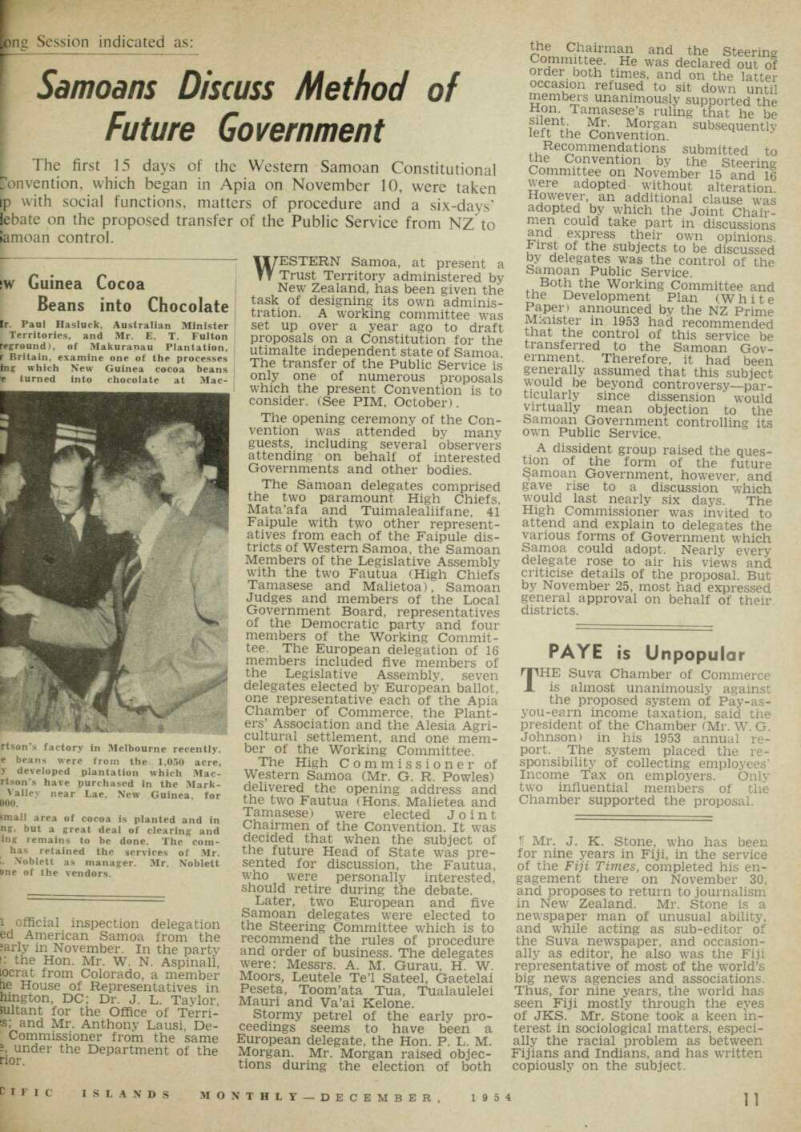
Beans into Chocolate
rtson’s factory in Melbourne recently, e beans were from the 1,050 acre, y developed plantation which Mac rtson’s have purchased in the Mark- Valley near Lae. New Guinea, for 000. small area of cocoa is planted and in ng, but a great deal of clearing and ing remains to be done. The com has retained the services of Mr.
Noblett as manager. Mr. Noblett one of the vendors. i official inspection delegation ed American Samoa from the "arly in November. In the party i: the Hon. Mr. W. N. Aspinall, ipcrat from Colorado, a member tie House of Representatives in hington, DC; Dr. J. L. Taylor, mltant for the Office of Terri 's; and Mr. Anthony Lausi. De- Commissioner from the same J, under the Department of the rior.
WESTERN Samoa, at present a Trust Territory administered by New Zealand, has been given the task of designing its own adminis tration. A working committee was set up over a year ago to draft proposals on a Constitution for the utimalte independent state of Samoa The transfer of the Public Service is only one of numerous proposals which the present Convention is to consider. (See PIM, October).
The opening ceremony of the Con vention was attended by many guests, including several observers attending on behalf of interested Governments and other bodies.
The Samoan delegates comprised the two paramount High Chiefs, Mata’afa and Tuimalealiifane, 41 Faipule with two other represent atives from each of the Faipule dis tricts of Western Samoa, the Samoan Members of the Legislative Assembly with the two Fautua (High Chiefs Tamasese and Malietoa), Samoan Judges and members of the Local Government Board, representatives of the Democratic party and four members of the Working Commit tee. The European delegation of 16 members included five members of the Legislative Assembly, seven delegates elected by European ballot, one representative each of the Apia Chamber of Commerce, the Plant ers’ Association and the Alesia Agri cultural settlement, and one mem ber of the Working Committee.
The High Commissioner of Western Samoa (Mr. G. R. Powles) delivered the opening address and the two Fautua (Hons. Malietea and Tamasese) were elected Joint Chairmen of the Convention. It was decided that when the subject of the future Head of State was pre sented for discussion, the Fautua, who were personally interested, should retire during the debate.
Later, two European and five Samoan delegates were elected to the Steering Committee which is to recommend the rules of procedure and order of business. The delegates were: Messrs. A. M. Gurau, H. W.
Moors, Leutele Te’l Sateel, Gaetelai Peseta, Toom’ata Tua, Tualaulelei Mauri and Va’ai Kelone.
Stprmy petrel of the early pro ceedings seems to have been a European delegate, the Hon. P. L. M.
Morgan. Mr. Morgan raised objec tions during the election of both
the Chairman and the Steering * He was declare d out of order both times, and on the latter S! n refused to sit down until members unanimously supported the Ta £? aSes £ s ruling that he b e
silent. Mi. Morgan subsequently
left the Convention.
Recommendations submitted to the Convention by the Steering Committee on November 15 and 16 were adopted without alteration.
However an additional clause was adopted by which the Joint Chair men could take part in discussions and express their own opinions.
First of the subjects to be discussed by delegates was the control of the Samoan Public Service.
Both the Working Committee and the Development Plan (White Paper) announced by the NZ Prime Minister in 1953 had recommended that the control of this service be transferred to the Samoan Gov ernment. Therefore, it had been generally assumed that this subject would be beyond controversy—par ticularly since dissension would virtually mean objection to the Samoan Government controlling its own Public Service.
A dissident group raised the ques tion of the form of the future Samoan Government, however, and gave rise to a discussion which would last nearly six days. The High Commissioner was invited to attend and explain to delegates the various forms of Government which Samoa could adopt. Nearly every delegate rose to air his views and criticise details of the proposal. But by November 25, most had expressed general approval on behalf of their districts.
Mr. Paul Hasluck, Australian Minister Territories, and Mr. E. T. Fulton reground), of Makurapau Plantation, [?] Britain, examine one of the processes [?]ing which New Guinea cocoa beans [?]e turned into chocolate at Mac-