Policy At Stake In N. Guinea
pp. 15-16 · Read in the full issue
Editorial . . .
Vital Land Settlement
A N important principle of land \ settlement is at stake in New Guinea. It can be summed up i this question: Should a land seker be allowed, as far as possible, ) make his own selection of land, jcality and crop: or should he sub lit to the direction of officials in 11 these matters? The original ittlers in all great pioneering enter rises (Australia, New Zealand, merica, and Africa) had a free loice.
While Australian Territories Min ter Hasluck, who sometimes seems i be unduly concerned about native ghts and UNO sensitiveness in re tion to land settlement, was pre icupied with land-use plans (1951- ), one of the outstanding District jmmissioners in New Guinea, Mr. n Downs, developed a notable rst e m of land settlement in istern Highlands. He was not in ly sense defying his Minister. He ,ppens to be a very energetic and actical young man, with plenty vision; he knew what his District eded; and, while awaiting Can rra’s wearisome policy directives, just naturally went ahead with ;h things as afforestation, road d bridge-building, training of tives, and encouragement of Euro ans to establish plantations. [n the latter regard, Mr. Downs lowed the principles of comm'on ise. When a man said that he nted land, Mr. Downs learned at he could of the man’s history d background—his practical owledge of tropical agriculture; i attitude towards natives; his lity to “stick it” through the dif ilt early years; and so forth. If passed this simple screening, he s encouraged to look around for uitable block—on the clear under tiding that he could not have land X the DC considered was neces y for future native needs; that could induce the natives to sell; X he must satisfy the DC that residence there, in close contact h the natives, would be beneficial that particular native com nity.
Within two years, the new ■opean settlement in Eastern hlands was a model for the )le Territory. Several small, in endent, European planters were iblished on lands of their own
sction, producing crops nomin
a by themselves, and under con ons which promoted a spirit of dwill and co-operation between opeans and natives
EVERYONE —officials and non officials alike—praised the work done by Downs in this District.
But Minister Hasluck was not im pressed. Over a year ago, he stamped hard upon Downs’s settlement activ ities, and issued a directive that all unregulated European settlement in the Dual Territory should cease forthwith.
That paralysis continued until last September. Then Minister Hasluck issued what he called his re-state ment of lands policy, which appar ently placed responsibility for land purchase, land assessment and land disposal completely and absolutely in the hands of a Lands Depart ment that is without adequate staff, and of Land Boards which must dispose of lands by public tender.
The success of the Downs system of land settlement was either ignored, or condemned.
The PIM, in November, described that policy as narrow, rigid, un imaginative, idealistic and un realistic. We urged the people of New Guinea to appeal directly to the Prime Minister of Australia, so as to escape the effects of the Hasluck dictatorship. After that at tack was in print, but before the PIM was in circulation in P-NG, much of what we said was endorsed by non-official members of the Legis lative Council, who were criticising the Administration’s failure to en courage European land settlement.
SINCE then, certain Departmental representations have been , made to us. We are assured that the new policy will be fi? mi ? ls^ in suc h a way that the best features of the Downs settlement system will be retained, while all settlement activities will be harmonised with an over-all policy encouraging private enter prise and co-ordinated with Aus tralia’s obligations in relation to the natives. This is to be achieved by giving new status and authority to the District Commissioners. The Australian Government’s plans and hopes are set out in an important article on another page, entitled Change in PNG-Administrative System.”
So far, so good. This journal is not concerned with the tender feel ings of Canberra czars, or the idealistic planning of high-ranking bureaucrats. What we are con cerned with are the following facts: There is enough land in P-NG to take care of all native needs for many generations, and also to allow the settlement of sufficient Euro peans to directly influence native agriculture, outlook and standards of living.
It is vital to the success of Euro pean settlement that prospective settlers he carefully chosen; and that they, for their part, have reasonable liberty in selecting their own land and location, and arrang ing their plantations as they wish.
The numerous inquiries for P-NG land now being made should be sympathetically received. Suitable men who know P-NG conditions, and who have been waiting a long time, should be given priority. Any attempt to subject this pioneering impulse to any Canberra-conceived system of “disposal by tenderand to direct the settlers to Department ally selected areas (a system ad ministered by officials who think far more of systems than of in-
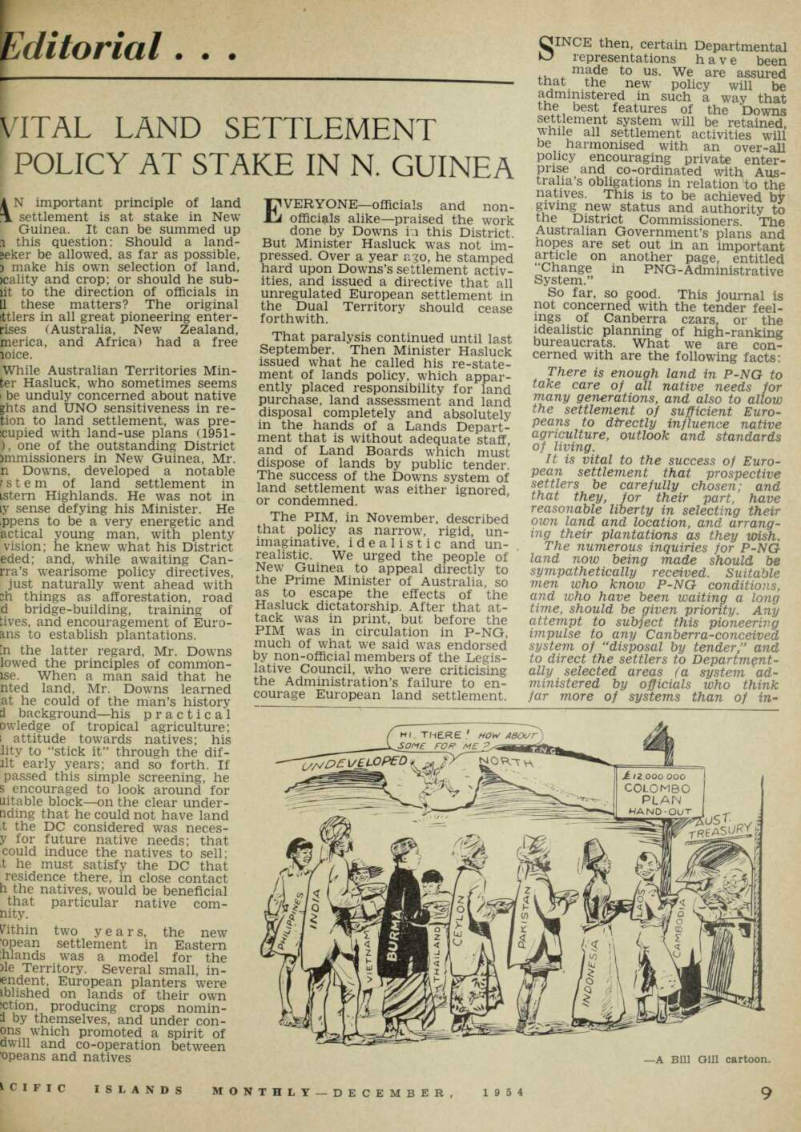
A Bill Gill cartoon.
dividualistic suitability) must be resisted with all the resources at the command of the non-official population.
BUT if the District Corhmissioners, under their new status, can shape and control land settle ment, and can combine the Downs principles of European settlement with the idealistic conceptions of Minister Hasluck and his depart mental planners, some of the more alarming features of the Minister’s “policy” may be avoided.
But the outlook is not good. Only the DC’s can save the Dual Territory from a rigid Departmentalised system of land settlement. There are 15 Districts; and in at least 11 of those Districts the needs of land settlement call for the services of District Commis sioners of vision and experience. Are there a dozen such men in sight?
We sincerely hope that, hand-in hand with Minister Hasluck’s new policy of making better use of the District Commissioners, there also will go a system of making more District Commissionerships avail able to the younger men of the field staffs. We see more hope in that direction than in any other section of Canberra’s weighty plan ning.