Marriage
pp. 139-140 · Read in the full issue
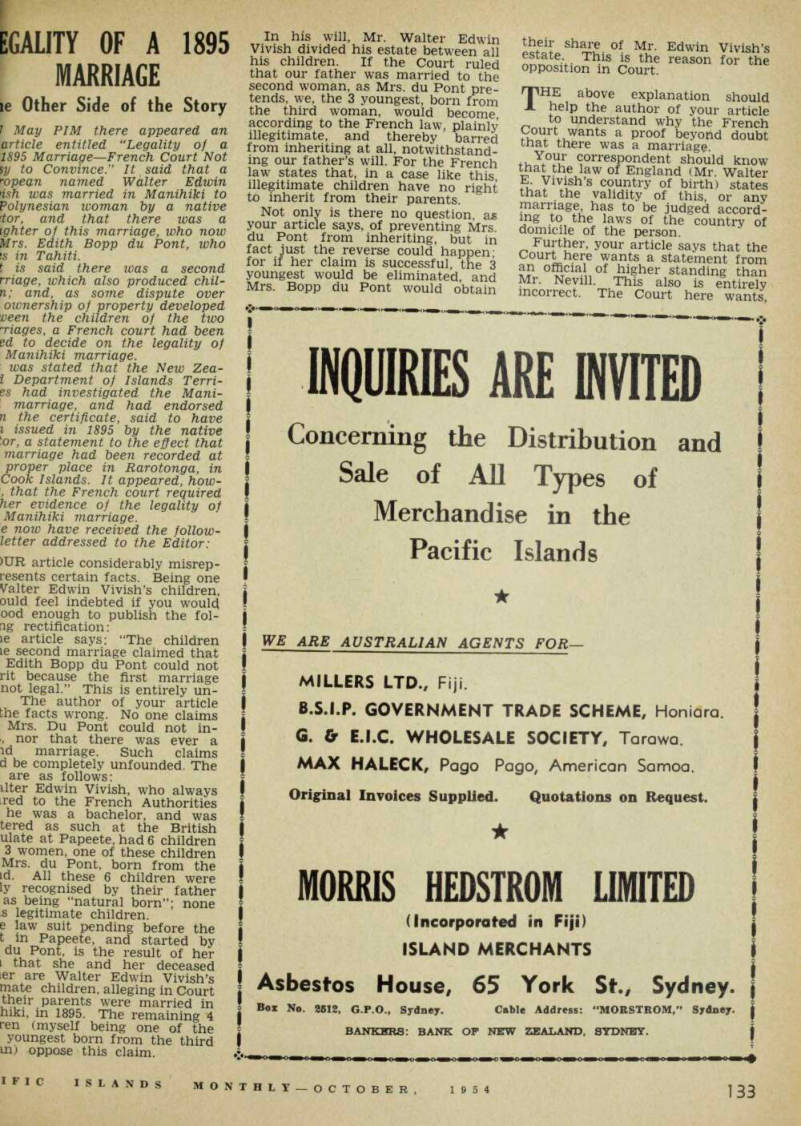
Egaiity Of A 1895
[?]e Other Side of the Story
1 May PIM there appeared an article entitled “Legality of a 1895 Marriage—French Court Not sy to Convince .” It said that a ropegn named Walter Edwin ish was married in Manihiki to Polynesian woman by a native tor, and that there was a ighter of this marriage, who now Mrs. Edith Bopp du Pont, who ts in Tahiti. t is said there was a second rriage, which also produced chil li; and, as some dispute over ownership of property developed veen the children of the two - riages, a French court had been ed to decide on the legality of Manihiki marriage, was stated that the New Zea i Department of Islands Terri es had investigated the Mani marriage, and had endorsed n the certificate, said to have i issued in 1895 by the native L or, a statement to the effect that marriage had been recorded at proper place in Rarotonga, in Cook Islands. It appeared, how ; that the French court required her evidence of the legality of Manihiki marriage, e now have received the follow letter addressed to the Editor: )UR article considerably misrep resents certain facts. Being one Valter Edwin Vivish’s children, ould feel indebted if you would ood enough to publish the fol ag rectification: le article says: “The children le second marriage claimed that Edith Bopp du Pont could not rit because the first marriage not legal.” This is entirely un- The author of your article the facts wrong. No one claims Mrs. Du Pont could not in , nor that there was ever a id marriage. Such claims d be completely unfounded. The are as follows; liter Edwin Vivish, who always red to the French Authorities he was a bachelor, and was tered as such at the British ulate at Papeete, had 6 children 3 women, one of these children Mrs. du Pont, born from the id. All these 6 children were ly recognised by their father as being “natural born”; none s legitimate children, e law suit pending before the t in Papeete, and started by du Pont, is the result of her i that she and her deceased ier are Walter Edwin Vivish’s mate children, alleging in Court their parents were married in hiki, in 1895. The remaining 4 ren (myself being one of the youngest born from the third in) oppose this claim.
In his will, Mr. Walter Edwin Vivish divided his estate between all his children. If the Court ruled that our father was married to the second woman, as Mrs. du Pont pre tends, we, the 3 youngest, born from the third woman, would become according to the French law, plainly illegitimate, and thereby barred from inheriting at all, notwithstand ing our father’s will. For the French law states that, in a case like this illegitimate children have no right to inherit from their parents.
Not only is there no question, as your article says, of preventing Mrs. du Pont from inheriting, but in fact just the reverse could happen; for if her claim is successful, the 3 youngest would be eliminated, and Mrs. Bopp du Pont would obtain
their share of Mr. Edwin Vivish’s estate This is the reason for the opposition in Court.
THE above explanation should help the author of your article to understand why the French Court wants a proof beyond doubt mat there was a marriage. correspondent should know that the law of England (Mr. Walter f- Y 1 ™*’ 8 coun try of birth) states that the validity of this, or any marriage, has to be judged accord mg to the laws of the country of domicile of the person.
Further, your article says that the Court here wants a statement from an official of higher standing than Mr. Nevill. This also is entirely incorrect. The Court here wants
as a proof, an abstract fr registers. It happens that reco were lost in Manihiki. Strang enough, the Registrar in Rarotoi issued a written statement, prodiii by Mrs. du Pont in Court here, si ing; “. . . that it would appear t] the marriage took place. . ”, t] merely expressing a view. T appears more an action of a defei lawyer in favour of his client, tl that of a Registrar. In the Frei legal system a Registrar deli\ abstracts from records in his cj and not commentaries about i certain events. From the C( Islands, where this marria allegedly took place, only facts any, are needed. It is up to the i partial and learned magistrates Papeete to judge the case.
In the chapter of your “Pac Islands Year Book” devoted to Cook Islands, I read: . . . “1 missionaries ... virtually direc the government” and also “. . . mi fantastic situations developed.”
The native preacher who allege performed the marriage in 1895 longed to the London Mission Society, I infer. It could well plain certain attitudes taken in y May article.
May I add that I would be “ easy to convince” that Mission rule is gone in the Cook Island I am, etc.,
Charles Henry Vivisp
Faaa, Tahiti, 17/8/54.