For Pacific Radio Amateurs
pp. 107-108 · Read in the full issue
Inducted By Ex Zk-1-Ac/Vr-2-Ak.
dress notes to P.O. Box 3408, Sydney. ■URRENT news is short this month, ■ due to your correspondent’s transfer m Auckland to Sydney. However, there word from Rarotonga which should srest DX men. tuart Kingan, ZK-l-AA, long silent, tes that he has just acquired a per rient home at Avatiu (Rarotonga) and be back on all bands in the near ire, mainly phone but also CW. In immediate post-war days Stuart, then charge of the ionisphere station, and second Op, David Evaroa, kept 1-AA on the air almost 24 hours of day. Conditions on 20 metres were i very good thousands of overseas ions making contact with ZK-l-AA— later also with David, a very keen man, who, with Stuart’s tuition, be e ZK-l-AH—first and only local-born qualify since World War 11. (Fred ey, ZK-l-AG, now inactive, also born >tonga, was on the air pre-war.) lose who worked ZK-l-AA in those ire days will recall how, every half ', the station had to go off the air a while as ionisphere measurements taken. David, now on the New and Post & Telegraph Department’s tal-grinding staff at Wellington, and icrarily off the air with housing prob , has the call ZL2ASJ to-day. ug, ZK-l-AB, out on a tour of his hern Group radio kingdom (he’s RI), was reported on the air from hyn Island in August, and probably also on from other islands as his made its way round, seat alongside Mr. H. E. Maude of louth Paciific Commission’s permanent at the September meeting of the ic Islands Society in Sydney, yielded iteresting story of the establishment le RNZN-P. & T. Department radio >n on Pitcairn Island during the war. jugh not a Ham story, it concerns a which is very much in the Ham The story arose through your corres mt, then radio operator in a egian ship, having met Mr. Maude d the schooner “New Golden Hind” ipeete at that time. The schooner, ed on hush-hush jobs to isolated Is, had just been down to Pitcairn :k up the Swiss Markwalder family, rors of the yacht “Trondjem” which »ecn wrecked on that island, k in New Zealand from this cruise, ffaude was immediately attached to xpedition which sailed aboard an can Liberty ship with staff, install technicians, and equipment, for rn. Half way to the Island the lor suddenly dropped off.
American Chief-Officer remarked these ships had been built in a and they sometimes forgot to n up some of the bolts! io silence was broken and within three ships were on the scene, tanker eventually taking them in nd heading north for the Cooks speed probably well in excess of the y’s best under her own steam, ever, before arriving anywhere, a
hurricane developed to the north, and an argument developed between the two Masters as to the safest course. The tanker's Master won the argument—but was wrong. They crossed the track of the hurricane, the tow parting, and the Liberty, with its Pitcairn expedition aboard, somehow survived seven fright ful days of 50-degree rolls, all hands fully expecting her to turn turtle.
t E 0 V r‘r y ’ 3 salvage arrived and \Z ihe vessel back to Wellington, where the propeller was replaced and the ex pedition despatched again, this time to arrive safely at the Island.
The station is still there, but silent, partly because a qualified operator could not be found in recent years, at the poor money offering, and partly because a low-powered station is adequate to-day or the Island’s needs, contact with the outside world being maintained via Raro tonga and with ships when nearing the island.
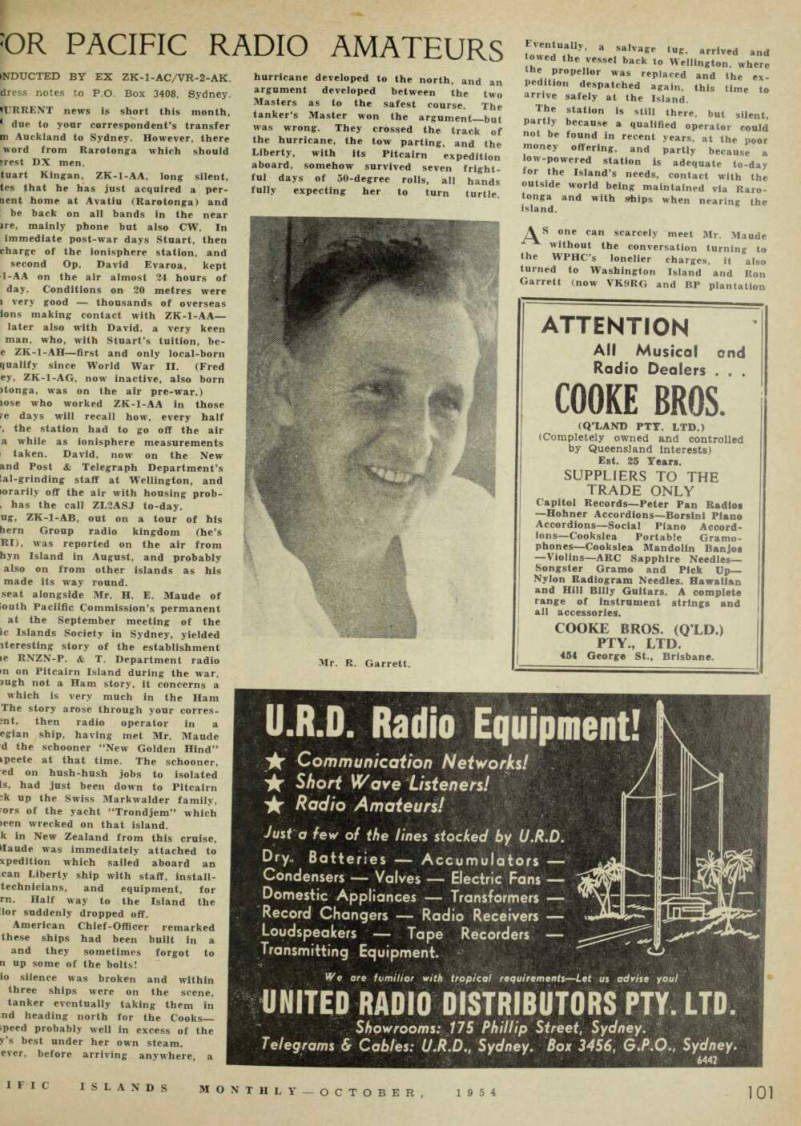
AS one can scarcely meet Mr. Maude without the conversation turning to the WPHC’s lonelier charges, it also turned to Washington Island and Ron Garrett (now VK9RG and BP plantation
Mr. R. Garrett.
inspector, with HQ in Rabaul) whose entry into Ham radio must have been as unorthodox as any on record.
Ron’s knowledge of radio was nil when he went to manage that island and its Gilbertese labour a few years before the war. But one day Worthing Castle, a Honolulu Ham whose call we’ve forgotten, came in with his wife aboard their yacht.
Worthing’s urgings, advice by letter and radio, and assistance in providing or despatching equipment and books from Honolulu later, put Ron, only European on Washington, on the air as the first Ham ever to be established on that atoll.
Some of his difficulties in the damp climate can be gauged from the fact that, without any mechanical aid of any kind, Ron not infrequently laboriously unwound the thousands of turns from various transformers, to find the corroded break, then rewound them again after repairs.
Then, of course, came the war close down and VRSA became a link in the Pacific coast-watching system.
To-day Washington Island is off the air —except when Phil Palmer, VR3C, takes along his portable rig from Fanning when he goes up to supervise the loading of the island’s copra aboard an overseas ship.
The following VK9 changes and additions are listed; New stations: VK9JH, J. F. Hanran, c o DCA. Port Moresby; VK9PF, P. T. Filmer, Kavieng.
New Ireland. Change QTH of VK9GV, G. V. Campbell from c/o AWA, Lae, to co DCA Mess, Lae. Delete VK9RO, R.
M. Ellison of Lae. station closed.
We also regret to record the recent
death of Bill Macgregor, VK9MC, of Baiyer River. NG.
Our last VK9 list appeared in May issue.
We note that VK4IC on Willis Islet, one of a total population of two persons on this meteorological reporting outpost off the Queensland coast, is very active on JO-metre phone. These boys receive a surface mail once per year, in June.
In the North Pacific KC6KU, Ja Youngstrom at Kusaie, a recent recn appears to be a keen man. He’s usi a Viking rig.
A new man joined the Tarawa ra staff in August—Mr. R. Jones. We bell he replaces Mr. Adams. Though thei no information, there are hopes that may liven the VR-1 air.