Brief Sojourn
pp. 87-97 · Read in the full issue
AMEL was horn in Fiji and has lived on numerous other islands. At the end of last year, she spent some months on Norfolk Island, which is in the Pacific, yet out of it. As a dweller from Real Pacific Islands, she wrote us this description.
IHE plane from Whenuapai (Auckland) was filled with holi day-makers, honeymooners and Unary citizens like ourselves, all ;ring through the windows trying get that first exciting glimpse of i rugged cliffs of Norfolk Island, len the plane landed and the r was opened, we were enveloped, once, in its warm, friendly, in mal atmosphere. .t the small guesthouse to which were whisked by a tall, lean, ■ndly taxi-driver, we were greeted the proprietress, hospitable, assed, hard-working Betty, and two gentlemen who sat sunning mselves on the edge of the mdah, their feet in a hydrangea h, their hands firmly holding ;e glasses of beer. 3i!” they said, looking us up and r n from city hats to city shoes, ficome to Norfolk Island! How ; are you staying?” rhree months,” we replied. * * * l due course, we set up house )ing for ourselves, at “Devon,” a pleasant, roomy house, sur ged by lawns and flower lens, and concealed from the I by Norfolk pines and thick i. ae house having been occupied ;he Army during the last War, es. and units were carved antically and ineradicably on kitchen tables, and all the lings were meticulously num d from 110 to 113. Number 110 the house; 111 was the garage was the laundry; and 113 was en coyly in a guava grove, and sed “Officers Only.” le house was embowered in j; glorious begonias climbed i i?: 1 ; night-blooming Cereus i the air with its heady per ;; and many tropical and sub cal flowers rioted together in garden. : never quite recovered from surprise of seeing bananas and les; fruiting side by side. Nature nsh with her fruits and vege
tables on this island, where the climate is so kind that from No vember until February—hot months in the Southern Hemisphere—it was cool enough for a blanket every night.
The lawn at “Devon,” which was once a croquet lawn, was a favourite playground for hundreds of birds.
Brilliant scarlet and purple parrots landed and took off; armies of quail marched regularly over it; green and bronze doves delved busily under the mulberry trees; and the tame little fantails almost perched on my sunhat. But the lovely birds are the Island’s worst pests, consuming and wasting many tons of fruit annually. They have a daily diet of fruit salad, flitting from pears, to guavas, to bananas, to peaches, to oranges, to pawpaws and to figs.
Other pests on the island are rats, and rabbits. The latter, however, are confined to Philip Island, it be ing strictly forbidden to bring live rabbits to the mainland. We were told that years of inbreeding and semi-starvation have now reduced these rabbits to the size of rats.
Surplus horses are also becoming a nuisance on Norfolk as they graze on land which could be given over to dairy herds. * * * When we were not occupied with mowing lawns, weeding flower-beds, chopping wood, cooking, housework and office work, we explored the Island, from Cemetery Bay to Anson Bay, from Bird Rock to Puppy’s Point.
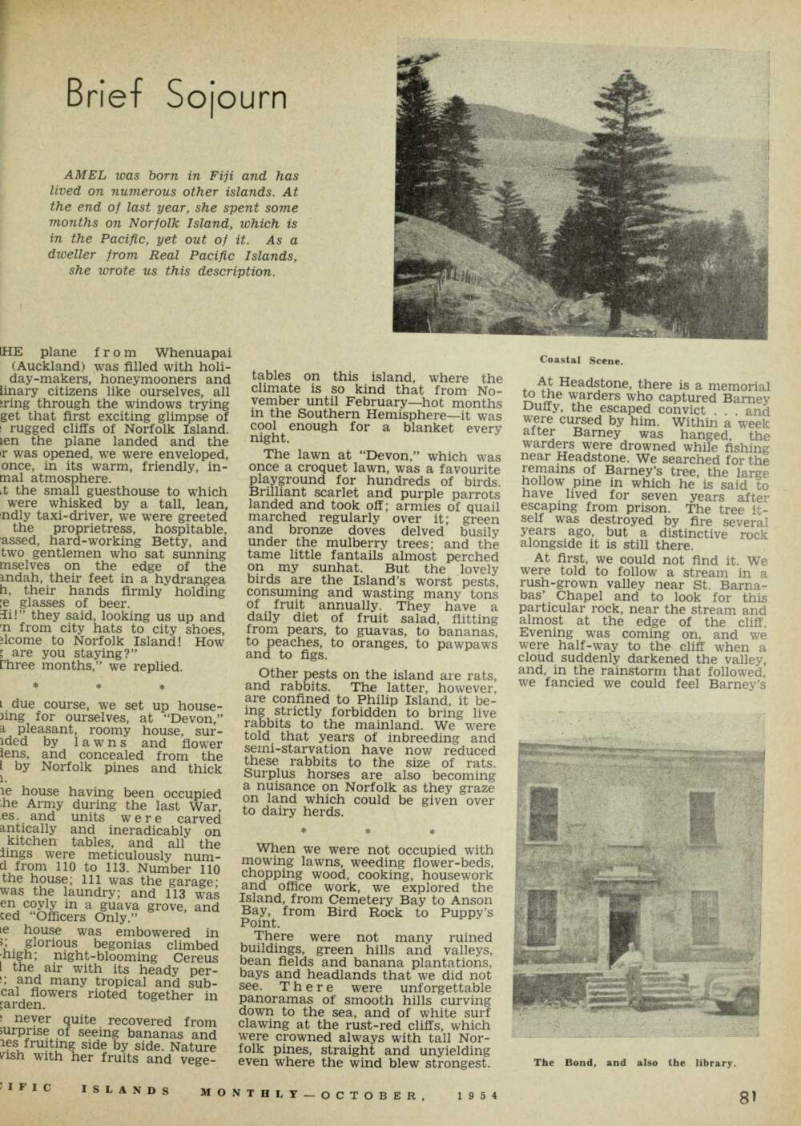
There were not many ruined buildings, green hills and valleys, bean fields and banana plantations, bays and headlands that we did not see. There were unforgettable panoramas of smooth hills curving down to the sea, and of white surf clawing at the rust-red cliffs, which were crowned always with tall Nor folk pines, straight and unyielding even where the wind blew strongest.
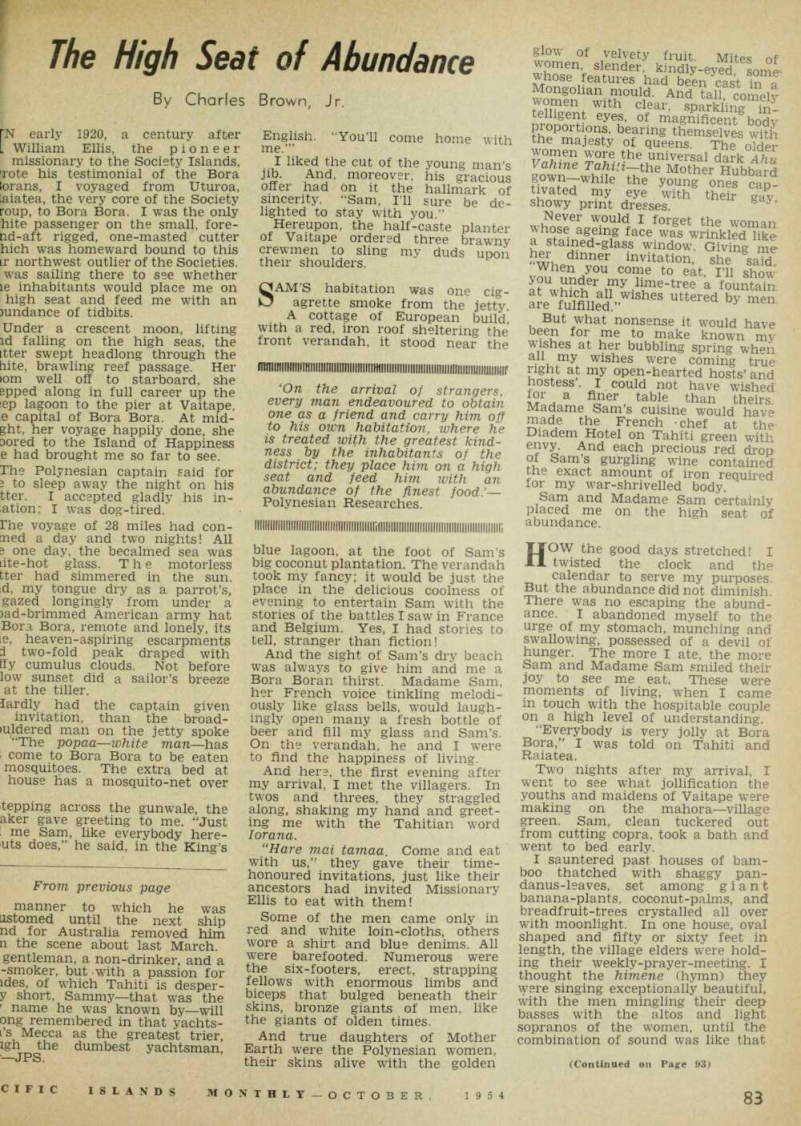
At Headstone, there is a memorial to the warders who captured Barney Duffy, the escaped convict . , . and were cursed by him. Within a week after Barney was hanged, the warders were drowned while fishing near Headstone. We searched for the remains of Barney’s tree, the large hollow pme in which he is said to have lived for seven years after escaping from prison. The tree it self was destroyed by fire several years ago, but a distinctive rock alongside it is still there.
At first, we could not find it. We were told to follow a stream in a rush-grown valley near St. Barna bas’ Chapel and to look for this particular rock, near the stream and almost at the edge of the cliff.
Evening was coming on, and we were half-way to the cliff when a cloud suddenly darkened the valley, and, in the rainstorm that followed, we fancied we could feel Barney’s
Coastal Scene.
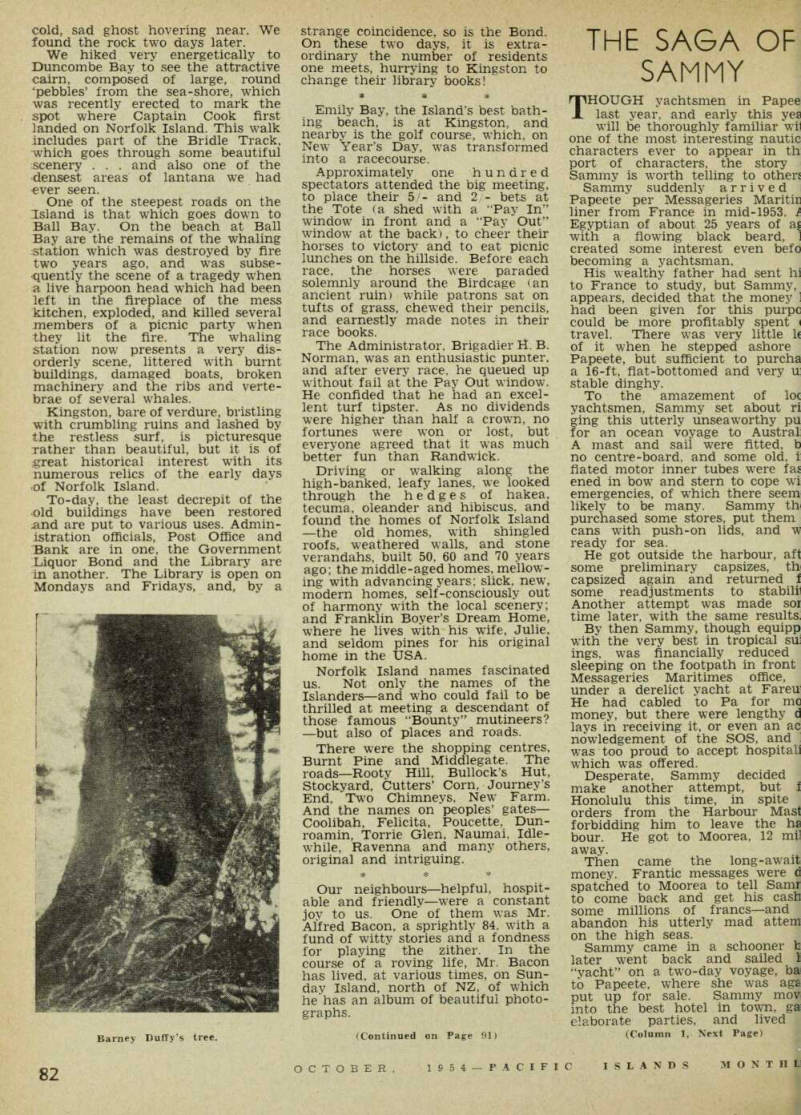
The Bond, and also the library.
cold, sad ghost hovering near. We found the rock two days later.
We hiked very energetically to Duncombe Bay to see the attractive cairn, composed of large, round ‘pebbles’ from the sea-shore, which was recently erected to mark the spot where Captain Cook first landed on Norfolk Island. This walk Includes part of the Bridle Track, which goes through some beautiful scenery . . . and also one of the densest areas of lantana we had ever seen.
One of the steepest roads on the Island is that which goes down to Ball Bay. On the beach at Ball Bay are the remains of the whaling station which was destroyed by fire two years ago, and was subse quently the scene of a tragedy when a live harpoon head which had been left in the fireplace of the mess kitchen, exploded, and killed several members of a picnic party when they lit the fire. The whaling station now presents a very dis orderly scene, littered with burnt buildings, damaged boats, broken machinery and the ribs and verte brae of several whales.
Kingston, bare of verdure, bristling with crumbling ruins and lashed by the restless surf, is picturesque rather than beautiful, but it is of great historical interest with its numerous relics of the early days 'Of Norfolk Island.
To-day, the least decrepit of the old buildings have been restored and are put to various uses. Admin istration officials, Post Office and Bank are in one, the Government Liquor Bond and the Library are in another. The Library is open on Mondays and Fridays, and, by a
strange coincidence, so is the Bond.
On these two days, it is extra ordinary the number of residents one meets, hurrying to Kingston to change their library books! * * * Emily Bay, the Island’s best bath ing beach, is at Kingston, and nearby is the golf course, wifich, on New Year’s Day, was transformed into a racecourse.
Approximately one hundred spectators attended the big meeting, to place their 5 - and 2 - bets at the Tote (a shed with a “Pay In" window in front and a “Pay Out” window at the back), to cheer their horses to victory and to eat picnic lunches on the hillside. Before each race, the horses were paraded solemnly around the Birdcage (an ancient ruin) while patrons sat on tufts of grass, chewed their pencils, and earnestly made notes in their race books.
The Administrator, Brigadier H. B.
Norman, was an enthusiastic punter, and after every race, he queued up without fail at the Pay Out window.
He confided that he had an excel lent turf tipster. As no dividends were higher than half a crown, no fortunes were won or lost, but everyone agreed that it was much better fun than Randwick.
Driving or walking along the high-banked, leafy lanes, we looked through the hedges of hakea, tecuma. oleander and hibiscus, and found the homes of Norfolk Island —the old homes, with shingled roofs, weathered walls, and stone verandahs, built 50. 60 and 70 years ago; the middle-aged homes, mellow ing with advancing years; slick, new, modern homes, self-consciously out of harmony with the local scenery; and Franklin Boyer’s Dream Home, where he lives with his wife, Julie, and seldom pines for his original home in the USA.
Norfolk Island names fascinated us. Not only the names of the Islanders —and who could fail to be thrilled at meeting a descendant of those famous “Bounty” mutineers? —but also of places and roads.
There were the shopping centres, Burnt Pine and Middlegate. The roads —Rooty Hill, Bullock’s Hut, Stockyard, Cutters’ Corn, Journey’s End. Two Chimneys, New Farm.
And the names on peoples’ gates— Coolibah, Felicita, Poucette. Dun roamin, Torrie Glen. Naumai. Idle while, Ravenna and many others, original and intriguing. * * * Our neighbours—helpful, hospit able and friendly—were a constant joy to us. One of them was Mr.
Alfred Bacon, a sprightly 84. with a fund of witty stories and a fondness for playing the zither. In the course of a roving life, Mr. Bacon has lived, at various times, on Sun day Island, north of NZ. of which he has an album of beautiful photo graphs.
(Continued on Page 91)
Barney Duffy’s tree.
Sunday Island, which many people ve loved and left, is described by *, Bacon as “the loveliest in the cific.’’ He first went there as a I of 17 to work for the Bell nily. After some years he left the md, but its appeal was so strong it he reiurned at the first oppor lity. Circumstances kept forcing n to leave, but he always re ned when he saw’ a chance to do Now he is too old to go back, ; he loves it still, and speaks of with a nostalgic gleam in his s. He lives in a small hut near ;von” with his beloved zither and devoted old dog, Pono, for com iy. ye shall never forget Christmas rning at Norfolk Island, when we )ke to find an entrancing cello me parcel on the table. Glowing ough the transparent wrapping e a dozen lovely brown eggs, and top of the eggs, a friendly little i:
A Merry Christmas
From
Fhe Chooks Next Door
ocial life on Norfolk Island can quiet or hectic according to e, and there’s plenty of “snake e“ to liven up the dullest party. the occasions which everyone )ys most are the musical even 1, when “Islanders” and “Main lers” get together for a remark display of talent—singers, lists, violinists, a cellist, and utionists, all combine to provide ly hours of first-class entertain t.
Jainlanders”—that is, residents are not descended from the inal Pitcairners—are people i many parts of the world and i all walks of life, who have id or bought land on the id and settled there, fe on Norfolk Island does not everybody’s temperament, e people have come with the ition of being permanent re its, but have departed after a weeks, complaining of loneli mental inertia, lack of culture too much work. One suspects the last was the deciding factor trfolk Island is not for lazy le. hers have come for two weeks , and have remained for 20 5. Content to spend the rest of lives there, they confess that orfolk Island they have found ideal of happiness— congenial Dany, a lovely climate, fertile beautiful surroundings and iom from the wear and tear of sation. ideal which could easily be we thought wistfully, as the - bore us far away again from “emerald isle set in a silver
H Mr. Terence McManus, of New Hebrides, married Miss Margaret Murray, of Sydney, at St. Mary’s Cathedral, Sydney, on September 19. The couple will fly to Santo in October to live in a home which is being built for them there.
Young farmers on Norfolk and Lord Howe Islands will be invited to attend a leadership school at Bathurst, NSW, in October. The school will be held by the Junior Farmers’ Clubs of New South Wales.
The Clubs will pay the travelling costs of one member from each island.
A ? e^ ent Commissioner Bernacchi and Mrs. Bernacchi, of the Gfibert and Ellice Islands, left Tarawa on jm* 1 2 i 3 al ?pard RCS Nareau on an official visit to Ocean Island and Honiara. Mr. I. G. Turbott was officer in charge during His Honour’s absence. i ten-year-old Fijian girl was and two boys were injured and taken to Levuka hospital, as the result of the collapse of a buree loii school o building at Veisoto.
Oyalau, on September 20. Fourteen children were inside the hure when the heavy thatched roof and coco nut log framing came down on them.