“Charley”
pp. 85-86 · Read in the full issue
The “Charley”
BILL GILL Shows How Not to Get into the Copra- Cutting Machine Business.
at once urgent Charley Jacksons Hospital.”
I lay in the Brisbane-bound irain and read the telegram over md over again. The refrain of the mpunctuated message blended with ;he rattle and clatter of the flying vheels, but not very happily.
It must be really urgent, I bought, otherwise even such a reck ess old walrus as Charley would lot have summoned me on such a ong and expensive journey. Jack lon’s Hospital? He must be desper itely ill (my thoughts ran on) but le was well enough when he boarded he ship in Sydney not long ago.
Charley, I remembered, had been iroud of his rugged good health.
When I first lobbed in New ■ruinea,” he would boast, “I suf ered from every tropical disease nown to Science, except a wooden jg. But I haven’t had a twinge bar a touch of alcoholic remorse) or over half a century.” Ah, well, reflected, it is the course of all .atu r e. A melancholy welcome waited me now, no doubt. . .
I well remembered my first meet ig with Charley. I had walked from le South Coast over the range, and escended on the north coast of astern Papua, slap-bang into Charley’s plantation.
I had heard of him, of course, )r he was quite a “character” even len, and legends already had be an to distinguish him from those f lesser clay. But he had never eard of me—although that didn’t issen the heartiness of his wel )me.
“Come on up,” he had said. iTou’ll stay the night, of course, or ; long as you like. Come along,” id he yelled to his house-boy to bustle up a bucketful of eggs.”
In those days the price of copra as somewhere in the vicinity of a ton and the coconut-boys were iving a really grim battle, living f their plantations as far as imanly was possible.
His boy, I remembered, had come iwnstairs on the run, and actually ith a bucket. He proceeded to ssick around amongst the passe )ra cover-crop, sending clouds of -bred, ginger chickens squawking id flapping in all directions.
Charley had sat yarning away Leerfully, with never a moan about e wretched condition of the copra
market—which, of itself, indicated an unusual individual. Presently his boy had appeared, grinning from ear to ear, and slapped down a gallon billy-can full of eggs, a loaf of sipora-yeast bread and a kettleful of tea.
“Hop in!”’ Charley had said, drawing up his chair to the table.
“I had a feed just before you came, but I’ll have a cup of tea with you.”
“But all these eggs,” I had pro tested. “There must be over two dozen of them. I’ll never eat a third of them.”
“So?” said Charley, with a grin.
“Have a shot at it, anyhow,” and I had opened nine of the eggs before finding one that was eatable. In all there were four eggs “fit for human consumption” and even these, some how, tasted like “the curate’s egg.” 1 AWOKE, as the train pulled into the platform at Brisbane, feel ing frowsy and irritable; and the first thing that caught my eye was not calculated to improve my morale.
There was Charley, composed and smiling, with hand outstretched in welcome. I had been worrying throughout the long journey in case Charley were really ill; and yet, when I found him hale and hearty, a perfectly illogical rage boiled up inside me.
“What’s this?” I cried wrathfully.
“What d’you mean, dragging me all this way, when there’s nothing the matter with you?”
“Why, what would be wrong with me?” enquired Charley, affably.
Then, not waiting for a reply: “Come along with me. Our fortunes are made, fellah,” he said, patting me on the back, “and I’ll be famous, famous “But what about this hospital of yours?” I said, feeling my rage suc cumb before my curiosity, but re solved to have a last snarl at him.
“What kind of a dirty trick was that to pull on a friend?”
“You sound as if you are dis appointed at not finding me on my deathbed,” said Charley with his devilish knack of putting one in the wrong. “I am living in a hospital—
of a kind—and that’s where we’re going right away.”
As we bowled along in a cab Charley began: “D’you remember Jacko?” ‘‘Shall I ever forget him!” I an swered. “That crimson and blue dial—the odd colours that whimsical nature had added so unexpectedly, here and there, the ”
“What are you talking about?” said Charley sharply. “ I’m not talk ing about a blue—ah—about a monkey. I’m talking about Ginger Jackson from the Islands, and well you know it!”
“No relation of Jacko the Man dril?” I came back, in mock surprise.
Ignoring my feeble jest, Charles continued: “So you don’t remember Jacko? Well, that’s soon remedied, for here’s his hospital.”
“Where?” I asked in perplexity.
“Behind that junk heap?”
Charley coughed self-consciously. (Over)
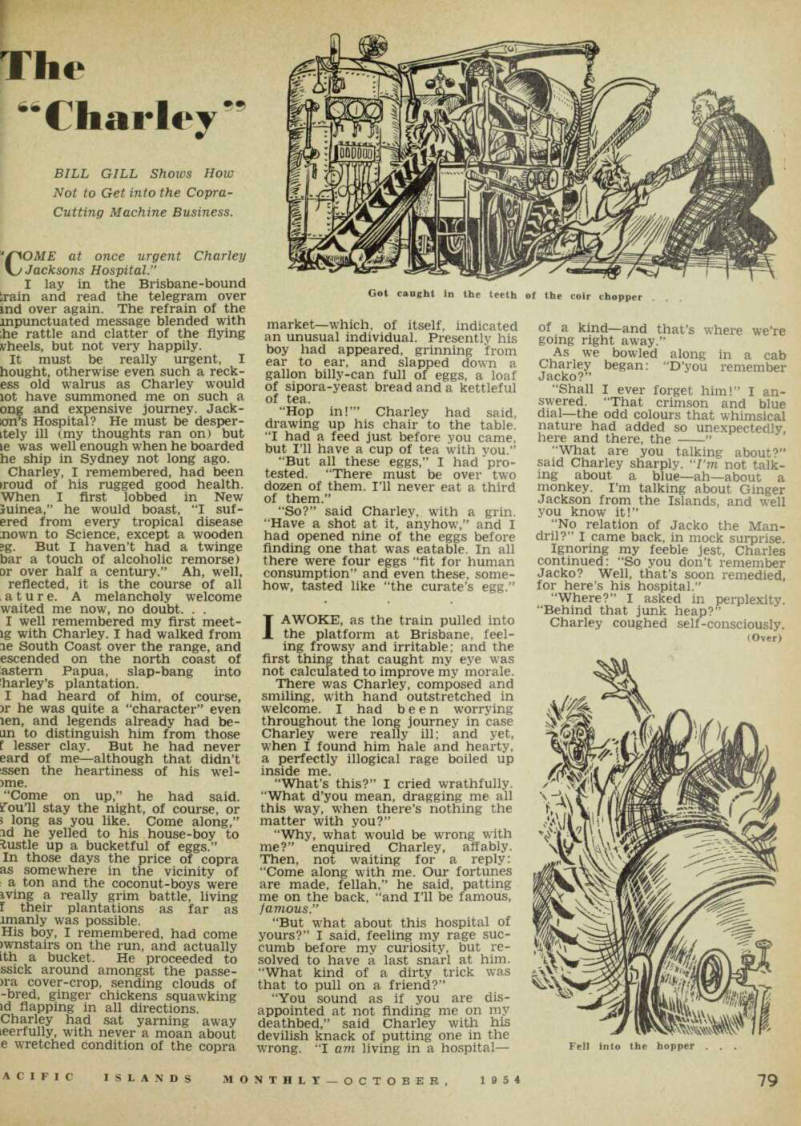
Got caught in the teeth of the coir chopper . . .
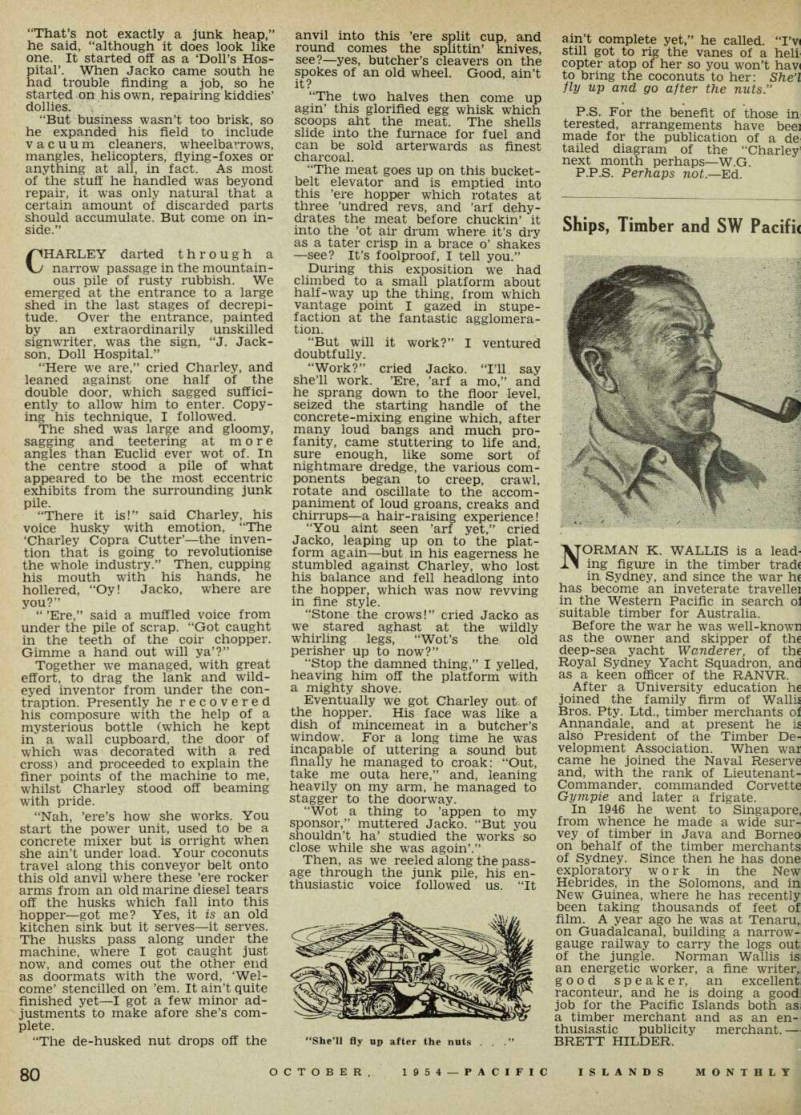
Fell into the hopper . . .
“That’s not exactly a junk heap,” he said, “although it does look like one. It started off as a ‘Doll’s Hos pital’. When Jacko came south he had trouble finding a job, so he started on his own, repairing kiddies’ dollies.
“But business wasn’t too brisk, so he expanded his field to include vacuum cleaners, wheelbarrows, mangles, helicopters, flying-foxes or anything at all, in fact. As most of the stuff he handled was beyond repair, it was only natural that a certain amount of discarded parts should accumulate. But come on in side.”
CHARLEY darted through a narrow passage in the mountain ous pile of rusty rubbish. We emerged at the entrance to a large shed in the last stages of decrepi tude. Over the entrance, painted by an extraordinarily unskilled sign writer, was the sign, “J. Jack son, Doll Hospital.”
“Here we are,” cried Charley, and leaned against one half of the double door, which sagged suffici ently to allow him to enter. Copy ing his technique, I followed.
The shed was large and gloomy, sagging and teetering at more angles than Euclid ever wot of. In the centre stood a pile of what appeared to be the most eccentric exhibits from the surrounding junk pile.
“There it is!” said Charley, his voice husky with emotion, “The ‘Charley Copra Cutter’ —the inven tion that is going to revolutionise the whole industry.” Then, cupping his mouth with his hands, he hollered, “Oy! Jacko, where are you?”
“ ’Ere,” said a muffled voice from under the pile of scrap. “Got caught in the teeth of the coir chopper.
Gimme a hand out will ya’?”
Together we managed, with great effort, to drag the lank and wild eyed inventor from under the con traption. Presently he recovered his composure with the help of a mysterious bottle (which he kept in a wall cupboard, the door of which was decorated with a red cross) and proceeded to explain the finer points of the machine to me, ■whilst Charley stood off beaming with pride.
“Nah, ’ere’s how she works. You start the power unit, used to be a concrete mixer but is orright when she ain’t under load. Your coconuts travel along this conveyor belt onto this old anvil where these ’ere rocker arms from an old marine diesel tears off the husks which fall into this hopper—got me? Yes, it is an old kitchen sink but it serves—it serves.
The husks pass along under the machine, where I got caught just now, and comes out the other end as doormats with the word, ‘Wel come’ stencilled on ’em. It ain’t quite finished yet—l got a few minor ad justments to make afore she’s com plete.
“The de-husked nut drops off the
anvil into this ’ere split cup, and round comes the splittin’ knives, see?—yes, butcher’s cleavers on the spokes of an old wheel. Good, ain’t it?
“The two halves then come up agin’ this glorified egg whisk which scoops aht the meat. The shells slide into the furnace for fuel and can be sold arterwards as finest charcoal.
“The meat goes up on this bucket belt elevator and is emptied into this ’ere hopper which rotates at three ’undred revs, and ’arf dehy drates the meat before chuckin’ it into the ’ot air drum where it’s dry as a tater crisp in a brace o’ shakes —see? It’s foolproof, I tell you.”
During this exposition we had climbed to a small platform about half-way up the thing, from which vantage point I gazed in stupe faction at the fantastic agglomera tion, “But will it work?” I ventured doubtfully.
“Work?” cried Jacko. “I’ll say she’ll work. ’Ere, ’arf a mo,” and he sprang down to the floor level, seized the starting handle of the concrete-mixing engine which, after many loud bangs and much pro fanity, came stuttering to life and, sure enough, like some sort of nightmare dredge, the various com ponents began to creep, crawl, rotate and oscillate to the accom paniment of loud groans, creaks and chirrups—a hair-raising experience!
“You aint seen ’arf yet,” cried Jacko, leaping up on to the plat form again—but in his eagerness he stumbled against Charley, who lost his balance and fell headlong into the hopper, which was now revving in fine style.
“Stone the crows!” cried Jacko as we stared aghast at the wildly whirling legs, “Wot’s the old perisher up to now?”
“Stop the damned thing,” I yelled, heaving him off the platform with a mighty shove.
Eventually we got Charley out. of the hopper. His face was like a dish of mincemeat in a butcher’s window. For a long time he was incapable of uttering a sound but finally he managed to croak: “Out, take me outa here,” and, leaning heavily on my arm, he managed to stagger to the doorway.
“Wot a thing to ’appen to my sponsor,” muttered Jacko. “But you shouldn’t ha’ studied the works so close while she was agoin’.”
Then, as we reeled along the pass age through the junk pile, his en thusiastic voice followed us. “It
ain’t complete yet,” he called. “I’v< still got to rig the vanes of a heli copter atop of her so you won’t hav< to bring the coconuts to her: She’l fly up and go after the nuts.”
P.S. For the benefit of those in terested, arrangements have beei made for the publication of a de tailed diagram of the “Charley’ next month perhaps—W.G.
P.P.S. Perhaps not. —Ed.
“She’ll fly up after the nuts . .